India's makhana market to hit ₹12,000 crore by 2029-30 on surging demand

Synopsis
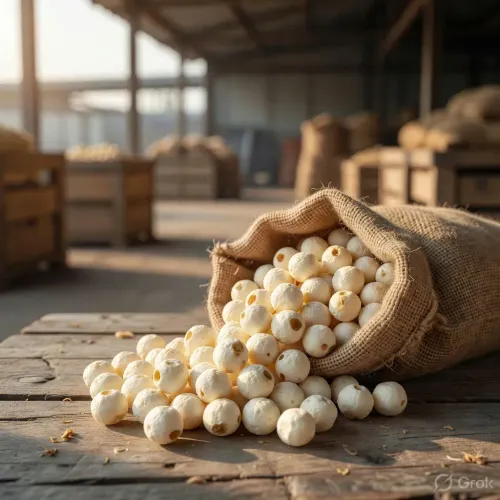
India's makhana sector is no longer a niche crop story — it is a ₹12,000 crore market in the making. With prices more than doubling in three years, a new National Makhana Board, and a ₹476 crore government scheme, fox nuts are fast becoming one of India's most strategically positioned agri-exports.
Key Takeaways
India's makhana market is projected to reach ₹11,000–₹12,000 crore by 2029–30 , per an official factsheet dated 19 August 2025 .
Average makhana prices more than doubled from ₹500/kg to nearly ₹1,250/kg between FY22 and FY25 .
Production is estimated at 80,590 metric tonnes in 2025–26 , up from 63,910 MT in 2024–25.
Bihar leads production with 60,000 MT in 2025–26; about 40% of total output is exported.
The government approved a ₹476.03 crore Central Sector Scheme for makhana development covering 2025–26 to 2030–31 .
The domestic market grew at 17–18% annually between 2021–22 and 2024–25.
India's makhana (fox nut) sector is on a sharp upward trajectory, with the domestic market projected to reach ₹11,000–₹12,000 crore by 2029–30, driven by rising production, surging prices, and expanding exports, according to an official factsheet released on Wednesday, 19 August 2025. The figures underscore a structural shift in how makhana is positioned — from a regional agricultural commodity to a globally traded superfood.
Production and Price Trends
Despite robust demand, production volumes grew at a modest 4–5 per cent between FY22 and FY25, creating a supply-demand gap that pushed average prices from roughly ₹500 per kilogram to nearly ₹1,250 per kilogram over the same period. The price surge reflects the premium branding of makhana as a health-focused snack, combined with limited supply response.
Total makhana production stood at 63,910 metric tonnes in 2024–25, with average productivity of 2.03 metric tonnes per hectare. The Second Advance Estimates for 2025–26 project output rising to 80,590 metric tonnes, with productivity improving to 2.34 metric tonnes per hectare.
Bihar's Dominance and Farming Innovation
Bihar remains the country's leading makhana-producing state, accounting for 60,000 metric tonnes in 2025–26 at an average productivity of 2 metric tonnes per hectare. Traditionally cultivated in ponds, the crop is increasingly being grown using field-system farming techniques, which reduce cultivation risks and allow for more predictable yields.
Improved varieties such as Swarna Vaidehi and Sabour Makhana-1 have contributed to productivity gains. According to the official statement, 'The growth has been driven by an increase in cultivated area, improved productivity, and reduced cultivation risks.'
Export Strength and Domestic Demand
India produces more than 0.6 lakh metric tonnes of makhana annually. Of this, approximately 40 per cent — or 0.23–0.25 lakh metric tonnes — is exported, while the remainder is consumed domestically. The domestic market recorded annual growth of 17–18 per cent between 2021–22 and 2024–25, providing a buffer against export market volatility.
With rising global appetite for clean-label and plant-based superfoods, India's established production base positions makhana as a premium offering in international markets. Notably, this growth has been largely organic, preceding any large-scale government intervention.
Government Push: National Makhana Board and ₹476 Crore Scheme
Recognising the sector's strategic importance, the government announced the establishment of the National Makhana Board in the Union Budget 2025–26. It has also approved a Central Sector Scheme for the Development of Makhana, with a total outlay of ₹476.03 crore covering the period 2025–26 to 2030–31.
The scheme targets research and innovation, quality seed availability, farmer skill development, post-harvest upgrades, value addition, branding, marketing, export promotion, and quality control. The policy push signals that the Centre views makhana not merely as a food crop but as an export-oriented agri-brand with significant rural income potential.
With institutional backing now in place, the sector's trajectory over the next five years will hinge on how effectively the scheme translates into farm-level outcomes and whether export infrastructure keeps pace with production growth.
Frequently Asked Questions
What is the projected size of India's makhana market by 2029-30?
India's makhana market is projected to reach ₹11,000–₹12,000 crore by 2029–30, according to an official factsheet released on 19 August 2025. The growth is driven by rising production, premium pricing, and expanding domestic and export demand.
Why have makhana prices risen so sharply in recent years?
Average makhana prices rose from around ₹500 per kilogram to nearly ₹1,250 per kilogram between FY22 and FY25. The increase reflects strong demand for health-focused and premium-branded snacks, combined with a limited supply response — production grew only 4–5% over the same period.
What is the National Makhana Board and why was it set up?
The National Makhana Board was announced in the Union Budget 2025–26 to provide institutional support to India's growing makhana sector. It is part of a broader Central Sector Scheme worth ₹476.03 crore, covering research, seed quality, farmer training, export promotion, and quality control through 2030–31.
Which state produces the most makhana in India?
Bihar is India's dominant makhana producer, contributing 60,000 metric tonnes in 2025–26 at an average productivity of 2 metric tonnes per hectare. Improved varieties like Swarna Vaidehi and Sabour Makhana-1 have helped raise yields.
How much of India's makhana production is exported?
Approximately 40% of India's annual makhana output — around 0.23–0.25 lakh metric tonnes — is exported each year. Growing global demand for plant-based and clean-label superfoods has strengthened India's position as a premium supplier in international markets.