India's capital markets raise ₹10 lakh crore annually; m-cap tops $5 trillion
Synopsis
SEBI Chairman Tuhin Kanta Pandey revealed at the CII Financing Summit 2026 that Indian companies now raise ₹10 lakh crore annually through equity and debt — and with market cap crossing $5 trillion, 235 IPOs raising ₹1.5 lakh crore in FY27, and AIF commitments topping ₹18 lakh crore, India's shift from bank-led to market-led financing is no longer incremental — it is structural.
Key Takeaways
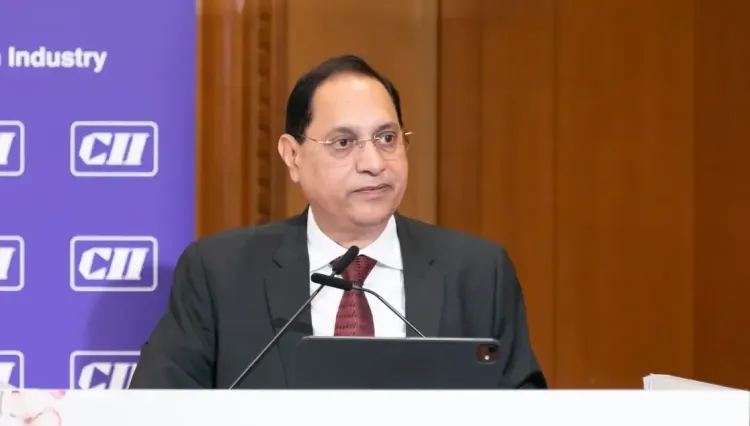
SEBI Chairman Tuhin Kanta Pandey addressed the CII Financing Summit 2026 in Mumbai on 20 November 2026 .
Indian companies have raised around ₹10 lakh crore annually through equity and debt over the past decade.
India's equity market capitalisation has crossed $5 trillion (nearly ₹500 lakh crore ) in the current financial year.
235 companies raised around ₹1.5 lakh crore through IPOs in FY27 so far.
Outstanding corporate bonds stood at ₹62 lakh crore as of August 2026 , nearly 55% of bank credit to industry and services.
Cumulative AIF investments reached ₹7.5 lakh crore by September 2026 ; REITs and InvITs assets crossed ₹10 lakh crore .
India's capital markets have cemented their role as a primary engine of business financing, with companies collectively raising around ₹10 lakh crore annually through equity and debt instruments over the past decade, Tuhin Kanta Pandey, Chairman of the Securities and Exchange Board of India (SEBI), said on Friday, 20 November 2026. Speaking at the CII Financing Summit 2026 in Mumbai, Pandey underscored the scale of India's capital market expansion, anchored by sustained economic growth, rising retail participation, and a decade of regulatory reforms.
Market Capitalisation and IPO Momentum
India's equity market capitalisation has crossed $5 trillion — equivalent to nearly ₹500 lakh crore — during the current financial year, Pandey noted, marking a landmark in the country's financial history. On the primary market front, 235 companies have collectively raised around ₹1.5 lakh crore through initial public offerings (IPOs) in FY27 so far, reflecting robust investor appetite for new listings and a deepening equity culture among Indian households.
Corporate Bonds: Reducing Bank Dependence
Corporate bonds, Pandey said, continue to play a pivotal role in diversifying financing avenues and reducing businesses' reliance on traditional bank lending. Outstanding corporate bonds stood at approximately ₹62 lakh crore as of August 2026, amounting to nearly 55 per cent of bank credit extended to the industry and services sectors. Companies have raised more than ₹5 lakh crore through bond issuances in the current financial year alone.
AIFs, REITs and InvITs: Broadening the Financing Stack
The SEBI Chairman also highlighted the expanding footprint of Alternative Investment Funds (AIFs) in channelling risk capital to emerging businesses not yet ready for public markets. Cumulative AIF investments had reached around ₹7.5 lakh crore by September 2026, while committed capital exceeded ₹18 lakh crore. Meanwhile, Real Estate Investment Trusts (REITs) and Infrastructure Investment Trusts (InvITs) have emerged as effective capital-recycling vehicles, enabling developers to monetise operational assets and redeploy funds into greenfield projects. Assets managed by REITs and InvITs have grown to more than ₹10 lakh crore, Pandey said.
What This Means for India's Growth Agenda
Pandey said India's capital markets today serve a wide spectrum of financing needs — from corporate expansion and venture funding to large-scale infrastructure development and long-term capital formation. This comes amid a broader push by the Centre to reduce infrastructure financing bottlenecks and attract global institutional capital into Indian assets. Continued economic growth, broader investor participation, and policy reforms have, according to Pandey, strengthened the capital markets ecosystem and positioned it as a key pillar of India's investment and development agenda. The scale of these numbers signals a structural shift in how Indian businesses are funding growth — moving away from bank-dominated credit toward diversified, market-based financing.
Point of View
But the more consequential signal is structural: corporate bonds at 55% of bank credit to industry suggest India is quietly replicating the disintermediation story that defined US and European capital markets over decades. SEBI's challenge now is depth, not size — secondary market liquidity in corporate bonds remains thin, and AIF growth, while impressive, is concentrated in a narrow slice of asset managers. The $5 trillion market cap milestone is real, but it reflects valuation expansion as much as underlying earnings growth. Whether retail investors — who have powered much of the IPO surge — are adequately protected from volatility in a market running on sentiment as much as fundamentals is a question Pandey's data-rich address did not fully answer.
NationPress
20 Nov 2026
Frequently Asked Questions
How much do Indian companies raise annually through capital markets?
According to SEBI Chairman Tuhin Kanta Pandey, Indian companies have raised around ₹10 lakh crore annually through equity and debt instruments over the past decade. This includes IPOs, bond issuances, and other market-based financing instruments.
Has India's stock market capitalisation crossed $5 trillion?
Yes. SEBI Chairman Pandey confirmed that India's equity market capitalisation crossed $5 trillion — equivalent to nearly ₹500 lakh crore — during the current financial year FY27. This marks a significant milestone for Indian capital markets.
How many IPOs have been launched in FY27 so far?
As of the CII Financing Summit on 20 November 2026, 235 companies had collectively raised around ₹1.5 lakh crore through IPOs in FY27, according to SEBI Chairman Pandey. This signals continued strong investor appetite for new listings.
What is the size of India's corporate bond market?
Outstanding corporate bonds stood at approximately ₹62 lakh crore as of August 2026, which is nearly 55% of bank credit extended to industry and services sectors. Companies raised more than ₹5 lakh crore through bond issuances in FY27 alone.
What is the role of AIFs, REITs, and InvITs in India's capital markets?
Alternative Investment Funds (AIFs) have cumulative investments of around ₹7.5 lakh crore as of September 2026, with committed capital exceeding ₹18 lakh crore, channelling risk capital to businesses not yet ready for public markets. REITs and InvITs, which help recycle infrastructure capital, now manage assets worth more than ₹10 lakh crore.