KOSPI plunges 5.54% in Seoul as chip stocks slide
Synopsis
South Korea's KOSPI fell 5.54% below 5,000 in morning trading, reversing a rally of more than 6% the previous day. Samsung Electronics and SK hynix led losses as the exchange imposed a temporary program-trading restriction.
Key Takeaways
The KOSPI fell 277.22 points , or 5.54% , to 4,728.81 by 11:20 am on 25 November .
Samsung Electronics dropped 9.03% and SK hynix fell 8.55% .
The Korea Exchange activated a sell-side sidecar at 9:09 am , suspending program-trading buy orders for five minutes .
The KOSPI had rebounded more than 6% on the previous day.
South Korea's combined sales at 26 major retail companies rose 5.7% year on year in October , according to government data.
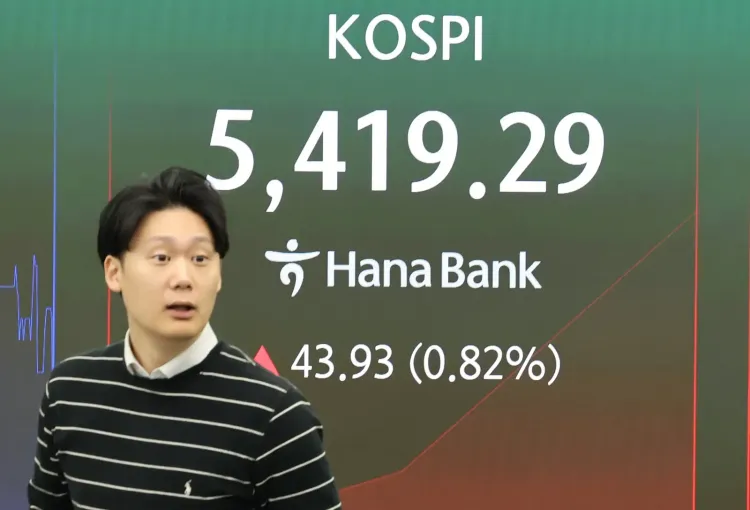
The Korea Composite Stock Price Index (KOSPI) fell 5.54% to 4,728.81 in Seoul by 11:20 am on Wednesday, 25 November, as South Korean chip stocks followed overnight weakness in technology shares on Wall Street. The decline reversed the previous session's rally and took the benchmark below the 5,000 mark.
The index had opened 3.94% lower before extending its loss to 277.22 points. The sell-off prompted the Korea Exchange to activate a temporary restriction on program trading.
Chipmakers lead the KOSPI decline
Market bellwether Samsung Electronics dropped 9.03%, while chipmaking rival SK hynix fell 8.55%. Their losses put the semiconductor sector at the centre of the decline in Seoul.
Among other index heavyweights, SK Square, the parent of SK hynix, lost 10.77%. Samsung Electro-Mechanics fell 9.44%.
The scale of the moves contrasted with Tuesday's session, when the KOSPI rebounded more than 6% as chipmakers rallied. That advance came amid global optimism linked to Nvidia chief executive Jensen Huang's return to the spotlight.
Exchange imposes trading restriction
As shares lost ground, the Korea Exchange activated a sell-side sidecar at 9:09 am, according to reports. The measure suspended buy orders in program trading for KOSPI-listed shares for five minutes.
The restriction was introduced during a session in which the benchmark moved below the psychologically important 5,000 level. The figures reported for the index and individual shares reflect trading during the session rather than closing prices.
The South Korean won was quoted at 1,342.9 won against the US dollar at 11:20 am, up 0.1 won from the previous session's close.
US technology shares and tariff concerns
Overnight, US stocks closed mixed, with Nvidia giving back part of its historic gains from the preceding session. Concerns about fresh US tariffs also weighed on the technology sector.
The moves in Seoul came after investors had tracked those US technology losses. The change in direction followed a strong rebound for South Korean chip shares a day earlier, illustrating how quickly the sector's trading picture had shifted across the two sessions.
Online sales lift South Korean retail figures
Separately, South Korea's retail sales rose in October from a year earlier, according to government data released on Wednesday. Combined sales at 26 major retail companies increased 5.7%, the Ministry of Trade, Industry and Resources said.
Offline retailers recorded a 1.4% decline, mainly because of sluggish sales at large discount outlets. The Chuseok holiday fell in September that year, whereas the lunar-calendar holiday had fallen in October the previous year, affecting the year-on-year comparison.
Major online platforms reported a 10.9% increase in revenue, supported by steady demand for food and delivery services. They accounted for 60.3% of total retail sales in October.
Investors will now watch whether the KOSPI can recover from its intraday losses as trading continues.
Frequently Asked Questions
Why did South Korea's KOSPI fall?
The KOSPI fell as investors tracked overnight weakness in US technology stocks and South Korean chip shares declined. Concerns about fresh US tariffs also weighed on the technology sector.
How much did the KOSPI fall on 25 November?
The KOSPI fell 277.22 points, or 5.54%, to 4,728.81 by 11:20 am. It had opened 3.94% lower.
What happened to Samsung Electronics and SK hynix shares?
Samsung Electronics fell 9.03%, while SK hynix declined 8.55% during the Seoul trading session.
What trading restriction did the Korea Exchange activate?
The Korea Exchange activated a sell-side sidecar at 9:09 am, suspending buy orders in program trading for KOSPI-listed shares for five minutes.
How did South Korean retail sales perform in October?
Combined sales at 26 major retail companies rose 5.7% from a year earlier, according to government data. Online revenue rose 10.9%, while offline sales fell 1.4%.