How Do New Labour Codes Enhance Safety and Welfare for Petroleum Workers?
Synopsis
The recent introduction of the OSHWC Code and Social Security Code is a game-changer for petroleum workers in India. These codes promise to enhance safety standards and welfare measures significantly, ensuring better health care and protection for those in hazardous environments. Discover how these changes will impact the industry and the workforce.
Key Takeaways
Strengthened safety measures for petroleum workers.
Mandatory health examinations for hazardous operations.
Enhanced welfare benefits through ESIC coverage.
Competency-based training for handling hazardous materials.
Digital compliance platforms for improved accountability.
New Delhi, Dec 1 (NationPress) The Occupational Safety, Health and Working Conditions Code, 2020 (OSHWC Code) and the Social Security Code, 2020 recently introduced by the government, are set to significantly enhance the safety and welfare of workers within the petroleum sector.
According to an official statement, these new labour codes integrate petroleum facilities, refineries, and fuel depots under a cohesive national safety framework and established welfare measures.
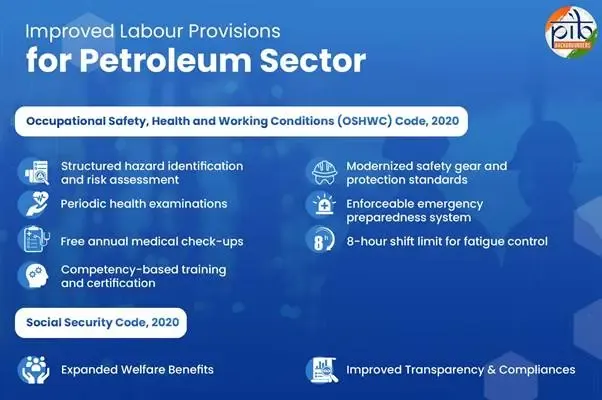
The OSHWC Code demands a systematic approach to hazard identification and risk assessment, requiring governmental approval prior to the initiation of hazardous operations.
Additionally, it sets forth national standards for the handling, storage, transportation, and disposal of petroleum materials. The code has also integrated risk-based inspections, safety audits, emergency command structure participation, and digital compliance platforms akin to those employed by leading global oil and gas companies.
The government emphasized that the protections for workers have been significantly improved, as the code mandates pre-employment, periodic, and post-exposure health assessments, alongside complimentary annual medical check-ups for all workers engaged in hazardous petroleum tasks.
Furthermore, the code stipulates competency-based training and certification prior to a worker handling petroleum or hazardous substances.
Employers are required to provide, maintain, and train their workforce, ensuring fatigue management through an 8-hour limit on shifts, which is a crucial safeguard for continuous-process facilities, as per the statement.
The Social Security Code, 2020 further strengthens welfare initiatives by extending Employees’ State Insurance Corporation (ESIC) coverage to petroleum workplaces, which facilitates medical care, injury compensation, disability and dependent benefits, and maternity protection for occupational diseases and accidents.
Digital social-security and health records promise portability, transparency for beneficiaries, and accountability.
The government noted that these codes transition the petroleum sector's safety approach from a reactive compliance-heavy model to a forward-thinking, prevention-oriented, technology-driven, and welfare-focused framework.
These provisions are anticipated to bolster operational discipline, workforce capabilities, emergency preparedness, medical monitoring, regulatory clarity, and coordination, as highlighted in the statement.
Point of View
It is imperative to recognize the transformative impact of the new labour codes on the petroleum sector. The government’s focus on worker safety and welfare is commendable and aligns with global best practices. These codes not only elevate safety standards but also ensure a robust framework for the health and well-being of workers, marking a progressive step in the industry.
NationPress
29 Sept 2026
Frequently Asked Questions
What are the main objectives of the new labour codes?
The new labour codes aim to enhance safety and welfare for workers in the petroleum industry by establishing a unified safety framework and institutionalized welfare measures.
How will the OSHWC Code improve worker safety?
The OSHWC Code mandates structured hazard identification, risk assessments, and requires government approval for hazardous operations, thereby improving overall worker safety.
What benefits does the Social Security Code offer to petroleum workers?
The Social Security Code extends ESIC coverage to petroleum workplaces, providing medical care, injury compensation, and maternity protection among other benefits.
What kind of health examinations are required under the new codes?
The codes require pre-employment, periodic, and post-exposure health examinations for workers involved in hazardous petroleum operations.
How does the government ensure compliance with these new safety standards?
The codes incorporate risk-based inspections, safety audits, and digital compliance platforms to ensure adherence to the new safety standards.