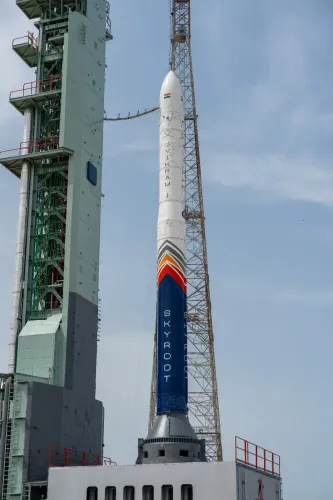
Anand Mahindra hails Skyroot's 'Vande Mataram in space' moment

Synopsis
Mahindra Group chairman Anand Mahindra on 18 July 2026 celebrated Skyroot Aerospace's latest milestone, amplifying co-founder Pawan Kumar Chandana's declaration that 'Vande Mataram is in space' and calling it a moment that fuels a billion aspirations — a landmark for India's liberalised private space sector.
Key Takeaways
Mahindra Group chairman Anand Mahindra publicly celebrated a Skyroot Aerospace milestone on 18 July 2026 .
He quoted Skyroot co-founder Pawan Kumar Chandana 's words: 'Vande Mataram is in space.' Skyroot Aerospace is a Hyderabad -based private startup developing small satellite launch vehicles.
India's IN-SPACe framework, established in 2020 , opened the space sector to private players for the first time.
ISRO 's PSLV-C37 mission in 2017 , which launched 104 satellites , helped inspire the current generation of private space entrepreneurs.
Upcoming IN-SPACe licensing decisions on Skyroot's orbital attempts will determine the next phase of India's private launch ambitions.
Mahindra Group chairman Anand Mahindra on Saturday, 18 July 2026 publicly celebrated a milestone by Hyderabad-based private space startup Skyroot Aerospace, calling it a moment that 'fuels not just a rocket but a billion aspirations.' Quoting Skyroot co-founder Pawan Kumar Chandana's declaration that 'Vande Mataram is in space,' Mahindra said he was glad to be alive to witness the achievement.
Context
Mahindra shared Chandana's words verbatim — 'Vande Mataram is in space' — framing the launch as far more than an engineering feat. The invocation of India's national song to describe a private rocket reaching space signals the emotional weight the country's industrialists and entrepreneurs now attach to indigenous launch capability. Mahindra's social media platforms, followed by millions, routinely amplify moments he regards as inflection points for Indian innovation.
Skyroot Aerospace, founded in Hyderabad, is among the first wave of private Indian companies to develop small satellite launch vehicles from the ground up. The company has positioned each milestone as a proof point that Indian engineering talent can compete in the global commercial space market.
Policy Backdrop
The breakthrough arrives against a backdrop of deliberate policy liberalisation. In 2020, the Government of India restructured the space sector through the Indian National Space Promotion and Authorisation Centre (IN-SPACe), ending decades of exclusive state control and opening launch and satellite activities to private firms. That single regulatory shift created the legal runway on which startups like Skyroot began building rockets.
The arc stretches further back: ISRO's record-setting PSLV-C37 launch in 2017, which placed 104 satellites in orbit in a single mission, demonstrated India's multi-payload capability and inspired a generation of private-sector engineers to enter the domain. Private entrants now aim to reduce launch costs and increase cadence beyond what a single government agency can sustain alone.
Stakeholders and Impact
The immediate beneficiaries of a successful private Indian launch are the country's fast-growing cohort of small satellite operators, defence technology firms, and academic institutions that need affordable, reliable access to orbit. A domestic private launch vehicle reduces dependence on foreign providers and keeps revenue within the Indian space economy, which the government has targeted for significant growth over the coming decade.
Endorsements from industrialists of Mahindra's stature carry weight beyond sentiment. They signal to global investors, domestic venture capital, and young engineers that the private space sector has arrived as a credible industry — not merely a government-adjacent experiment. Chandana's choice of 'Vande Mataram' as the verbal marker for the moment reflects a deliberate fusion of technological pride with cultural identity that resonates across India's diverse public.
What's Next
Attention will now turn to IN-SPACe licensing decisions governing Skyroot's upcoming orbital attempts and to any new foreign direct investment norms the government may announce for the space sector. A successful orbital mission would place Skyroot among a very small global club of private companies to have independently reached orbit, opening the door to commercial launch contracts from international customers.
For India's broader space ambitions, the moment underscores a structural shift: the country is no longer solely reliant on a single state agency to carry its flag into orbit. As private capability matures, the question shifts from whether India can launch privately to how quickly it can scale that capability into a globally competitive launch services industry.
Point of View
Not merely a commercial venture. The invocation of 'Vande Mataram' by a startup founder, and its amplification by one of India's most-followed industrialists, signals that the sector has crossed a threshold from technical curiosity to cultural milestone. This pattern mirrors the public reception of ISRO's Chandrayaan and Mangalyaan missions, suggesting that private launches are beginning to attract the same emotional ownership from the public. The political and regulatory implications are significant: broad elite and popular support makes it harder for any future government to reverse the liberalisation that IN-SPACe represents.
NationPress
17 Oct 2026
Frequently Asked Questions
What did Anand Mahindra say about Skyroot Aerospace?
Mahindra Group chairman Anand Mahindra shared Skyroot co-founder Pawan Kumar Chandana's words — 'Vande Mataram is in space' — on 18 July 2026, calling the moment one that 'fuels not just a rocket but a billion aspirations' and expressing personal joy at witnessing it.
What is Skyroot Aerospace and where is it based?
Skyroot Aerospace is a Hyderabad-based private Indian startup that develops small satellite launch vehicles. It is among the first private companies in India to build and launch rockets under the IN-SPACe liberalisation framework introduced in 2020.
Who is the founder of Skyroot Aerospace?
Pawan Kumar Chandana is a co-founder of Skyroot Aerospace. He has publicly linked the company's milestones to national aspirations, including the declaration that 'Vande Mataram is in space' that Mahindra cited in his post.
What is IN-SPACe and how does it relate to private space companies in India?
IN-SPACe, or the Indian National Space Promotion and Authorisation Centre, was established in 2020 to open India's space sector to private firms after decades of exclusive government control through ISRO. It provides the regulatory framework under which startups like Skyroot can develop and launch rockets.
Why is a private rocket launch significant for India?
A successful private Indian launch reduces dependence on foreign providers, lowers costs, and demonstrates that indigenous engineering talent can compete globally. It also signals the maturation of an entire ecosystem of startups, investors, and institutions beyond the government space agency.