Anand Mahindra hails Earthshot Prize win as proof profit and purpose align
Synopsis
Mahindra Group chairman Anand Mahindra says the Earthshot Prize win in Mumbai validates a conviction stretching back to the 1999 Bijli EV, the unit's women-empowerment push under Suman Mishra, and his long-held belief that sustainability and profitability are complementary, not competing, goals.
Key Takeaways
Mahindra Group won the Earthshot Prize at a ceremony in Mumbai on 18 November 2026 .
The award recognised Mahindra Last Mile Mobility for scaling electric three-wheelers while empowering women operators.
Chairman Anand Mahindra traced the journey to the Bijli , India's first electric three-wheeler launched in 1999 , which failed commercially but shaped the company's EV conviction.
Suman Mishra , who leads Mahindra Last Mile Mobility, heads a woman-led company that Mahindra says gave the mission added purpose and energy.
Mahindra argued that persuading last-mile drivers required making the economics work 'for the individual earning a livelihood' — not just for the manufacturer.
Mahindra framed the win as proof that sustainability is 'one of the greatest growth opportunities for business,' not a compliance burden.
Twenty-seven years after a quiet failure, vindication arrived on a Mumbai stage. Mahindra Group chairman Anand Mahindra declared Wednesday that winning the Earthshot Prize in Mumbai on 18 November 2026 was 'a milestone moment' for his conglomerate — one rooted in a conviction his company has held since 1999, when it launched India's first electric three-wheeler and watched it stall commercially.
From the Bijli's stumble to an Earthshot stage
The Bijli — Mahindra's pioneering electric three-wheeler introduced in 1999 — 'failed to find a viable business model or make its mark,' Mahindra acknowledged candidly. Most corporations bury such experiments quietly. Mahindra, instead, carried the lesson forward for more than two decades, treating the Bijli not as a dead end but as a proof-of-direction. That persistence is now the spine of the Earthshot story.
The award, founded by Prince William to fund scalable solutions to climate challenges, recognised Mahindra Last Mile Mobility — the Group's unit focused on electric three-wheelers and small commercial vehicles. This is precisely the automotive segment where battery economics have consistently outpaced the internal combustion engine: low daily mileage, predictable routes, high fuel spend. The three-wheeler, long dismissed as unglamorous, turns out to be an ideal early proving ground for electrification at scale.
The economics had to work for the driver, not just the factory
Mahindra's post draws a sharp distinction between conventional sustainability messaging and what actually moved the needle. 'The most powerful way to persuade customers to embrace cleaner mobility,' he wrote, was to demonstrate 'that doing good for the planet could also mean doing well for themselves.' He was explicit: the economics had to work 'not just for us as manufacturers, but for the individual earning a livelihood from our vehicles.'
That framing matters enormously in the Indian context. The electric three-wheeler market is not driven by environmentally motivated consumers — it is driven by auto-rickshaw operators calculating fuel savings against EMIs. If the numbers work for the driver on a Rs 600-a-day income, the green transition happens. If they don't, no amount of policy nudging will move the needle fast enough.
Suman Mishra and the gender dimension the jury noticed
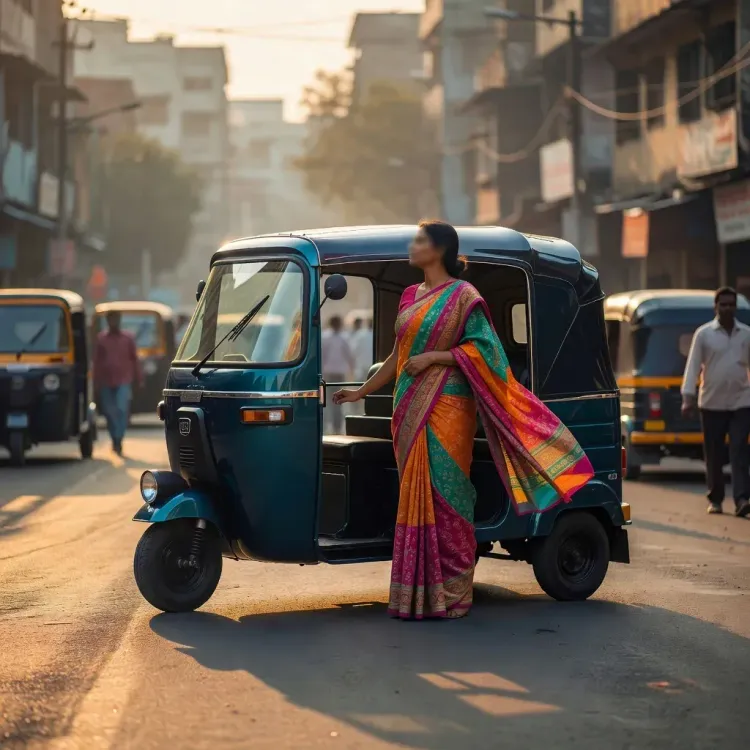
Suman Mishra, who leads Mahindra Last Mile Mobility, sits at the centre of what Mahindra called 'perhaps most gratifyingly' the award's deeper meaning. The Earthshot submission did not merely describe electric powertrains replacing fossil-fuel ones — it documented women being enabled to 'take the wheel and build independent livelihoods in a profession traditionally dominated by men.'
Mahindra said he suspects this dimension 'resonated with the Earthshot jury' and that having a woman-led company gave the mission 'an added sense of purpose, energy and conviction.' The pairing of technology substitution with gender inclusion is precisely the kind of systemic intervention that distinguishes transformative programmes from incremental ones. One change shifts the fuel source. The other shifts who controls the vehicle, the income, and the future.
Sustainability as growth engine, not compliance checkbox
Running through the entire post is a business thesis Mahindra says he has 'articulated for many years': that sustainability 'is not merely a compliance obligation or a box to be ticked' but 'one of the greatest growth opportunities for business in the decades ahead.' The Earthshot win, in his reading, is a public validation of that thesis — not just for Mahindra but for every Indian company still treating ESG as a reporting burden rather than a strategy.
India's three-wheeler EV segment has seen rapid adoption, driven partly by central and state government incentive frameworks and partly by the simple arithmetic of running costs. Mahindra's Earthshot recognition lands at a moment when Indian automakers are making consequential bets on last-mile electrification, and when global capital is increasingly benchmarking Indian manufacturers against climate-aligned metrics.
Profit and purpose, Mahindra concluded, 'can, and must, go hand in hand.' After 27 years and one Earthshot Prize, that is no longer a philosophy. It is a balance sheet.
Point of View
Globally visible proof. For ESG-focused global investors benchmarking Indian auto stocks, an Earthshot win attached to a commercially operational, woman-led business unit is a materially different signal than a corporate sustainability pledge. The gender-inclusion dimension also broadens the investable thesis: Mahindra Last Mile Mobility is simultaneously an EV play, a financial-inclusion story, and a supply-side women-empowerment programme — a combination that attracts both development-finance and impact capital at a time when blended-finance instruments are proliferating in India's mobility sector.
NationPress
18 Nov 2026
Frequently Asked Questions
What is the Earthshot Prize and who founded it?
The Earthshot Prize is an environmental award founded by Prince William to identify and fund scalable solutions to the world's most urgent climate and environmental challenges.
What did Mahindra win the Earthshot Prize for?
Mahindra Last Mile Mobility won the Earthshot Prize for scaling electric three-wheelers in India while also empowering women to operate vehicles and earn independent livelihoods in a male-dominated profession.
What was the Bijli electric three-wheeler?
The Bijli was India's first electric three-wheeler, launched by Mahindra in 1999 . It failed to find a viable business model at the time but is cited by Anand Mahindra as the origin of the Group's long-term EV conviction.
Who is Suman Mishra and what is her role at Mahindra?
Suman Mishra heads Mahindra Last Mile Mobility , making her the leader of the Group's electric three-wheeler and small commercial vehicle unit that won the Earthshot Prize.
Where was the Earthshot Prize ceremony held in 2026?
The 2026 Earthshot Prize ceremony was held in Mumbai , where Mahindra Group received the award on 18 November 2026 .