Mines and Minerals Amendment Bill 2026: Uniform tax regime to boost critical mineral security
Synopsis
India's mining sector gets its most significant legislative overhaul in years: the Mines and Minerals Amendment Bill 2026 strips states of the power to impose fresh mineral taxes without Central approval, directly targeting the fiscal chaos that had made domestic extraction commercially unviable and pushed industries toward imports despite sufficient local reserves.
Key Takeaways
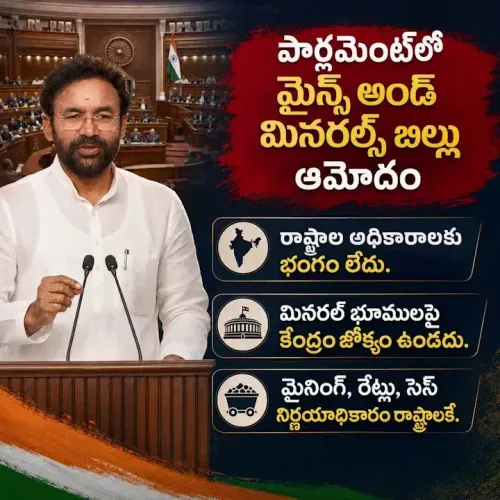
The Mines and Minerals (Development and Regulation) Amendment Bill, 2026 has been passed by both houses of Parliament .
State governments are now barred from imposing new taxes, cesses, or levies on mineral rights or mineral-bearing lands without conditions set by the Central government .
Levies not yet paid or collected before the amendment takes effect will be treated as invalid ; amounts already recovered will not be refunded.
The bill addresses multiple levies, non-uniform state rates, and retrospective tax imposition — distortions that had hit small and medium miners hardest.
The legislation aims to reduce import dependence by making domestic mineral extraction commercially competitive amid a global scramble for critical minerals.
The Mines and Minerals (Development and Regulation) Amendment Bill, 2026, passed by both houses of Parliament, will overhaul India's mineral governance framework by establishing a stable, uniform fiscal regime that strengthens critical mineral security and sustainable resource development, according to an official factsheet released on Thursday, 13 August 2026. The legislation directly addresses the unpredictable and often prohibitive tax environment that had rendered mining commercially unviable in several parts of the country.
Key Provisions of the Amendment
The bill restricts state governments from imposing new taxes on mineral rights or mineral-bearing lands without conditions prescribed by the Central government. As the official statement noted, 'No tax, cess or other levy, by whatever name called, shall be imposed by a State Government on mineral rights or mineral-bearing lands. This covers levies based on mineral quantity, mineral value, royalty or any other basis.'
Critically, any levy not paid or collected by a state before the amendment takes effect will be treated as invalid. However, amounts already deposited or recovered prior to commencement are not liable for refund — a provision designed to provide legal finality without triggering large-scale fiscal disruption for state exchequers.
Problems the Bill Addresses
The amendment targets a cluster of structural distortions that had long plagued India's mining sector. These include multiple levies on mineral production or dispatch, non-uniform tax rates across states, and the retrospective imposition of charges — all of which created cascading compliance costs and deterred long-term investment.
Small and medium-scale mining operators were disproportionately affected, according to the factsheet. High and inconsistent levies pushed downstream industries toward imported minerals despite adequate domestic reserves, weakening local supply chains, inflating transport costs, and increasing pollution from longer haulage routes.
Impact on Mineral Security and End-Users
The legislation has direct implications for India's critical mineral security — a priority that has gained urgency as global supply chains for battery metals, rare earths, and industrial minerals face geopolitical strain. Costlier domestic extraction had created a structural incentive to import, even where local resources were sufficient.
An excessive tax burden at the extraction stage also has a downstream effect: it ultimately raises the cost of goods and services for the common citizen. By rationalising the fiscal regime, the Centre aims to make domestic mineral supply commercially competitive and reduce import dependence.
Why This Matters Now
This comes amid a broader global scramble for critical minerals, with the European Union, United States, and China all accelerating domestic mining and strategic stockpiling. India, which holds significant reserves of minerals including lithium, cobalt, and rare earths, has historically under-extracted due to regulatory and fiscal friction. The 2026 amendment is the most significant legislative intervention in the sector in recent years, and signals a shift from fragmented state-level governance to a Centre-led framework for mineral resource management.
With parliamentary approval secured, the focus now shifts to implementation — specifically, how states adapt their existing levy structures and whether the Centre issues detailed guidelines within a defined timeframe.
Point of View
Effectively double-taxing the same mineral output. But the real test is enforcement: states with significant mining revenues — Odisha, Jharkhand, Rajasthan — will resist fiscal centralisation, and the Centre's ability to prescribe conditions without triggering federal friction remains untested. The bill's silence on a transition timeline for existing state levies is a gap that will likely end up in litigation. More broadly, rationalising taxes is a necessary but not sufficient condition for critical mineral security — India still needs faster environmental clearances and a credible exploration pipeline to convert policy intent into actual extraction.
NationPress
28 Sept 2026
Frequently Asked Questions
What does the Mines and Minerals Amendment Bill 2026 do?
The bill establishes a uniform fiscal regime for India's mining sector by prohibiting state governments from imposing new taxes, cesses, or levies on mineral rights or mineral-bearing lands without conditions prescribed by the Central government. It also invalidates unpaid levies imposed before the amendment takes effect, while clarifying that amounts already recovered will not be refunded.
Why were state mineral taxes a problem?
States had been imposing multiple, inconsistent, and sometimes retrospective levies on mineral production and dispatch, creating a cascading tax burden and high compliance costs. This made mining commercially unviable in several instances, disproportionately hit small and medium operators, and pushed industries to import minerals despite sufficient domestic reserves.
How does this bill affect critical mineral security in India?
By making domestic extraction commercially competitive, the bill aims to reduce India's dependence on mineral imports — a strategic concern given global supply chain pressures on battery metals, rare earths, and industrial minerals. India holds significant reserves that have been under-extracted partly due to fiscal and regulatory friction.
What happens to mineral taxes that states had already imposed?
Any levy not yet paid or collected by a state before the amendment comes into force will be treated as invalid. However, amounts already deposited or recovered by states prior to commencement are not liable to be refunded, providing legal finality on past collections.
Who benefits most from this amendment?
Small and medium-scale mining operators stand to benefit most, as they were disproportionately affected by unpredictable and high state levies. Downstream industries that had been sourcing minerals from imports due to costlier domestic supply, and ultimately consumers who bear the cost of expensive raw material chains, are also expected to benefit.