Kishan Reddy: Mines Bill Won't Curb State Powers
Synopsis
Parliament passed the Mines and Minerals Bill on 13 August 2026. Union Minister G. Kishan Reddy assured states their powers over mining operations, rates, and cess remain intact, while the bill seeks a uniform tax structure for major minerals like coal, iron ore, steel, and cement across all states.
Key Takeaways
Parliament passed the Mines and Minerals Bill on 13 August 2026 .
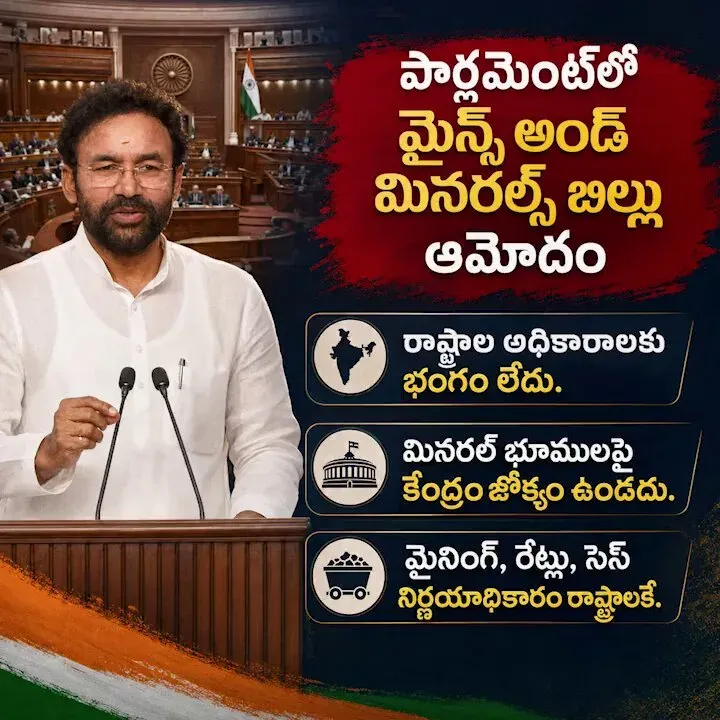
Kishan Reddy stated the Centre will have no interference over mineral lands within state boundaries.
States retain full authority over mining operations, rate-fixing, and cess imposition .
The bill's primary goal is a uniform tax regime across all states for major minerals including coal, iron ore, steel, and cement .
The move follows a series of MMDR amendments since 1957 , each navigating centre-state tensions over mineral revenue and regulation.
Mineral-rich states including Jharkhand, Odisha, and Chhattisgarh are key stakeholders to watch for legislative or legal responses.
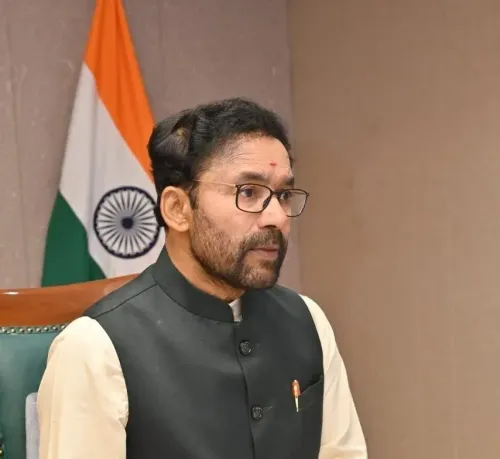
A significant piece of legislation cleared Parliament on Thursday, 13 August 2026, as the Mines and Minerals Bill won approval — and Union Coal and Mines Minister G. Kishan Reddy moved quickly to address the central anxiety surrounding it: that New Delhi was reaching into territory that belongs to the states.
Posting in Telugu, Reddy was direct. 'States will retain complete authority over conducting mining operations, fixing rates, and imposing cess,' he wrote, adding that the Centre would have 'no interference' over mineral lands within state boundaries. The message was calibrated — reassurance first, rationale second.
What the Bill Actually Does
The core purpose, as Reddy framed it, is uniformity: a single tax structure across all states for major minerals — steel, cement, coal, and iron ore. The argument is industrial logic. When royalty and tax regimes differ sharply from one state to the next, supply chains for India's foundational sectors — power, construction, steel — become hostage to geography. A uniform framework, the Centre contends, smooths that out without stripping states of their operational levers.
That distinction — operational control staying with states, tax standardisation moving to the Centre — is the political tightrope the bill walks. Reddy's post is essentially the government's first public pitch for that balance.
A Long-Running Federal Negotiation
This bill arrives on a well-worn battlefield. The Mines and Minerals (Development and Regulation) Act has been the primary central framework for mining governance since 1957, and it has been amended repeatedly as the Centre and mineral-rich states have haggled over who controls what. The MMDR Amendment of 2015 mandated auctions for mineral concessions and locked in royalty rates to curb discretion. The 2021 amendment opened exploration to the private sector and eased clearances for critical minerals.
Each round has followed the same script: the Centre standardises, states push back, assurances are issued. The 2026 bill is the latest chapter — and the assurances are arriving faster this time, within hours of passage.
Why Mineral-Rich States Are Watching Closely
States like Jharkhand, Odisha, Chhattisgarh, and Telangana — Reddy's own home state — derive significant revenue from mineral royalties and cess. Any perception that a uniform central tax framework could compress those earnings triggers immediate political resistance. The fact that a BJP minister who is also Telangana BJP president is the face of this reassurance is not incidental: it signals the party's awareness that the bill's reception in mineral-producing states will be a test of federal trust.
Whether state governments accept that framing — or whether legal challenges and assembly resolutions follow — will define the bill's political afterlife as much as its legislative text.
Point of View
Several of which are governed by opposition parties. By leading with state autonomy rather than central authority, the BJP is attempting to defuse a federalism argument before it crystallises into organised resistance. The bill fits a decade-long pattern of incremental standardisation of India's mining regime, each step justified on supply-chain efficiency grounds while the underlying tension — who ultimately controls resource revenues — remains structurally unresolved. Whether the 'uniform tax, state operations' formula holds in practice will depend on how the royalty notifications are drafted and whether states perceive revenue compression.
NationPress
28 Sept 2026
Frequently Asked Questions
What is the Mines and Minerals Bill passed by Parliament in August 2026?
The Mines and Minerals Bill, passed on 13 August 2026, aims to establish a uniform tax structure for major minerals such as coal, iron ore, steel, and cement across all Indian states, while keeping operational mining authority with state governments.
Will the Mines and Minerals Bill reduce state powers over mining?
Union Minister G. Kishan Reddy has stated it will not — states retain full powers over conducting mining operations, fixing rates, and imposing cess, with no central interference over mineral lands within state territories.
Which minerals does the new Mines and Minerals Bill cover?
The bill targets major minerals including coal, iron ore, and those used in steel and cement production, seeking a single tax framework for these across all states.
How does this bill relate to the MMDR Act?
The Mines and Minerals (Development and Regulation) Act has governed Indian mining since 1957 and has been amended multiple times — in 2015 to mandate auctions and fix royalties, and in 2021 to open exploration to private players. The 2026 bill is the latest amendment in this lineage.
Which states could be most affected by the Mines and Minerals Bill?
Mineral-rich states such as Jharkhand, Odisha, Chhattisgarh, and Telangana — which derive significant revenue from royalties and cess — are the primary stakeholders watching whether the uniform tax framework affects their fiscal autonomy.