Mobile Phone Manufacturing Scheme: ₹62,500 crore push to deepen India's component ecosystem

Synopsis
India's ₹62,500 crore Mobile Phone Manufacturing Scheme isn't just another incentive round — it is a deliberate pivot from assembly-scale growth to deep, high-value manufacturing. With electronics output hitting ₹13.11 lakh crore in FY26 and mobile exports at ₹2.59 lakh crore, the MPMS bets that India can now build the component backbone to match its export ambition.
Key Takeaways
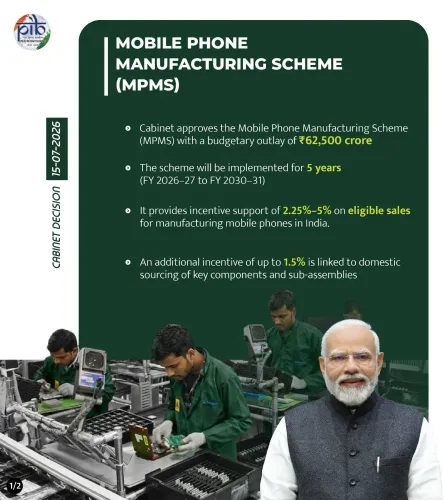
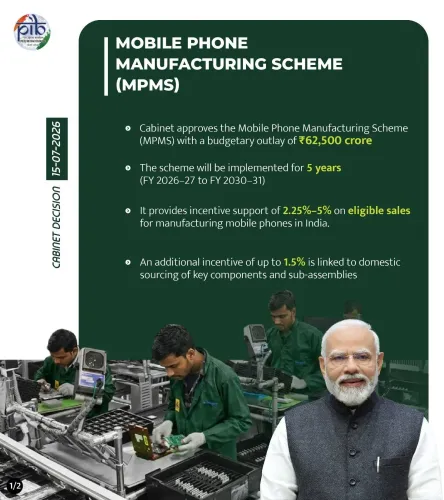
The Central government has approved the Mobile Phone Manufacturing Scheme (MPMS) with an outlay of ₹62,500 crore .
ICEA Chairman Pankaj Mohindroo called the scheme the next phase of India's mobile manufacturing journey, building on existing PLI frameworks.
The MPMS creates an aggregator framework for the Electronics Components Manufacturing Scheme (ECMS) , aligning demand and scale efficiencies.
India's electronics production grew 15.8% year-on-year to ₹13.11 lakh crore in FY26 , with mobile exports reaching ₹2.59 lakh crore .
The scheme targets domestic sourcing of key components, support for Indian brands , and investment in design and R&D .
India's ₹62,500 crore Mobile Phone Manufacturing Scheme (MPMS) has drawn strong backing from industry leaders, who say the newly approved programme will deepen domestic value addition, strengthen the supply chain, and accelerate the development of a robust component ecosystem. The endorsements came on Friday, 21 August, as the scheme entered public discourse following its Central government approval.
Industry Welcome and Policy Continuity
Pankaj Mohindroo, Chairman of the India Cellular and Electronics Association (ICEA), called the scheme a natural progression of India's mobile manufacturing journey. 'We welcome the Central government's launch of the Rs 62,500 crore Mobile Phone Manufacturing Scheme (MPMS). The scheme builds on the strong foundation of PLI for Large Scale Electronics Manufacturing and marks the next phase of India's mobile manufacturing journey,' Mohindroo said.
He emphasised that successive policy frameworks — from production-linked incentives to the Electronics Components Manufacturing Scheme (ECMS) — have provided industry the confidence to make long-term investments and build deep manufacturing capabilities in India. 'This creates continuity of policy and strengthens predictability,' he added.
What the Scheme Targets
According to the ICEA statement, the MPMS is designed to deepen domestic sourcing of key components, support Indian brands, and boost investment in design and R&D. The scheme also creates what the industry body described as a 'natural aggregator framework' for the ECMS — aligning demand aggregation, scale efficiencies, and ecosystem development across critical components.
'This convergence will be instrumental in accelerating component manufacturing in India and improving global competitiveness,' the ICEA statement said.
From Assembly to High-Value Manufacturing
Ashok Gupta, Executive Chairman of Optiemus Infracom Ltd, said the scheme provides a 'strong and sustained policy framework' to shift India's electronics sector from scale-driven assembly towards deeper, high-value manufacturing. 'The scheme would create a powerful demand-supply ecosystem by aligning with ECMS and strengthening domestic sourcing. Its focus on Indian brands, design and R&D would give a significant boost to local champions, enabling them to scale, innovate and compete globally,' Gupta said.
India's Electronics Surge: The Numbers
The scheme arrives at a moment of significant momentum in India's electronics sector. Domestic electronics production rose from ₹11.32 lakh crore in FY25 to ₹13.11 lakh crore in FY26, marking a 15.8% year-on-year increase. Mobile phone exports have skyrocketed, reaching ₹2.59 lakh crore — cementing India's status as a major global smartphone exporter.
What Comes Next
Industry bodies see the MPMS as the bridge between India's current export success and its longer-term ambition of becoming a full-stack electronics manufacturing hub. The focus now shifts to implementation: whether the scheme's domestic sourcing mandates and R&D incentives translate into a genuine component ecosystem, or remain aspirational targets. With global supply chains in flux and China-plus-one strategies accelerating, the window for India to move up the value chain is arguably wider now than at any point in the past decade.
Point of View
In components sourced from Taiwan, South Korea, and China. The MPMS is the right diagnosis, but the cure depends entirely on whether domestic sourcing mandates are enforceable and whether R&D incentives attract genuine IP creation or just label-switching. The ECMS-MPMS convergence framework is conceptually sound; the risk is that 'aggregator framework' becomes bureaucratic language for a coordination problem that never gets solved. India has a narrow window — China-plus-one demand is real but not permanent. The next 24 months of implementation will matter far more than the ₹62,500 crore headline.
NationPress
21 Aug 2026
Frequently Asked Questions
What is the Mobile Phone Manufacturing Scheme (MPMS)?
The MPMS is a Central government scheme with an outlay of ₹62,500 crore designed to deepen domestic value addition in India's mobile phone manufacturing sector. It builds on the existing Production-Linked Incentive (PLI) framework and aims to develop a robust component ecosystem within India.
How does the MPMS connect to the Electronics Components Manufacturing Scheme?
The MPMS creates what industry body ICEA describes as a 'natural aggregator framework' for the Electronics Components Manufacturing Scheme (ECMS), aligning demand aggregation, scale efficiencies, and ecosystem development across critical components. This convergence is intended to accelerate component manufacturing and improve global competitiveness.
What has India's electronics sector achieved ahead of the MPMS launch?
India's electronics production rose 15.8% year-on-year from ₹11.32 lakh crore in FY25 to ₹13.11 lakh crore in FY26. Mobile phone exports reached ₹2.59 lakh crore, establishing India as a significant global smartphone exporter.
Which industry leaders have welcomed the MPMS?
ICEA Chairman Pankaj Mohindroo and Optiemus Infracom Ltd Executive Chairman Ashok Gupta have both publicly welcomed the scheme. Mohindroo highlighted policy continuity, while Gupta emphasised the scheme's potential to shift India from assembly-scale to high-value manufacturing.
What does the MPMS mean for Indian brands and R&D?
The scheme specifically includes support for Indian brands, domestic design, and R&D investment. Industry leaders say this focus will enable local champions to scale, innovate, and compete globally — moving beyond contract manufacturing for foreign labels.