India's 7.5-8% GDP growth unmatched globally, says Scindia at Gwalior event
Synopsis
Union Minister Jyotiraditya Scindia declared at a Gwalior event that no nation on earth matches India's 7.5-8% GDP growth, human capital base, or its 'volcano-like drive' to become a developed nation by 2047 — a claim that lands as global attention on India's economic trajectory reaches a new high, with even the US President invoking India's growth in monetary policy debates.
Key Takeaways
Union Minister Jyotiraditya Scindia addressed an event in Gwalior, Madhya Pradesh on 21 November 2026 .
Scindia said no country matches India's GDP growth rate of 7.5 to 8 per cent or its human capital base.
He reaffirmed the government's Viksit Bharat 2047 goal, calling it a 'shared national aspiration.' India's youth was cited as the most critical driver of achieving developed-nation status by 2047 .
Earlier in November 2026 , US President Donald Trump referenced India's growth while critiquing the US Federal Reserve's monetary policy.
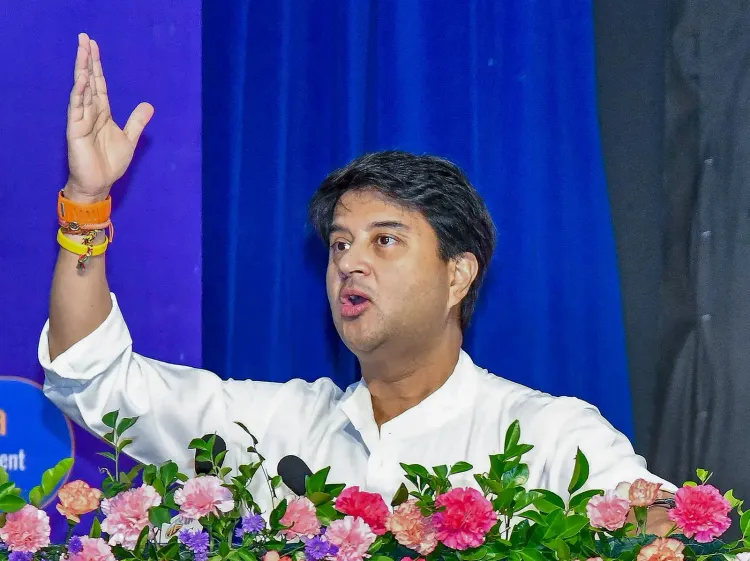
Union Minister Jyotiraditya Scindia on Saturday, 21 November 2026, declared that no country in the world matches India's GDP growth rate of 7.5 to 8 per cent, citing the nation's demographic strength and collective ambition to achieve the Viksit Bharat 2047 goal. Speaking at an event in Gwalior, Madhya Pradesh, Scindia argued that India's combination of economic momentum and human capital is effectively impossible to replicate elsewhere.
What Scindia Said
'No other country in the world is growing at a GDP rate of 7.5 to 8 per cent. No other country has the human resources that India has. No other country has a volcano-like drive to realise a developed India by 2047. That capability is not there in any other country; it is in India,' the minister said.
Scindia also expressed strong confidence in the country's youth, stating that 'a developed India in 2047 is possible and the youth of India will play the most important role in achieving that goal.'
India's Economic Position in Context
India continues to rank among the world's fastest-growing major economies, a standing that has drawn increasing global attention. Notably, earlier in November, US President Donald Trump cited India's economic growth and comparatively lower interest rates while criticising the US Federal Reserve's monetary policy, arguing that reduced borrowing costs could accelerate expansion. The reference underscored how India's growth trajectory has become a reference point in international economic debates.
Viksit Bharat 2047 as a National Aspiration
The government's Viksit Bharat 2047 vision — aimed at transforming India into a fully developed nation by the centenary of its independence — has emerged as a central policy anchor for long-term economic planning. Scindia described the initiative as having created a 'shared national aspiration,' one that he said distinguishes India from other emerging economies at a similar stage of development.
He urged audiences to look beyond short-term market volatility and focus on India's long-term structural growth trajectory, underpinned by its large talent pool and entrepreneurial energy.
Human Capital as a Key Driver
Beyond raw growth figures, Scindia emphasised India's demographic dividend as a structural advantage. With a large and young workforce, the minister argued that India's human capital — combined with its determination to achieve developed-nation status — would remain the primary engine of economic progress over the next two decades. He said the country's growth story is built not just on investment and infrastructure, but on the ambition and skill of its people.
What Comes Next
As India pushes toward its 2047 milestone, the ability to convert high headline growth into broad-based employment and income gains will determine whether the Viksit Bharat vision translates from aspiration to reality. Scindia's remarks signal continued government emphasis on framing India's economic narrative in global competitive terms — a posture likely to intensify ahead of key multilateral forums in the coming months.
Point of View
Citing a headline GDP rate of 7.5-8% without addressing the quality of that growth — wage levels, employment intensity, regional inequality — leaves the argument incomplete. The fact that Donald Trump has also started invoking India's growth in US domestic debates gives the narrative an unexpected geopolitical dimension, but it also exposes India to sharper external scrutiny. The Viksit Bharat goal still lacks a credible public scorecard; until that changes, 'volcano-like drive' risks remaining a slogan rather than a measurable national commitment.
NationPress
21 Nov 2026
Frequently Asked Questions
What did Jyotiraditya Scindia say about India's GDP growth?
Union Minister Jyotiraditya Scindia said no other country in the world is growing at a GDP rate of 7.5 to 8 per cent, asserting that India's combination of economic momentum and human capital is unmatched globally. He made the remarks at an event in Gwalior, Madhya Pradesh on 21 November 2026.
What is the Viksit Bharat 2047 vision?
Viksit Bharat 2047 is the Indian government's long-term goal of transforming India into a fully developed nation by the centenary of its independence in 2047. It serves as the central anchor for the government's economic and social policy planning.
Why did US President Donald Trump mention India's economic growth?
Earlier in November 2026, US President Donald Trump cited India's economic growth and relatively lower interest rates while criticising the US Federal Reserve's monetary policy. He used India's example to argue that lower borrowing costs could help accelerate economic expansion.
What role does India's human capital play in its growth story?
Scindia described India's large and young workforce as a structural advantage that cannot be replicated elsewhere. He argued that alongside entrepreneurial energy and national ambition, human capital would remain a primary driver of India's progress toward developed-nation status by 2047.
How does India's growth rate compare to other major economies?
India is widely regarded as one of the world's fastest-growing major economies, with the government citing a GDP growth rate of 7.5 to 8 per cent. Most other large economies — including the United States, China, and European nations — are growing at considerably lower rates, according to available data.