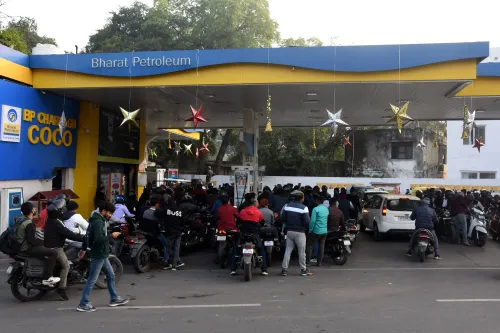
Oil prices near multi-month lows, but Q1 FY27 set to hit OMC profits hard
Synopsis
Brent crude has fallen below $80 — its lowest since March 2026 — but for India's oil marketing companies, the relief is too little, too late. PL Capital analysts flag a ₹7-10/litre under-recovery in Q1 FY27, and warn that a potential excise duty rollback could erase whatever margin recovery the crude dip provides. OMC profitability looks set to stay under pressure through the full year.
Key Takeaways
Brent crude fell below $80 per barrel , its lowest since March 2026 , following the US-Iran ceasefire deal .
Analysts at PL Capital expect crude to rise again as countries replenish Strategic Petroleum Reserves (SPRs) .
Swarnendu Bhushan of PL Capital projects an under-recovery of ₹7 per litre (petrol) and ₹10 per litre (diesel) for OMCs in Q1 FY27 .
The ₹10 per litre excise duty cut may be rolled back as crude moderates, posing a key earnings risk for OMCs.
OMC profitability is expected to remain under pressure through FY27 despite near-term sentiment improvement.
Brent crude has slipped below $80 per barrel — its lowest level since March 2026 — as geopolitical risk premiums tied to the Middle East conflict continue to unwind. While the retreat offers a measure of relief for oil marketing companies (OMCs), analysts warn that Q1 FY27 profitability is set to take a sharp hit, with full-year earnings under pressure from compressed margins and an uncertain excise duty outlook.
Where Crude Prices Stand
Crude has pulled back to levels last seen before the escalation of the Middle East conflict, driven by easing supply fears following a US-Iran ceasefire deal. Analysts at PL Capital (Prabhudas Lilladher) note that if the situation progresses positively and full normalcy is restored at the Strait of Hormuz, prices could soften further. Notably, the ceasefire, while a positive development, leaves considerable uncertainty — particularly around the nuclear deal.
However, the same analysts caution that a sustained price decline is unlikely. 'We expect crude oil prices to rise again as countries are expected to replenish inventories and Strategic Petroleum Reserves (SPRs) to maintain optimum resource levels, creating incremental demand in the market,' they said. The inventory restocking cycle, a recurring pattern after major supply disruptions, could put a floor under prices sooner than markets anticipate.
Q1 FY27: The Profitability Crunch
Swarnendu Bhushan, Co-Head of Research, Institutional Research at PL Capital, has flagged a significant under-recovery for OMCs in the first quarter. 'Q1 FY27 is expected to weigh sharply on profitability, impacting earnings for the full year. We expect an under-recovery of ₹7 per litre and ₹10 per litre in Q1 FY27, after considering a ₹10 per litre excise cut and capping of cracks at $10 per barrel and $15 per barrel for MS (petrol) and HSD (high-speed diesel), respectively,' he said.
The core problem: the benefit from lower crude prices arrived too late in the quarter to offset the full-quarter drag of elevated input costs and squeezed marketing margins. Overall Q1 FY27 performance, analysts noted, remains weak despite the crude correction.
The Excise Duty Risk
A key risk that analysts argue is under-appreciated is the potential rollback of the excise duty cut. The reduction was introduced as a crisis management measure — not a permanent structural change — during the peak of the energy shock. With crude moderating and retail fuel prices hiked, the government may gradually withdraw the concession, according to analyst projections.
This creates a double bind for OMCs: if crude stays low, the government has less justification to maintain the excise relief; if crude rises again, the relief may be rolled back just as input costs climb. Either scenario pressures gross marketing margins (GMMs).
Outlook for OMCs Through FY27
The broader picture for OMCs remains cautious. 'Overall, while near-term sentiment has improved, Q1 FY27 losses and continued uncertainty around the excise duty rollback suggest that OMC profitability is likely to remain under pressure through FY27,' analysts at PL Capital said. Market participants are reassessing the near-term supply outlook as geopolitical risk premiums unwind, but the structural earnings headwinds for Indian OMCs have not yet cleared. How quickly the US-Iran situation stabilises — and whether the nuclear deal holds — will be the key variables to watch in the months ahead.
Point of View
But its benefit to OMCs is being systematically eroded from two directions. The Q1 FY27 under-recovery reflects a timing mismatch — elevated input costs dominated the quarter before the price drop arrived. More structurally, the excise duty cut was always a crisis instrument, and its withdrawal is now a question of when, not if. What mainstream coverage underweights is the inventory restocking cycle: the same geopolitical de-escalation that pushed crude down will trigger SPR replenishment globally, putting a floor under prices. OMCs could find themselves caught between a crude rebound and a shrinking excise buffer — precisely the scenario that makes FY27 earnings guidance unreliable.
NationPress
19 Sept 2026
Frequently Asked Questions
Why are crude oil prices falling in June 2026?
Crude prices have retreated below $80 per barrel — the lowest since March 2026 — primarily because the US-Iran ceasefire deal has reduced geopolitical risk premiums and eased supply fears around the Strait of Hormuz. Analysts note that further softening is possible if the situation normalises fully.
What is the expected under-recovery for OMCs in Q1 FY27?
Analysts at PL Capital project an under-recovery of ₹7 per litre for petrol (MS) and ₹10 per litre for diesel (HSD) in Q1 FY27, after accounting for a ₹10 per litre excise duty cut and capped refining cracks at $10 and $15 per barrel respectively.
Why will crude prices rise again despite the current dip?
PL Capital analysts expect countries to replenish inventories and Strategic Petroleum Reserves (SPRs) following the supply disruption, which will generate incremental demand and push prices higher. This inventory restocking pattern is a recurring feature after major energy shocks.
What is the excise duty rollback risk for oil marketing companies?
The excise duty cut was introduced as a crisis measure, not a permanent policy change. With crude prices moderating and retail fuel prices already hiked, analysts warn the government may gradually withdraw the benefit, compressing gross marketing margins for OMCs even if crude stays range-bound.
What is the overall outlook for OMC profitability in FY27?
Profitability is expected to remain under pressure through FY27, according to PL Capital. Q1 FY27 losses, the potential excise duty rollback, and lingering uncertainty over the US-Iran nuclear deal all weigh on the earnings outlook despite improved near-term crude sentiment.