Remarkable Safety Improvements in Indian Railways: 92% Drop in Rail Fractures and 93% in Weld Failures
Synopsis
Discover how Indian Railways has achieved a remarkable 92% reduction in rail fractures and 93% drop in weld failures, enhancing track safety significantly. Union Railway Minister Ashwini Vaishnaw shares insights on the structural changes implemented since 2014.
Key Takeaways
Rail fractures down by 92% Weld failures reduced by 93% Consequential Accident Index improved to 0.01 Accident numbers fell from 135 to 16 Safety enhancements due to structural reforms since 2014
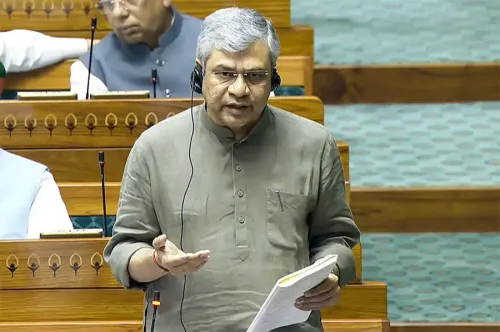
New Delhi, April 17 (NationPress) Rail fractures have seen a reduction of 92% and weld failures have decreased by 93% within Indian Railways, marking a pivotal advancement in track safety, stated Union Railway Minister Ashwini Vaishnaw on Friday.
In an article for a national publication, Vaishnaw highlighted that these enhancements are part of a comprehensive structural overhaul initiated post-2014, when Prime Minister Narendra Modi established safety as a fundamental priority for railway operations.
The minister pointed out that railway safety is assessed globally based on fatalities or accidents per billion passenger-kilometres, allowing for international comparisons.
While the European Union registers roughly 0.09 fatalities per billion passenger-kilometres, India has made significant strides, as reflected in its Consequential Accident Index, which has markedly improved to 0.01.
According to Vaishnaw, this positions India advantageously among extensive and complex railway systems worldwide.
He referenced decade-over-decade statistics as clear indicators of fundamental changes. The number of consequential train accidents has plummeted from 135 in 2014–15 to just 16 in 2025–26, showcasing an impressive 89% decrease.
Simultaneously, the accident index has dropped from 0.11 to 0.01, highlighting a structurally safer network even as train services have expanded considerably.
Vaishnaw noted that these achievements are particularly remarkable given the intricate nature of India’s railway system, where various services including passenger, freight, suburban, and express run on shared tracks.
He described the transformation as not just incremental but fundamentally structural, bolstered by consistent funding, technological advancements, and a long-term commitment to safety.
"The journey of railway safety in India should be perceived not as an overnight achievement of global standards, but as a reflection of the pace and intent of reforms—an approach that is progressively aligning the nation with leading international counterparts," Vaishnaw asserted.
Point of View
The substantial improvements in railway safety metrics underscore a commendable commitment to infrastructure reform. By prioritizing safety, India is not only enhancing public trust but also aligning itself with global standards, reflecting a nation-first approach.
NationPress
19 Sept 2026
Frequently Asked Questions
What improvements have been made in Indian Railways' safety?
Indian Railways has achieved a 92% reduction in rail fractures and a 93% decrease in weld failures, enhancing overall safety significantly.
How does India compare to global railway safety standards?
India's Consequential Accident Index has improved to 0.01 , positioning it favorably against the European Union's 0.09 fatalities per billion passenger-kilometres.
What are the key factors behind these safety improvements?
The improvements are attributed to a structural transformation initiated in 2014, focusing on consistent funding, technological upgrades, and a long-term commitment to safety.
How have train accidents changed over the years?
Consequential train accidents have decreased from 135 in 2014–15 to just 16 in 2025–26, marking an 89% reduction.
What is the significance of these safety metrics?
These metrics reflect a fundamentally safer railway network, even as train operations expand, showcasing India's commitment to passenger safety.