India's AI future hinges on R&D and skilling, says Salesforce South Asia CEO
Synopsis
Salesforce South Asia CEO Arundhati Bhattacharya says India's AI potential is real but incomplete — talent is the foundation, not the finish line. With R&D gaps to close and a commitment to skill one million people by 2030, Salesforce is betting big on India as its second-largest global R&D hub.
Key Takeaways
Arundhati Bhattacharya , CEO of Salesforce South Asia , says India must combine talent with stronger R&D and skilling to lead in global AI.
Salesforce's AI deployment on help.salesforce.com lifted first-call resolution from 44% to over 84% .
The company has committed to skilling one million people in AI by 2030 via partnerships with AICTE and educational institutions.
Salesforce now employs more than 17,000 people across seven locations in India — its second largest R&D centre globally after the US.
The Salesforce Hyderabad Centre of Excellence has completed 10 years of operations.
Arundhati Bhattacharya, President and CEO of Salesforce South Asia, said on 14 June that India has the potential to become a pivotal contributor to the global artificial intelligence ecosystem — but only if it pairs its existing talent base with stronger research and development and sustained skilling efforts. The remarks come as India's AI ambitions gain momentum across both government policy and private enterprise.
The Case for India's AI Leadership
Bhattacharya argued that India's competitive edge in AI will be shaped by its unique domestic demands. 'A lot of innovation will come from India's unique requirements, whether it is multilingual AI, cost-efficient models, or solutions that can work at enormous scale,' she said. She added that talent alone is insufficient, calling for 'stronger focus on research, greater collaboration between industry, academia and government, and a sustained focus on innovation.'
India already possesses, according to Bhattacharya, the three foundational pillars for AI leadership: a large and skilled talent pool, a maturing digital infrastructure, and a vibrant entrepreneurial culture. The challenge, she noted, is converting these advantages into globally competitive research output.
The Human Skills That AI Cannot Replace
In an AI-first world, Bhattacharya stressed that adaptability and curiosity matter more than any single technical skill. Drawing on her own career trajectory — from an English Literature graduate to leading one of the world's fastest-growing technology regions — she said the willingness to pivot and keep learning defines long-term career resilience.
'Human judgement, creativity, communication and empathy will become even more valuable because these are the capabilities that complement AI,' she said. She also cautioned that some existing skills will become obsolete while new ones emerge, and that 'many of the jobs of the future do not yet have names.'
Salesforce's Own AI Outcomes
Bhattacharya pointed to Salesforce's internal deployment of AI as evidence of what is possible when data, context, and governance align. After the company introduced an agentic AI layer into its help.salesforce.com platform, its first-call resolution rate reportedly rose from approximately 44 per cent to over 84 per cent. 'It reinforced for us that when the data, context and governance are right, AI can deliver measurable business outcomes,' she noted.
This 'customer zero' philosophy — using its own technology extensively before deploying it for clients — is central to how Salesforce validates its AI products, she explained.
Skilling Commitment and India Footprint
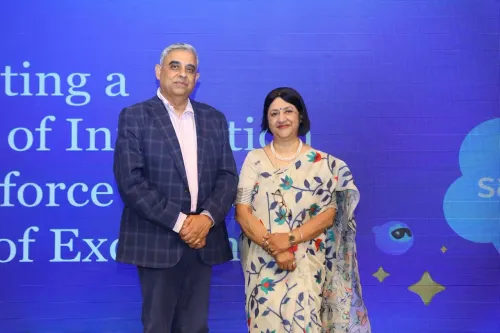
Salesforce has committed to skilling one million people in AI by 2030, working through partnerships with the All India Council for Technical Education (AICTE), government initiatives, educational institutions, and its broader ecosystem. The company's Hyderabad Centre of Excellence recently completed a decade of operations.
Today, Salesforce employs more than 17,000 people across seven locations in India, making the country its second largest R&D centre globally after the United States. Bhattacharya described this growth as 'a journey that has been quite significant.' As India's AI policy landscape continues to evolve, the company's expanding India footprint positions it as both a stakeholder and a benchmark in the country's technology ambitions.
Point of View
Only a potential one. The gap between talent supply and research output is a structural problem that industry-academia collaboration has promised to fix for years without delivering at scale. Salesforce's own numbers — 17,000 employees, second-largest R&D hub globally — give the company credibility here, but the one-million-skilling target by 2030 will need independent tracking to mean anything. The more pointed observation is that India's AI edge, if it materialises, will likely come from necessity-driven innovation: multilingual models, low-cost inference, and population-scale deployment. That is a different kind of leadership from frontier model research, and policymakers would do well to distinguish between the two.
NationPress
13 Sept 2026
Frequently Asked Questions
What did Arundhati Bhattacharya say about India's AI potential?
Bhattacharya said India can become a very important contributor to the global AI ecosystem if it combines its talent advantage with stronger R&D and sustained skilling. She highlighted multilingual AI, cost-efficient models, and large-scale solutions as areas where India-specific innovation is likely to emerge.
What is Salesforce's skilling commitment for AI in India?
Salesforce has committed to skilling one million people in AI by 2030, through partnerships with AICTE, government initiatives, and educational institutions. The effort is part of the company's broader push to build AI-ready talent across its ecosystem in India.
How has Salesforce used AI internally?
Salesforce introduced an agentic AI layer into its help.salesforce.com platform and saw its first-call resolution rate rise from approximately 44 per cent to over 84 per cent. Bhattacharya cited this as evidence that AI delivers measurable outcomes when data, context, and governance are properly aligned.
How large is Salesforce's presence in India?
Salesforce employs more than 17,000 people across seven locations in India, making it the company's second-largest R&D centre globally after the United States. The Hyderabad Centre of Excellence recently marked its tenth year of operations.
What human skills does Bhattacharya say will remain valuable in an AI-driven world?
She identified human judgement, creativity, communication, and empathy as the capabilities that will complement AI and grow in value. She also stressed that the most important skill today is the ability to keep learning, as some existing roles will sunset and new ones will emerge.