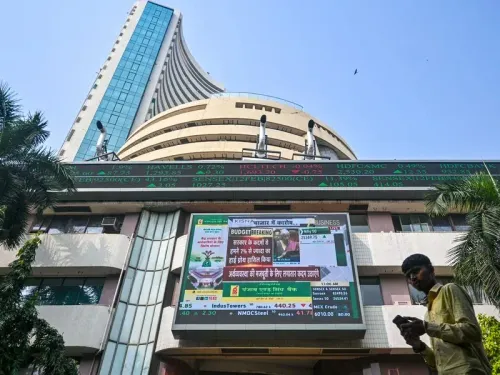
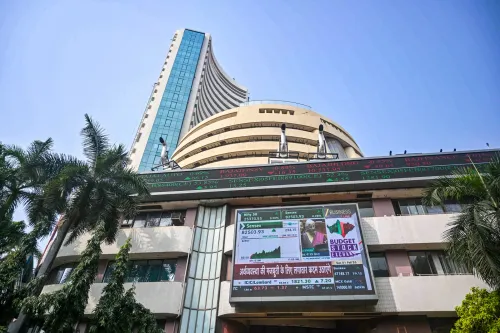
Sensex drops 561 points, Nifty slips below 24,100 on West Asia tensions
Synopsis
West Asia tensions hit Dalal Street hard on 14 July, sending the Sensex down 561 points and pushing the Nifty below 24,100. With PSU banks, realty, and auto stocks leading the slide and the US Fed Chair's remarks awaited, the next few sessions could determine whether this is a temporary dip or the start of a deeper correction.
Key Takeaways
Sensex closed 561.46 points lower at 77,054.94 on 14 July , a decline of 0.72% .
Nifty50 fell 159 points to settle at 24,052.05 , slipping below the 24,100 level.
Nifty Realty , Nifty PSU Bank , and Nifty Auto were the worst-hit sectoral indices.
HCL Technologies , Shriram Finance , and HDFC Life Insurance were the biggest Nifty laggards.
Nifty Pharma bucked the trend, finishing as the top sectoral gainer on defensive buying.
Key support for Nifty seen at 23,950 ; resistance in the 24,250–24,300 zone, according to analysts.
Sensex closed 561.46 points, or 0.72%, lower at 77,054.94 on Tuesday, 14 July, as escalating geopolitical tensions in West Asia triggered broad-based selling across Indian equity markets. The Nifty50 fell 159 points, or 0.66%, to settle at 24,052.05, slipping below the psychologically significant 24,100 mark.
Sectors Hit Hardest
Nifty Realty, Nifty PSU Bank, and Nifty Auto recorded the steepest sectoral losses, reflecting risk-off sentiment across rate-sensitive and cyclical segments. Among individual Nifty constituents, HCL Technologies, Shriram Finance, and HDFC Life Insurance Company emerged as the biggest laggards.
The sell-off was not confined to large caps. The Nifty MidCap index ended 0.44% lower, while the Nifty SmallCap index declined a steeper 1.01%, signalling broader market stress.
One Bright Spot: Pharma
Bucking the trend, the Nifty Pharma index finished as the top sectoral gainer, as investors rotated into defensive stocks amid the wider uncertainty. This is consistent with a pattern seen in previous risk-off sessions, where healthcare and pharma attract safe-haven buying when geopolitical risk spikes.
Technical Outlook
Market analysts noted that the Nifty opened with a gap-down — coinciding with the expiry of NSE weekly options — but found support near the previous session's low and held above a falling trendline. 'In the short term, the outlook is likely to remain positive as long as the index stays above 23,950. On the higher side, it may advance towards the 24,250–24,300 zone,' an analyst said. However, the same analyst cautioned that 'a decisive fall below 23,950 could weaken the current bullish setup and trigger a phase of consolidation.'
What to Watch Next
Investor focus is now squarely on upcoming remarks from the US Federal Reserve Chair, which are expected to shape global rate expectations and, by extension, foreign fund flows into emerging markets like India. Separately, the Q1 earnings season has so far tracked on a positive note, but analysts warn that a rapid escalation in geopolitical risk could continue to dampen sentiment. Any further deterioration in West Asia could amplify selling pressure, particularly in energy-linked and export-oriented sectors.
Point of View
A classic defensive rotation that suggests institutional money is hedging rather than exiting. The real risk is a prolonged West Asia conflict that pushes crude higher — a double blow for India through import costs and inflation. Markets are also caught between two narratives: a supportive Q1 earnings season and an uncertain Fed path. Until the Fed Chair speaks, expect range-bound volatility with a downside bias.
NationPress
14 Jul 2026
Frequently Asked Questions
Why did the Sensex fall on 14 July 2025?
The Sensex dropped 561.46 points to 77,054.94 on 14 July primarily due to heightened geopolitical tensions in West Asia, which triggered broad-based risk-off selling across Indian equity markets. PSU bank, realty, and auto stocks were the hardest hit.
Where is the key support level for Nifty after Tuesday's fall?
Analysts have identified 23,950 as the critical support level for the Nifty in the near term. A decisive break below that level, according to market experts, could weaken the current bullish setup and lead to a phase of consolidation.
Which sectors gained despite the market fall?
The Nifty Pharma index was the standout gainer on 14 July, as investors sought defensive exposure amid the broader sell-off. This reflects a typical safe-haven rotation seen during periods of elevated geopolitical uncertainty.
How did mid-cap and small-cap stocks perform?
The broader market also came under pressure, with the Nifty MidCap index ending 0.44% lower and the Nifty SmallCap index declining 1.01% — a steeper fall than the headline indices, indicating wider market stress.
What events will drive market direction next?
Upcoming remarks from the US Federal Reserve Chair are being closely watched, as they are expected to set the tone for global rate expectations and foreign fund flows. The ongoing Q1 earnings season and any further developments in West Asia will also be key factors.