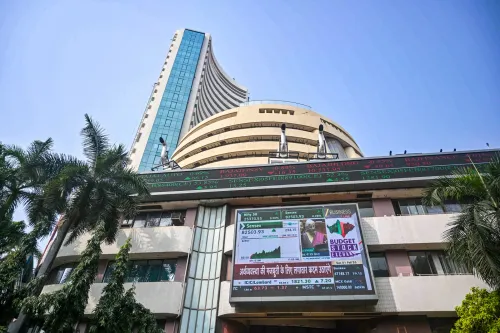
Sensex, Nifty outlook stays positive despite Iran-US Strait of Hormuz tensions
Synopsis
Indian markets dipped on Friday as Iran-US clashes near the Strait of Hormuz unsettled investors, yet both the Sensex and Nifty closed the week more than 0.70% higher. Analysts say the structural trend remains intact, but warn that a Nifty break below 23,800 could unleash fresh selling pressure.
Key Takeaways
Sensex fell 0.67% to 77,321 and Nifty dropped 0.55% to 24,193 on 10 May .
Both indices still ended the week with gains of more than 0.70% despite intra-day volatility.
Trigger: reported Iran-US clashes near the Strait of Hormuz dampened risk appetite.
Nifty Smallcap 100 rose 0.22% ; Nifty Midcap 100 slipped 0.15% .
Key Nifty support at 24,000 and 23,800 ; a break below 23,800 could intensify selling.
Analysts advise disciplined stop-loss strategies amid ongoing geopolitical uncertainty.
Indian equity benchmarks ended lower on Friday, 10 May as reported clashes between Iran and the US near the Strait of Hormuz rattled investor sentiment, pulling the Sensex and Nifty into the red for the session. Despite the pullback, market analysts maintain that the broader trend for both indices remains positive, even as near-term volatility is expected to persist.
Friday's Market Close
The Nifty declined 0.55% to settle at 24,193, while the Sensex fell 0.67% to close at 77,321. Both benchmarks, however, managed to end the week with gains of more than 0.70% despite sharp intra-day swings, reflecting underlying resilience even amid geopolitical headwinds.
In the broader market, the Nifty Smallcap 100 rose 0.22%, while the Nifty Midcap 100 slipped 0.15%, indicating a mixed picture beyond the headline indices.
Technical Levels to Watch
On the Sensex, analysts pointed to immediate downside support in the 54,600–54,200 zone should selling pressure re-emerge. On the upside, 56,400 acts as immediate resistance, with 56,800 identified as the next key supply zone, according to market experts.
For the Nifty, the index ended the week at 24,176.15, gaining 178.60 points or 0.74% on a weekly basis. Resistance levels are placed at 24,500 and 24,600, while support is seen at 24,000 and 23,800. Analysts cautioned that a breakdown below 23,800 could trigger increased selling pressure.
Geopolitical Trigger: Iran-US Tensions
The session's weakness was attributed to reports of clashes between Iran and the US near the strategically critical Strait of Hormuz — a chokepoint through which a significant share of global oil supply passes. Geopolitical flare-ups in this region have historically prompted risk-off sentiment across emerging markets, including India. This is not the first time that Hormuz-related tensions have weighed on Dalal Street; similar episodes in 2019 and 2022 triggered short-lived but sharp corrections in Indian equities.
Notably, the fact that both benchmarks still closed the week in positive territory suggests that domestic institutional buying may have provided a cushion against the external shock.
Analyst Outlook and Risk Management
Market experts have advised traders to remain cautious and follow disciplined risk management while closely tracking key technical levels for the next directional move.
Point of View
Even when domestic fundamentals are supportive. The Strait of Hormuz is an oil-supply artery, and any sustained disruption there feeds directly into India's import bill and inflation calculus — risks the market has not yet fully priced. That both benchmarks still ended the week in the green is encouraging, but the technical picture is fragile: a Nifty close below 23,800 would invalidate the current bullish structure and could trigger stop-loss-driven selling. The broader question is whether domestic institutional flows — which have cushioned several recent corrections — can continue to absorb external shocks if the Iran-US standoff escalates beyond skirmishes.
NationPress
23 Sept 2026
Frequently Asked Questions
Why did the Sensex and Nifty fall on 10 May 2025?
The Sensex and Nifty fell on 10 May due to reported clashes between Iran and the US near the Strait of Hormuz, which dampened global risk appetite. The Sensex dropped 0.67% to 77,321 and the Nifty fell 0.55% to 24,193.
Did Indian markets end the week positively despite Friday's fall?
Yes, both the Sensex and Nifty ended the week with gains of more than 0.70% despite sharp intra-day swings on Friday. The Nifty gained 178.60 points or 0.74% on a weekly basis, closing at 24,176.15.
What are the key support and resistance levels for the Nifty?
Analysts have identified resistance levels for the Nifty at 24,500 and 24,600. On the downside, support is seen at 24,000 and 23,800, with a break below 23,800 potentially triggering increased selling pressure.
What are the key technical levels for the Sensex?
For the Sensex, immediate downside support is placed in the 54,600–54,200 zone. On the upside, 56,400 acts as immediate resistance, while 56,800 is identified as the next key supply zone, according to market analysts.
How did broader markets perform on 10 May?
Broader markets showed a mixed picture on 10 May. The Nifty Smallcap 100 rose 0.22%, while the Nifty Midcap 100 slipped 0.15%, suggesting selective resilience outside the headline indices.