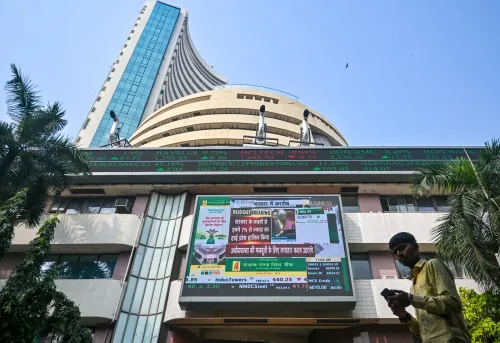
Sensex, Nifty post second weekly gain as RBI rupee support lifts markets

Synopsis
The RBI's special dollar window for oil marketing companies proved to be the week's turning point — steadying the rupee when inflation data and rising bond yields had threatened to derail India's equity recovery. With FII selling sharply easing but not yet reversing, and IT carrying the bulk of the rally, the broader market's staying power now rests on whether financials and consumption can deliver in earnings season.
Key Takeaways
BSE Sensex closed up 413 points at 74,729 on 17 October 2026 , gaining 3.11% for the week.
Nifty50 ended at 23,146 , adding 2.78% over the week and 0.65% on the day.
RBI's special dollar window for oil marketing companies and tighter hedging norms drove the rupee rebound that revived market sentiment.
IT stocks led sectoral gains on strong earnings; FMCG lagged on input-cost margin concerns.
FIIs remained net sellers for a ninth straight week but weekly outflows fell sharply to ₹899.1 crore from ₹3,029.4 crore the previous week.
DIIs were net buyers for a ninth consecutive week at ₹781.3 crore .
Indian equity benchmarks closed the week on a firm note on 17 October 2026, with the BSE Sensex rising 413 points or 0.56% to 74,729 and the Nifty50 gaining 0.65% to close at 23,146. It marked the second consecutive week of sustained recovery, driven largely by the Reserve Bank of India's (RBI) intervention through a special dollar window for oil marketing companies that helped the rupee rebound from recent pressure.
What Triggered the Weekly Rally
Sentiment had soured earlier in the week after consumer inflation hovered near the upper end of the RBI's tolerance band and a hotter-than-expected Wholesale Price Index (WPI) print pushed benchmark bond yields to multi-year highs. The central bank also raised the daily Cash Reserve Ratio (CRR) maintenance requirement to absorb surplus liquidity, adding to market caution.
The tide turned when the RBI activated a special dollar window for oil marketing companies and tightened hedging norms, spurring a meaningful rupee recovery. Analysts noted that expectations of a review of Long-Term Capital Gains (LTCG) tax and the Securities Transaction Tax (STT), softer crude oil prices, and easing bond yields further revived risk appetite across the market.
Sector Performance: IT Leads, FMCG Lags
The Information Technology (IT) sector emerged as the standout performer of the week, buoyed by robust earnings results and upbeat management commentary. Healthcare and pharmaceuticals, however, lagged as investors gravitated toward sectors offering stronger near-term earnings visibility.
Fast-moving consumer goods (FMCG) stocks came under pressure amid concerns over margin compression driven by elevated input costs. The rally remained concentrated in large-cap counters, with the Nifty Midcap100 adding a modest 0.58% and the Nifty Smallcap100 dipping 0.12% for the week, according to analysts.
FII and DII Flows
Foreign Institutional Investors (FIIs) turned net buyers of ₹116.6 crore in Indian equities on Friday as overall selling eased sharply through the week. FIIs nonetheless remained net sellers for the ninth straight week, though their weekly net outflow moderated significantly to ₹899.1 crore from ₹3,029.4 crore the previous week.
Domestic Institutional Investors (DIIs) continued their support, staying net buyers for a ninth consecutive week at ₹781.3 crore, even as they turned net sellers of ₹366.1 crore on Friday alone.
What Markets Are Watching Next
Analysts caution that the sustainability of this recovery will depend on earnings growth broadening beyond IT, with revenue and margin delivery across financials, consumption, and industrials under close scrutiny. Investors are awaiting India's October PMI data for a read on domestic demand momentum, while US jobless claims and Japan's inflation print will shape global rate expectations in the sessions ahead. Market experts recommend a selective approach with disciplined position sizing and a hedged stance given elevated macroeconomic and earnings-related uncertainty.
Point of View
At its core, a central bank confidence play — the RBI's dollar window did what rate signals alone could not: it stabilised the currency and broke the negative feedback loop between a weak rupee and bond-yield anxiety. But the rally's concentration in large-cap IT is a structural warning sign, not a market-wide endorsement of India's macro outlook. FIIs cutting their selling pace is not the same as turning bullish; nine straight weeks of outflows reflects a structural wariness that a single rupee bounce is unlikely to reverse. The real test arrives when financials and consumption companies report — if margin pressures persist in FMCG and loan-growth slows in banking, the rally's foundation looks narrower than headline index moves suggest.
NationPress
17 Oct 2026
Frequently Asked Questions
Why did the Sensex and Nifty recover this week?
The Sensex and Nifty posted a second consecutive weekly gain primarily after the RBI activated a special dollar window for oil marketing companies, which triggered a rupee rebound and eased bond yield pressure. Expectations of a review of LTCG tax and STT, along with softer crude prices, further boosted risk appetite.
What did the RBI do to support the rupee?
The RBI opened a special dollar window for oil marketing companies and tightened hedging norms, both of which increased dollar supply in the market and helped the rupee recover. The central bank also raised the daily CRR maintenance requirement to absorb surplus liquidity, though this initially added to market caution.
Which sectors performed best and worst this week?
IT was the standout performer, driven by robust Q2FY27 earnings and positive management commentary. FMCG was among the worst performers, weighed by fears of margin compression from elevated input costs. Healthcare and pharmaceuticals also lagged as investors preferred sectors with clearer near-term earnings visibility.
What is the current status of FII and DII flows in Indian markets?
FIIs remained net sellers for a ninth straight week, though their weekly net outflow fell sharply to ₹899.1 crore from ₹3,029.4 crore the week before. DIIs countered with a ninth consecutive week of net buying at ₹781.3 crore, though they were net sellers of ₹366.1 crore on Friday.
What key data will determine the market direction next week?
India's October PMI data will be closely watched for signals on domestic demand momentum. Global cues from US jobless claims and Japan's inflation print will influence rate expectations worldwide. Analysts also stress that the earnings season — especially results from financials, consumption, and industrials — will be critical to determining whether the rally can broaden beyond IT.