South Korean Stocks Decline Amid US-Iran Ceasefire Disputes
Synopsis
On April 9, South Korean stocks experienced a decline as uncertainties over a US-Iran ceasefire agreement persisted. As key market players fluctuated, analysts noted the resilience of the market despite geopolitical tensions.
Key Takeaways
South Korean stocks fell amid US-Iran ceasefire disputes.
KOSPI dropped by 0.99% to 5,814.
Major companies like Samsung and SK Hynix experienced losses.
Oil refiners gained amid rising global crude prices.
The local currency decreased against the US dollar.
Seoul, April 9 (NationPress) The South Korean stock market faced a downturn late Thursday morning as Washington and Tehran remained at odds regarding the specifics of a two-week ceasefire. A key point of contention is whether this ceasefire includes a halt to Israel's military actions against Lebanon.
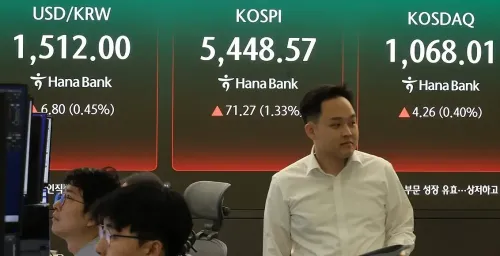
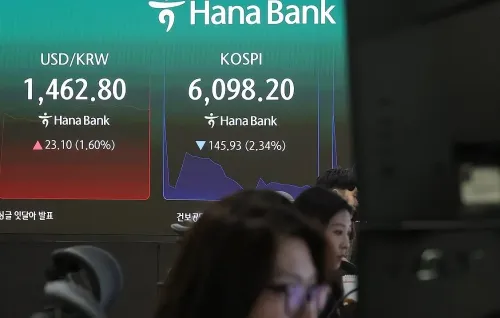
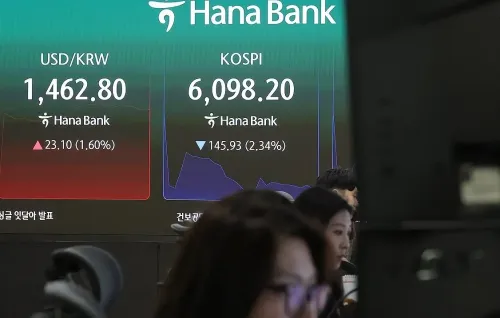
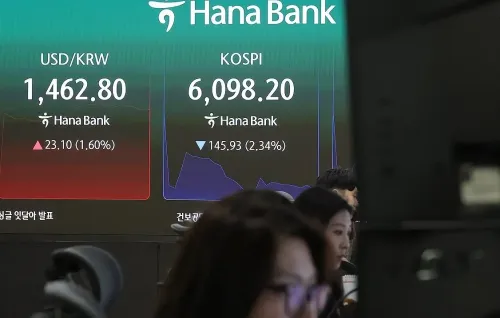
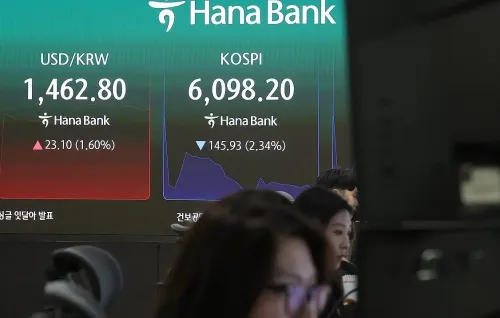
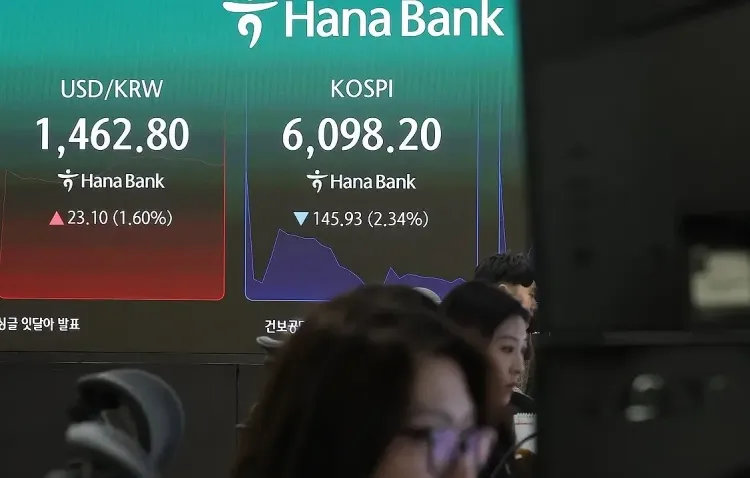
The benchmark Korea Composite Stock Price Index (KOSPI) dropped by 57.93 points, equivalent to a 0.99 percent decline, reaching 5,814 by 11:20 am (local time), according to reports by the Yonhap news agency.
On Tuesday (U.S. time), the United States and Iran had agreed to a two-week ceasefire that also aimed to reopen the crucial Strait of Hormuz. However, uncertainties persisted surrounding the Middle Eastern tensions, particularly over whether the ceasefire would also include a cessation of Israel's military actions.
According to Han Ji-young, an analyst at Kiwoom Securities, the U.S. and Iran are also disagreeing on matters related to uranium enrichment and control over the Strait of Hormuz. Han pointed out that while the market is stabilizing, extreme volatility in the South Korean stock market is unlikely.
“The resilience of the market is notable, especially with the U.S. market closing higher despite ongoing disagreements,” Han remarked.
In the Seoul market, major player Samsung Electronics saw a decline of 2.38 percent, while SK Hynix experienced a loss of 2.42 percent.
On the flip side, oil refiners saw gains as global crude prices rebounded amid geopolitical tensions, with SK Innovation rising by 3.32 percent and S-Oil increasing by 5.89 percent.
Carmakers had mixed results, with Hyundai Motor decreasing by 0.98 percent, while its counterpart Kia gained 1.07 percent.
In the technology sector, leading online search engine Naver fell 0.99 percent, and Kakao dropped 0.84 percent.
The local currency was valued at 1,479.9 won against the U.S. dollar at 11:20 a.m., marking a decrease of 9.3 won from the prior session.
Point of View
The recent fluctuations in the South Korean stock market underscore the impact of international relations on local economies. The ongoing uncertainty surrounding the US-Iran ceasefire agreement has created a cautious atmosphere among investors, reflecting broader geopolitical concerns.
NationPress
11 Sept 2026
Frequently Asked Questions
What caused the decline in South Korean stocks?
The decline was primarily due to ongoing disputes between the US and Iran regarding a ceasefire agreement, causing uncertainty in the market.
How did major companies like Samsung fare?
Samsung Electronics saw a decline of 2.38%, reflecting the overall downturn in the market.
What is the KOSPI index?
The KOSPI index is the benchmark stock market index of South Korea, reflecting the performance of its largest companies.
Are oil refiners performing well?
Yes, oil refiners have shown gains as global crude prices rebounded amid geopolitical uncertainties.
What was the currency exchange rate against the US dollar?
As of 11:20 a.m., the local currency was trading at 1,479.9 won against the US dollar.