Sitharaman meets AIIB chief Zou Jiayi, BRICS 2026 to deepen India ties
Synopsis
On the sidelines of BRICS 2026 in New Delhi, Finance Minister Sitharaman met AIIB President Zou Jiayi to push deeper infrastructure and local-currency financing ties — while PM Modi sealed the summit with the unanimous New Delhi Declaration 2026, warning that 'the changing world order cannot be managed by old institutions.'
Key Takeaways
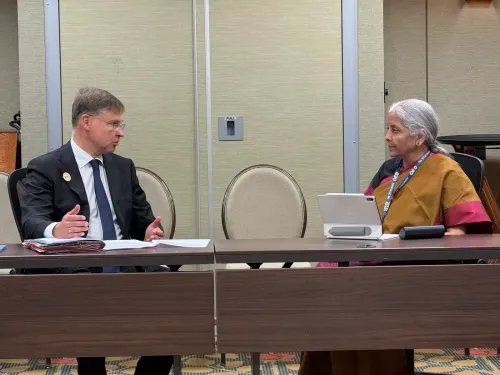
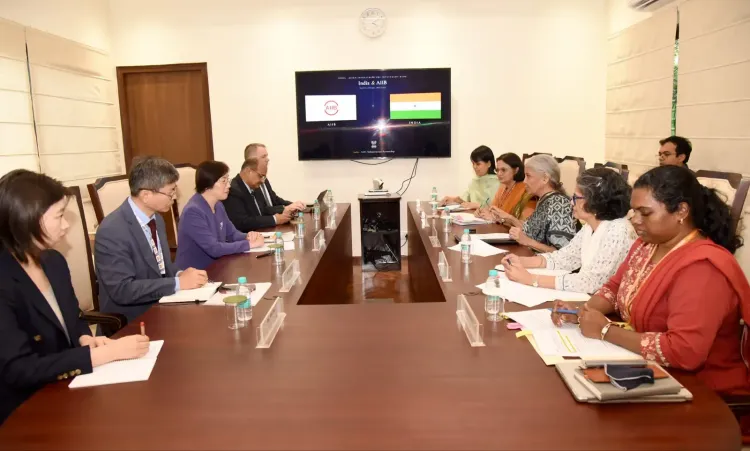
Finance Minister Nirmala Sitharaman met AIIB President Zou Jiayi on 12 September 2026 in New Delhi on the sidelines of the 18th BRICS Summit 2026 .
Talks covered India's infrastructure and transport priorities, local-currency financing , and increased private-sector participation in AIIB operations.
Sitharaman also met Russian First Deputy PM Denis Manturov ; both sides agreed to advance Bilateral Investment Treaty (BIT) negotiations.
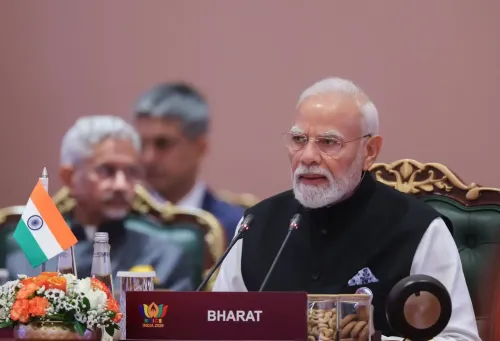
PM Modi announced the unanimous adoption of the New Delhi Declaration 2026 , calling it 'clear direction to our shared resolve.' Modi described the changing world order as one that 'cannot be managed by old institutions' — underscoring the BRICS push for reformed multilateralism.
Finance Minister Nirmala Sitharaman on 12 September 2026 met Asian Infrastructure Investment Bank (AIIB) President Zou Jiayi in New Delhi, with both sides discussing concrete steps to further deepen the India–AIIB partnership on the sidelines of the 18th BRICS Summit 2026.
Key Agenda: Infrastructure, Local-Currency Financing, Private Sector
According to the Finance Ministry, discussions covered ways to support India's infrastructure and transport connectivity priorities, enhance local-currency financing mechanisms, and increase private-sector participation in AIIB operations. Expanding the global footprint of the multilateral lender was also on the table.
Notably, Jiayi had arrived in New Delhi specifically to attend the BRICS Summit 2026. The Ministry of External Affairs (MEA), in a post on X, extended a formal welcome, stating: 'The visit will strengthen partnerships to advance sustainable development and expand opportunities for emerging economies.'
Sitharaman–Manturov Bilateral: Investment Treaty in Focus
Separately, Sitharaman also held a bilateral meeting with Denis Manturov, First Deputy Prime Minister of the Russian Federation. Both sides deliberated on deepening economic cooperation and agreed to advance negotiations on a Bilateral Investment Treaty (BIT), according to an official statement. The BIT, once concluded, is aimed at establishing a mutually beneficial framework to enhance investment flows and broader economic engagement. Cooperation in the financial services sector was also a focal point of the discussions.
New Delhi Declaration 2026 Adopted at BRICS Summit
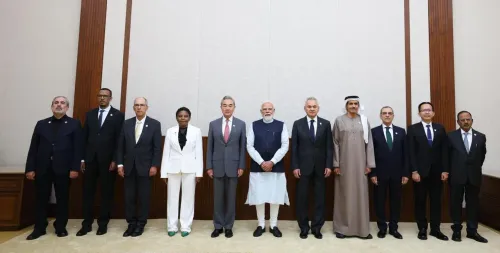
The diplomatic momentum at the summit culminated in a landmark outcome: Prime Minister Narendra Modi on 12 September 2026 announced the unanimous adoption of the New Delhi Declaration 2026 at the 18th BRICS Summit.
Delivering his closing remarks during the session on 'Inclusive Global Governance and Strengthening Multilateralism', Modi said, 'The New Delhi Declaration adopted today gives clear direction to our shared resolve. Now it is our responsibility to convert these resolutions into concrete results.'
The Prime Minister described the BRICS leaders' discussions as 'meaningful and constructive' and noted that deliberations spanned key regional and global issues. He also underscored that 'the changing world order cannot be managed by old institutions' — a pointed signal of the BRICS bloc's push for reformed multilateralism.
Why This Matters for India
India is among the largest borrowers from the AIIB since its founding in 2016, with funding channelled into roads, metro rail, and clean energy projects. A deeper partnership — particularly around local-currency financing — could reduce exchange-rate risk on large sovereign loans. The push to bring in more private capital also aligns with India's infrastructure gap, estimated at several trillion dollars over the next decade.
The India–Russia BIT negotiations gain added significance given the evolving global trade architecture and both countries' interest in rupee-rouble trade settlement mechanisms. With the New Delhi Declaration 2026 now adopted, the next phase will test whether BRICS's multilateral ambitions translate into operational commitments on the ground.
Point of View
Which could materially reduce the foreign-exchange cost burden on large sovereign infrastructure loans. But the real diplomatic weight at BRICS 2026 rests on PM Modi's New Delhi Declaration, whose language on 'old institutions' is a direct challenge to the Bretton Woods order. India is threading a difficult needle: deepening ties with a Chinese-led multilateral bank while simultaneously advancing a bilateral investment treaty with a sanctioned Russia. Whether New Delhi can convert that strategic ambiguity into leverage — rather than contradiction — will define its BRICS presidency legacy.
NationPress
13 Sept 2026
Frequently Asked Questions
What did Finance Minister Sitharaman discuss with AIIB President Zou Jiayi?
Sitharaman and Jiayi discussed ways to deepen the India–AIIB partnership, focusing on India's infrastructure and transport connectivity priorities, local-currency financing, and greater private-sector participation. The meeting took place on 12 September 2026 in New Delhi on the sidelines of the 18th BRICS Summit.
What is the New Delhi Declaration 2026?
The New Delhi Declaration 2026 is a consensus document unanimously adopted by BRICS leaders at the 18th BRICS Summit in New Delhi on 12 September 2026. PM Modi described it as giving 'clear direction to our shared resolve' on inclusive global governance and multilateralism.
What was agreed between India and Russia at the BRICS 2026 sidelines?
Finance Minister Sitharaman and Russian First Deputy Prime Minister Denis Manturov agreed to advance negotiations on a Bilateral Investment Treaty (BIT) aimed at enhancing investment flows and economic engagement. They also discussed deepening cooperation in the financial services sector.
Why is the India–AIIB partnership significant?
India is one of the largest AIIB borrowers since the bank's founding in 2016, with loans supporting roads, metro rail, and clean energy. Enhanced local-currency financing could reduce exchange-rate risk on sovereign loans, while greater private-sector involvement could help bridge India's vast infrastructure financing gap.
What did PM Modi say at the closing session of the BRICS Summit 2026?
PM Modi described the leaders' discussions as 'meaningful and constructive' and announced the unanimous adoption of the New Delhi Declaration 2026. He also stated that 'the changing world order cannot be managed by old institutions,' signalling the BRICS bloc's push for reformed multilateralism.