TDB backs BigEndian's ₹260 crore AI chip project with ₹130 crore grant
Synopsis
India's Technology Development Board has committed ₹130 crore — half the total project cost — to help Bengaluru-based BigEndian Semiconductors build a domestically developed AI Vision chip aimed at surveillance, defence, and beyond. If Project VeerAI reaches TRL-9, it would become one of the few indigenous AI SoCs in India cleared for commercial deployment, turning a long-standing semiconductor ambition into a concrete product.
Key Takeaways
Technology Development Board (TDB) signed a ₹130 crore funding agreement with BigEndian Semiconductors on 6 October 2026 .
Funds come from the Research Development and Innovation (RDI) Fund , extended as Optional Convertible Debt (OCD) .
Project VeerAI has a total cost of ₹260 crore and aims to develop an AI Vision System-on-Chip (SoC) for surveillance, defence, and other sectors.
The project will advance the technology from TRL-5 to TRL-9 , achieving full commercial readiness.
Initial applications target CCTV surveillance in India and the Global South , with expansion planned into defence, automotive, and healthcare.
The initiative aims to reduce India's dependence on foreign semiconductor supply chains by building a sovereign AI chip platform.
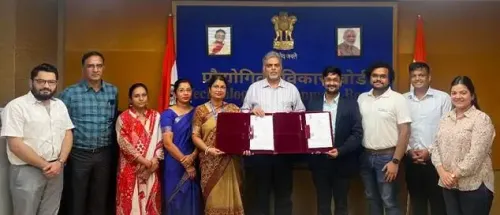
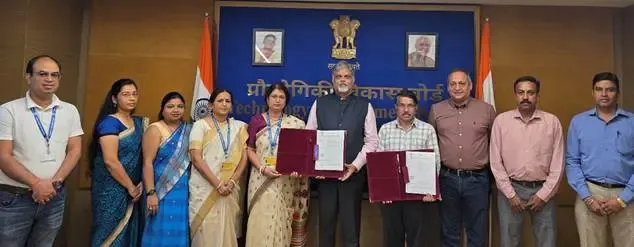
The Technology Development Board (TDB), operating under the Department of Science and Technology (DST), has signed a funding agreement with Bengaluru-based BigEndian Semiconductors to extend financial support of ₹130 crore under the Research Development and Innovation (RDI) Fund. The deal, formalised on 6 October 2026 in New Delhi, backs Project VeerAI — an indigenous semiconductor initiative with a total project outlay of ₹260 crore — and marks a significant push to build India's domestic AI chip capabilities.
What Project VeerAI Aims to Build
Project VeerAI is designed to develop a camera-focused Artificial Intelligence (AI) Vision System-on-Chip (SoC), primarily targeting surveillance applications such as CCTV systems. The initiative aims to advance the technology from Technology Readiness Level (TRL)-5 to TRL-9 — the threshold for full commercial deployment. The TDB assistance will be structured as Optional Convertible Debt (OCD), providing the government flexibility in how it recovers or converts the investment.
The proposed AI Vision SoC is engineered to integrate AI processing with advanced security, privacy, and connectivity features. While surveillance in India and countries across the Global South is the immediate target market, BigEndian Semiconductors has outlined plans to extend the technology into defence, automotive, industrial automation, and healthcare sectors over time.
India's Semiconductor Push: The Bigger Picture
This funding comes amid India's broader ambition to reduce dependence on imported semiconductor technologies and foreign supply chains. By focusing on application-specific chips rather than general-purpose processors, BigEndian is targeting a commercially faster route to market — a strategy that analysts note sidesteps the massive capital intensity of general-purpose fab production. The project is also expected to harness India's growing pool of VLSI design and semiconductor engineering talent, deepening domestic expertise in a sector that global powers are racing to control.
Notably, this is the kind of investment the Centre has been signalling for years under its semiconductor mission, and the RDI Fund mechanism offers a structured, milestone-linked pathway from lab to commercial product — a model that differs from earlier grant-based schemes with weaker accountability frameworks.
What the Government Said
Rajesh Kumar Pathak, Secretary, Technology Development Board, said that semiconductors are at the core of nearly every emerging technology, and that 'building domestic capabilities in application-specific AI chips is crucial for strengthening India's technology ecosystem.' The promoters of BigEndian Semiconductors said the funding will help accelerate development and validation of Project VeerAI and push the AI Vision SoC towards commercial readiness.
Road to Commercialisation
Through the RDI Fund support, BigEndian will undertake technology development, validation, integration, testing, and scale-up activities required to move Project VeerAI from advanced development to market-ready status. Successfully reaching TRL-9 would make it one of the few indigenous AI chip platforms in India to achieve full commercial readiness — a milestone that could attract further private investment and government procurement. The outcome of this project will be closely watched by India's broader semiconductor ecosystem as a test case for the RDI Fund model.
Point of View
And Project VeerAI is a meaningful test of whether the RDI Fund model can close that gap. Focusing on application-specific AI chips for surveillance is a pragmatic entry point — faster to commercialise than general-purpose silicon and immediately relevant to India's large government procurement market. The Optional Convertible Debt structure adds accountability that pure grants lacked. The harder question is whether a ₹260 crore project can generate the volume and ecosystem depth needed to meaningfully shift India's chip import dependence — or whether it remains a proof-of-concept that stops short of strategic scale.
NationPress
6 Oct 2026
Frequently Asked Questions
What is Project VeerAI and who is behind it?
Project VeerAI is an indigenous semiconductor initiative by Bengaluru-based BigEndian Semiconductors, aimed at developing an AI Vision System-on-Chip (SoC) for surveillance and other applications. The project has a total cost of ₹260 crore and has received ₹130 crore in support from the Technology Development Board under the DST's RDI Fund.
What will the ₹130 crore TDB funding be used for?
The funding will support technology development, validation, integration, testing, and scale-up activities to advance Project VeerAI from Technology Readiness Level (TRL)-5 to TRL-9, which represents full commercial readiness. The assistance is structured as Optional Convertible Debt (OCD), giving the government the option to convert the debt into equity.
What applications is the AI Vision SoC designed for?
Initially, the chip is targeted at surveillance applications, particularly CCTV systems, in India and across the Global South. BigEndian Semiconductors plans to later expand use cases into defence, automotive, industrial automation, and healthcare sectors.
Why is India investing in indigenous AI chip development?
India is seeking to reduce its dependence on foreign semiconductor technologies and supply chains by building a sovereign chip platform. Application-specific AI chips offer a faster route to commercialisation compared to general-purpose processors and align with India's growing VLSI and semiconductor engineering talent base.
What is the significance of moving from TRL-5 to TRL-9?
Technology Readiness Level (TRL)-9 represents a technology that is fully proven and commercially deployable, whereas TRL-5 is an advanced lab-validated prototype stage. Reaching TRL-9 would make Project VeerAI one of India's few domestically developed AI chips cleared for large-scale commercial and government deployment.