TDB approves ₹86 crore for Peptris' AI drug discovery programme VIGOR
Synopsis
India's Technology Development Board has committed ₹86 crore — half of a ₹172 crore project — to back Peptris Technologies' AI-driven VIGOR programme, which aims to push four novel drug candidates, including one targeting Duchenne muscular dystrophy, from lab-stage discovery to clinical-trial readiness within three years. It is a rare government bet on indigenous AI-to-molecule origination.
Key Takeaways
TDB signed an agreement with Peptris Technologies Pvt Ltd on 12 October 2026 to provide ₹86 crore under the RDI Fund .
The total project cost of the VIGOR programme is ₹172 crore ; funding is structured as Optionally Convertible Debt (OCD) .
The three-year programme targets advancing four drug candidates from TRL-4 to TRL-6 through preclinical and IND-enabling studies.
Candidates include PEPR112 for Duchenne muscular dystrophy, PEPR111 for neuromuscular disorders and oncology, PEPRX101 for alopecia, and PEPR202 for neuropathy.
The initiative is intended to strengthen India's capabilities in biotechnology , pharmaceuticals , and AI-enabled healthcare .
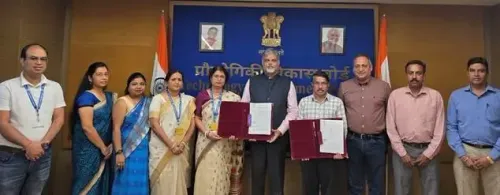
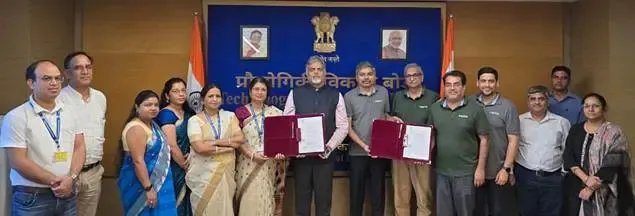
The Technology Development Board (TDB), operating under the Department of Science and Technology (DST), has signed a formal agreement with Peptris Technologies Pvt Ltd to extend ₹86 crore in financial support under the Research Development and Innovation (RDI) Fund for an artificial intelligence-led drug development initiative. The agreement was confirmed through an official statement on Monday, 12 October 2026, from New Delhi.
About the VIGOR Programme
The initiative, titled VIGOR: Advancing AI-Discovered Molecules from Bench to Clinic, carries a total project cost of ₹172 crore, with TDB contributing half through Optionally Convertible Debt (OCD). The three-year programme aims to advance four drug candidates from Technology Readiness Level (TRL)-4 to TRL-6, bridging the critical gap between computational discovery and real-world clinical trials.
The programme spans advanced preclinical studies, investigational new drug (IND)-enabling studies, formulation development, and clinical trial preparation — all subject to regulatory and scientific requirements.
The Four Drug Candidates
VIGOR covers a portfolio of four molecules targeting diseases with significant unmet medical needs. These include PEPR111 for neuromuscular disorders and oncology, PEPRX101 for alopecia, PEPR202 for neuropathy, and PEPR112 for Duchenne muscular dystrophy (DMD). All four candidates are currently at TRL-4 and are expected to reach TRL-6 under the funded programme.
What the Government Said
TDB Secretary Rajesh Kumar Pathak said that 'the application of artificial intelligence in pharmaceutical research has the potential to transform how new drug candidates are identified and developed.' He emphasised that sustained investment and rigorous scientific validation are essential to translate promising computational discoveries into viable therapeutic candidates.
The government stated that the project is designed to strengthen India's capabilities in biotechnology, pharmaceuticals, and AI-enabled healthcare innovation.
Peptris' Approach and the Broader Challenge
A representative of Peptris said the RDI Fund support would help the company advance VIGOR through critical preclinical milestones and accelerate its AI-discovered molecules toward potential clinical development. The company's platform combines AI-driven discovery with experimental validation and established drug-development processes.
Notably, one of the key bottlenecks in AI-based drug discovery is translating computational predictions into experimentally validated candidates — a process that demands extensive preclinical studies and clinical preparation. VIGOR is positioned precisely at this inflection point.
Why It Matters for India
This comes amid growing global interest in AI-accelerated pharmaceutical pipelines, with major drug developers and startups worldwide racing to shorten the traditionally decade-long drug development timeline. For India, backing an indigenous AI-drug discovery platform signals a strategic intent to move up the pharmaceutical value chain — from generics manufacturing toward novel molecule origination. The outcome of VIGOR's preclinical phase will be closely watched by investors and policymakers alike as a marker of whether India's biotech-AI convergence can produce clinical-stage assets.
Point of View
But ₹86 crore across four therapeutic candidates over three years is a modest bet by global standards — where single programmes routinely attract hundreds of millions in private capital. The real question is whether TDB's OCD structure gives Peptris the runway to clear preclinical hurdles without the commercial pressure that often derails early-stage biotech. India's pharmaceutical sector has excelled at generics but consistently struggled to originate novel molecules; VIGOR's success or failure at TRL-6 will say something significant about whether that can change through AI-augmented pipelines.
NationPress
12 Oct 2026
Frequently Asked Questions
What is the VIGOR programme funded by TDB?
VIGOR — Advancing AI-Discovered Molecules from Bench to Clinic — is a three-year drug development programme by Peptris Technologies Pvt Ltd, backed by ₹86 crore from the Technology Development Board under the RDI Fund. The programme aims to advance four AI-discovered drug candidates from TRL-4 to TRL-6 through preclinical studies and clinical trial preparation.
Which diseases do the four Peptris drug candidates target?
The four candidates target Duchenne muscular dystrophy (PEPR112), neuromuscular disorders and oncology (PEPR111), alopecia (PEPRX101), and neuropathy (PEPR202). All four are currently at Technology Readiness Level 4 and are expected to reach TRL-6 under the funded programme.
What is Technology Readiness Level (TRL) in drug development?
TRL is a scale used to measure the maturity of a technology or drug candidate. TRL-4 typically indicates laboratory validation, while TRL-6 represents demonstration in a relevant environment — in drug development, this corresponds to completion of key preclinical studies that make a candidate ready for investigational new drug applications and early clinical trials.
How is the ₹86 crore funding structured?
The financial support is being provided through Optionally Convertible Debt (OCD) under the Research Development and Innovation (RDI) Fund administered by TDB. This structure allows the government to potentially convert the debt into equity, aligning public risk with upside if the programme succeeds.
Why is the government investing in AI-driven drug discovery?
According to the Ministry of Science and Technology, the project is intended to bridge the gap between AI-based molecular discovery and clinical development, while building India's capabilities in biotechnology, pharmaceuticals, and AI-enabled healthcare innovation. AI tools have the potential to significantly shorten drug discovery timelines, and backing an indigenous platform aligns with India's broader push up the pharmaceutical value chain.