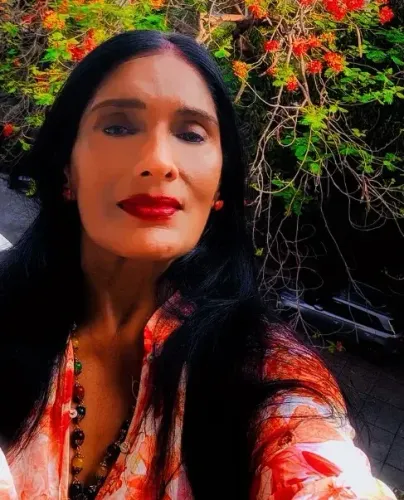
Anu Aggarwal on rejecting film offers: 'The audience deserved more'

Synopsis
Anu Aggarwal, the face of the 1990 blockbuster 'Aashiqui', says she turned down film after film because she couldn't stop thinking about the working-class families who saved up for a cinema ticket. In a candid Instagram post, she reframes what looked like a quiet career as a deliberate act of accountability to the audience.
Key Takeaways
Anu Aggarwal revealed on Instagram that she declined numerous film offers out of a sense of responsibility to her audience.
She highlighted that many viewers came from middle-class and lower-middle-class families who saved money specifically to watch her films.
Aggarwal stated that a film had to 'deserve its audience' — commercial success alone was not sufficient justification for her to accept a role.
She rose to fame with Mahesh Bhatt's 'Aashiqui' ( 1990 ), opposite Rahul Roy , whose soundtrack became the highest-selling Bollywood album of its time.
Her subsequent filmography included 'King Uncle' , 'Khal-Naaikaa' , 'The Cloud Door' , and 'Ram Shastra' , among others.
Former actress Anu Aggarwal has spoken candidly about her decision to decline numerous film offers during her acting career, citing a deep sense of responsibility towards the audiences who paid to watch her films. In a recent Instagram post, the 'Aashiqui' star explained that her selective approach to roles was driven by far more than commercial considerations.
What Anu Aggarwal Said
In her own words, shared alongside a personal photograph, Aggarwal reflected: 'You first. One of the things that troubled me as an actor was this: people paid to watch my films. That may sound obvious, but I couldn't stop thinking about it. Many of them came from middle-class and lower-middle-class families. Some would save up for that ticket. Some would go out of their way to buy it. And I kept asking myself: are we giving them something worth more than what they paid for?'
She elaborated further, writing: 'That question changed the way I chose the films I agreed to act in. It wasn't enough for a film to be successful. It had to deserve its audience. Perhaps that's one reason I turned down so many offers. It wasn't only about being typecast or choosing the right role. I felt a responsibility towards the people sitting in the theatre. The audience had given me everything. The least I could do was respect their time, attention, and trust.'
The Career Behind the Choices
Anu Aggarwal rose to national prominence with the 1990 romantic drama 'Aashiqui', directed by Mahesh Bhatt and featuring her opposite Rahul Roy. The film became a landmark commercial success, and its soundtrack went on to become the highest-selling Bollywood album at the time of its release — a cultural moment that defined early-1990s Hindi cinema.
She subsequently appeared in a range of Hindi films, including 'Ghazab Tamasha', 'King Uncle', 'Khal-Naaikaa', 'The Cloud Door', 'Janam Kundli', and 'Ram Shastra'. Despite the momentum her debut generated, her filmography remained deliberately sparse.
Why It Matters
Aggarwal's remarks offer a rare window into the ethical calculus some actors apply when navigating commercial cinema. At a time when Bollywood was churning out high volumes of content, her conscious restraint — anchored in audience-first thinking rather than stardom — stands as an unusual counterpoint to the industry's typical career logic.
Notably, her reflection also touches on class: the acknowledgement that many in her audience were working-class families spending carefully saved money on a cinema ticket adds moral weight to what might otherwise read as artistic selectivity. It frames her choices not as privilege, but as accountability.
Looking Back
Aggarwal has, in recent years, been increasingly vocal about her inner life and the values that shaped her career decisions. Her latest post suggests a continued engagement with questions of purpose and artistic integrity — themes that resonate well beyond her years in front of the camera.
Point of View
But it carries a sharper edge: it is a quiet indictment of an industry that routinely treats audience investment as a given. Her class-conscious framing — centring the working-family ticket-buyer — is almost never heard from actors of her era or any other. What mainstream coverage will miss is the structural implication: if more actors applied this standard, the economics of greenlit mediocrity would look very different. The rarity of her position is itself the story.
NationPress
22 Sept 2026
Frequently Asked Questions
Why did Anu Aggarwal turn down so many film offers?
Anu Aggarwal says she rejected numerous film offers because she felt a strong responsibility towards audiences, particularly those from middle-class and lower-middle-class families who saved money to buy cinema tickets. She believed a film had to genuinely deserve its audience, not merely succeed commercially.
Where did Anu Aggarwal share these thoughts?
She shared her reflections in a recent post on Instagram, accompanied by a personal photograph. The post included a detailed, first-person account of the values that guided her career decisions.
What is Anu Aggarwal best known for?
Anu Aggarwal is best known for her debut in the 1990 romantic drama 'Aashiqui', directed by Mahesh Bhatt and co-starring Rahul Roy. The film was a major commercial success, and its soundtrack became the highest-selling Bollywood album at the time of its release.
What other films did Anu Aggarwal appear in?
After 'Aashiqui', she appeared in several Hindi films including 'Ghazab Tamasha', 'King Uncle', 'Khal-Naaikaa', 'The Cloud Door', 'Janam Kundli', and 'Ram Shastra', though her overall filmography remained selective by choice.
What does Anu Aggarwal's post reveal about her approach to acting?
Her post reveals that she approached acting as a form of public trust rather than personal ambition. She consistently asked whether a film offered viewers something worth more than what they paid — a standard that led her to decline many offers despite her high-profile debut.