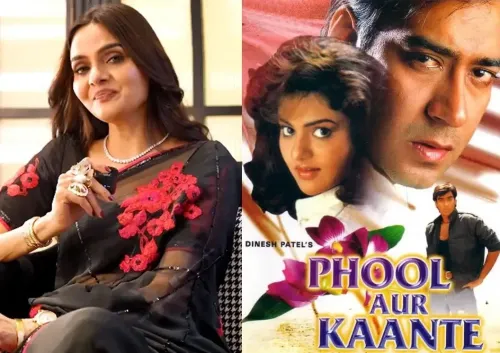
Madhoo: Phool Aur Kaante glorified eve-teasing, wouldn't survive today

Synopsis
Madhoo's admission that her own 1991 hit 'Phool Aur Kaante' glorified eve-teasing — and was celebrated for it — is the most honest thing Bollywood has said about its own past in years. At a time when 'Peddi' is being trolled for similar reasons, her words cut both ways: an indictment of the industry's history and a marker of how far, and how unevenly, it has travelled.
Key Takeaways
Actress Madhoo said her 1991 film 'Phool Aur Kaante' glorified eve-teasing, which she acknowledged would be unacceptable today.
She noted the film's first two songs depicted campus harassment framed as romance, and was celebrated as a blockbuster — never criticised at the time.
Madhoo also recalled that rape scenes were commonplace in films of the 1980s and 1990s , with one director nicknamed a 'rape specialist.' She warned that romanticising harassment on screen today could give 'subtle permission' to young men to replicate such behaviour.
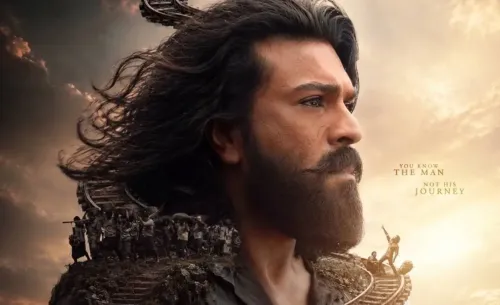
Her remarks came amid the controversy over Janhvi Kapoor's portrayal in Ram Charan 's 'Peddi' , which sparked fresh debate on women's objectification in cinema.
Veteran actress Madhoo has candidly acknowledged that her 1991 blockbuster 'Phool Aur Kaante' glorified eve-teasing — behaviour she says would not only be unacceptable today but would likely land the perpetrator in jail. Her remarks come amid a renewed national conversation on the objectification of women in Hindi cinema, reignited by criticism of the portrayal of Janhvi Kapoor in the Ram Charan-starrer 'Peddi'.
What Madhoo Said About Phool Aur Kaante
Speaking to reporters, Madhoo pointed to the film's opening songs as a case study in how Bollywood once romanticised harassment. 'In Phool Aur Kaante, the first two songs are only eve-teasing. The boys are chasing on a college campus and whistling, and I am looking at it as romance, and we all looked at it as romance. I fall in love with the boy who is teasing me and harassing me. Today, you will call that and put him behind bars. If a boy chased you today in college and campus and did all this, it would not be accepted,' she said.
Crucially, she noted that the film was never called out at the time — it was celebrated as one of the biggest commercial hits of the decade. 'That was not trolled, that was only made a big hit,' she added, describing the contrast with the scrutiny films face today.
On Rape Scenes and Changing Norms
Madhoo also addressed how the depiction of sexual violence has shifted over the decades. 'Back in the day, rape scenes were very easily accepted, which is why they were included in almost every film. No questions were raised about them. In fact, Ranjit sir was referred to as a 'rape specialist.' Such scenes would be depicted with pulling, struggling, and assault. I, too, was involved in one such scene,' she said.
She contrasted that era with the present: 'Today, rape scenes are rarely shown in films. Even when they are depicted, they are presented very subtly.' The shift, she argued, reflects a broader change in audience expectations and social consciousness.
Cinema as a Mirror of Society
The 'Roja' actress framed the evolution of on-screen representation as inseparable from societal change. 'Our cinema reflects our society. As the society changes, as the conversation changes, the movie has to reflect that,' she said. She warned that showing romanticised harassment today could send dangerous signals: 'If you show that in a movie and we start admiring it as an audience, then it may give subtle permission to young men that they can do this. But you cannot do this — this is not romance, this is not love, this is eve-teasing, this is harassment.'
The Peddi Controversy and the Broader Debate
Madhoo's remarks are particularly significant against the backdrop of the backlash over 'Peddi', in which critics argued that Janhvi Kapoor's portrayal was objectifying. The controversy has prompted a wider industry reckoning about whether Bollywood and regional cinema have genuinely moved on from the tropes of the past — or whether they have merely updated the packaging. Notably, 'Phool Aur Kaante' was also the debut film of Ajay Devgn, and its massive success at the time is a reminder of how deeply such narratives were once embedded in mainstream cinema.
As the debate continues, Madhoo's self-critical reflection offers a rare moment of accountability from within the industry itself.
Point of View
But it also reveals a selective reckoning. The industry is quick to critique today's films when controversy erupts — yet 'Phool Aur Kaante' is still referenced with nostalgia, its problematic framing rarely centred in retrospectives. The 'Peddi' backlash is not a new phenomenon; it is the same old pattern meeting a newly vocal audience. What has changed is not the industry's instinct, but its ability to get away with it. Until filmmakers — not just actors reflecting in hindsight — own this publicly, the conversation will keep cycling.
NationPress
27 Oct 2026
Frequently Asked Questions
What did Madhoo say about Phool Aur Kaante and eve-teasing?
Madhoo said the first two songs of 'Phool Aur Kaante' depicted boys chasing and harassing a girl on a college campus, which was portrayed as romance. She acknowledged that such behaviour, if shown today, would be recognised as eve-teasing and harassment, and the perpetrator would face legal consequences.
Why is the objectification of women in films being debated again?
The debate was reignited after the makers of 'Peddi', starring Ram Charan and Janhvi Kapoor, were criticised for the way Kapoor was portrayed in the film. The controversy prompted broader reflection on how Hindi and regional cinema have historically depicted women.
How have depictions of sexual violence in Bollywood changed over the decades?
According to Madhoo, rape scenes were commonplace and largely unquestioned in films of the 1980s and 1990s. Today, such scenes are rarely shown, and when they are, they are handled with far greater restraint — a shift she attributes to changing social attitudes.
What was Madhoo's broader point about cinema and society?
Madhoo argued that cinema is a reflection of society, and as social norms evolve, films must evolve with them. She cautioned that romanticising harassment on screen could normalise such behaviour among young male audiences.
Which film sparked the latest controversy that prompted Madhoo's comments?
The immediate trigger was 'Peddi', a Ram Charan-starrer in which Janhvi Kapoor's portrayal drew criticism from audiences and commentators who felt it was objectifying. The backlash prompted wider industry discussion, including Madhoo's remarks about her own past work.