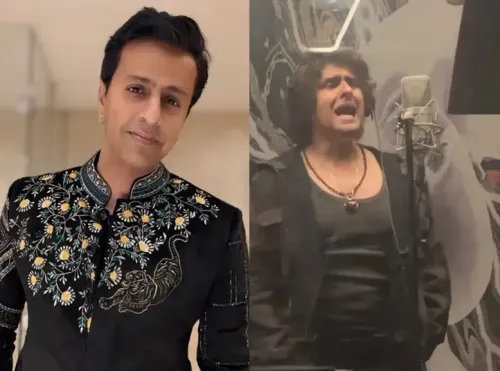
Sonu Nigam on singing in multiple languages: 'I kept SP Balasubrahmanyam in mind'

Synopsis
Sonu Nigam has revealed that learning to sing authentically in South Indian languages meant keeping S. P. Balasubrahmanyam in mind as a benchmark — and that the quality of the language coach matters just as much as the singer’s own effort. The insight comes as he releases ‘Chunni’, a Haryanvi track with Renuka Panwar, signalling a deliberate return to regional roots.
Key Takeaways
Balasubrahmanyam as his benchmark when first recording in South Indian languages .
He emphasised that authentic multilingual singing requires both personal effort and a skilled language guide.
Nigam warned that a poorly versed coach can lead to phonetically incorrect recordings regardless of the singer’s hard work.
His latest release is a Haryanvi track titled ‘Chunni’ , co-sung with Renuka Panwar and penned by Aamin Barodi .
The music video of ‘Chunni’ features Charmee Zaveri .
Veteran playback singer Sonu Nigam has opened up about the challenges of singing in unfamiliar languages, revealing that he looked to the late legendary vocalist S. P. Balasubrahmanyam as his guiding reference when he first ventured into South Indian film music. The singer spoke candidly about the dual effort required — personal preparation and reliance on a knowledgeable language coach — to deliver authentic multilingual performances.
The Art of Sounding Authentic
Nigam explained that singing in a language one does not natively speak demands a layered approach. “First of all, it depends on the singer’s capability to imbibe a style. When I first sang songs in the South Indian languages, I kept S. P. Balasubrahmanyam in my mind,” he said.
The singer noted that authenticity in an unfamiliar tongue is not something that comes from effort alone. The quality of the person guiding the singer through phonetics and pronunciation plays an equally critical role. “If that person is not well-versed in the language, which is very much possible, then we will obviously sing in incorrect language,” Nigam added.
Why the Guide Matters as Much as the Singer
Nigam’s insight points to a lesser-discussed aspect of the Indian film music industry: the role of language coaches and music directors in shaping cross-regional recordings. For a playback singer working across Hindi, Tamil, Telugu, Kannada, Malayalam, and regional folk traditions, the margin for phonetic error is narrow and can affect audience reception significantly.
He stressed that the responsibility is shared — “some efforts we have to put from our side and some we have to rely on the person teaching us.” This collaborative dynamic, he suggested, is what separates a passable multilingual recording from a genuinely immersive one.
Reconnecting with Roots: The Haryanvi Track 'Chunni'
The conversation comes as Nigam has recently released a Haryanvi track titled 'Chunni', marking a return to his regional roots. The song is a joint effort with singer Renuka Panwar, scored and penned by Aamin Barodi. The music video features Charmee Zaveri.
The release of ‘Chunni’ is notable in the context of Nigam’s multilingual career — it demonstrates the same principle he articulated: genuine engagement with a language’s cultural texture, rather than a surface-level rendering.
A Career Built on Linguistic Range
Over a career spanning more than three decades, Sonu Nigam has recorded songs in over a dozen languages, including Hindi, Urdu, Bengali, Kannada, Tamil, Telugu, Odia, Nepali, and Haryanvi. His ability to adapt tonal and phonetic registers across these languages has made him one of the most versatile voices in Indian playback singing.
His reference to S. P. Balasubrahmanyam — who himself recorded in multiple languages and was widely regarded as one of India’s greatest multilingual vocalists — underscores the depth of cross-regional musical influence that has shaped Nigam’s approach. As regional music continues to gain mainstream streaming traction, the craft of multilingual singing is likely to draw renewed attention.
Point of View
And the quality of regional-language output varies widely as a result. His invocation of S. P. Balasubrahmanyam is also telling: it reflects how a single artist’s body of work can become the de facto reference standard for an entire generation of singers working across linguistic borders. As streaming platforms push regional content aggressively, the craft of multilingual singing is commercially more relevant than ever — yet the infrastructure supporting it remains largely informal and word-of-mouth.
NationPress
26 Sept 2026
Frequently Asked Questions
How does Sonu Nigam approach singing in languages he doesn’t know?
Sonu Nigam says he focuses on imbibing the style of a reference artist and relies heavily on a knowledgeable language guide. He kept S. P. Balasubrahmanyam in mind when first recording in South Indian languages to sound as authentic as possible.
Why does Sonu Nigam say the language coach is so important?
According to Nigam, even maximum personal effort cannot compensate for a poorly versed language coach. If the guide is not fluent in the language, the singer will inevitably produce phonetically incorrect recordings, regardless of how hard they work.
What is Sonu Nigam’s latest song?
Sonu Nigam recently released a Haryanvi track titled ‘Chunni’, co-sung with Renuka Panwar. The song is scored and written by Aamin Barodi, and its music video features Charmee Zaveri.
In how many languages has Sonu Nigam sung?
Over his three-decade career, Sonu Nigam has recorded in more than a dozen languages including Hindi, Urdu, Bengali, Tamil, Telugu, Kannada, Odia, Nepali, and Haryanvi, making him one of India’s most versatile playback singers.
Who was S. P. Balasubrahmanyam and why did Sonu Nigam reference him?
S. P. Balasubrahmanyam was one of India’s most celebrated multilingual vocalists, having recorded in Tamil, Telugu, Hindi, Kannada, and several other languages. Nigam referenced him as the stylistic benchmark he aimed for when first venturing into South Indian film music.