AI will transform healthcare, BHU V-C tells PGIMER at 63rd Foundation Day
Synopsis
At PGIMER's 63rd Foundation Day, BHU Vice-Chancellor Ajit Kumar Chaturvedi issued a pointed challenge: India must stop consuming Western AI healthcare tools and start building its own — because algorithms trained on Western patients may simply not work for Indian ones. His warning lands as hospitals across the country race to adopt AI with little scrutiny of dataset origins.
Key Takeaways
BHU Vice-Chancellor Ajit Kumar Chaturvedi delivered the keynote on 'AI in Healthcare' at PGIMER Chandigarh's 63rd Foundation Day on 7 September .
He argued AI should augment doctors, not replace them, calling current successful deployments examples of 'AI helping doctors perform at their best.' He cautioned that AI systems trained on Western datasets may not reflect Indian disease patterns or patient populations.
India must shift from being a consumer of healthcare AI to a creator of India-specific solutions , he stressed.
PGIMER Director Vivek Lal announced the institute's bed capacity has grown from 2,200 to 3,000 following PM Modi's inauguration of two new centres on 17 July .
Patient savings through Ayushman Bharat and Amrit Pharmacy outlets run into crores, according to Lal.
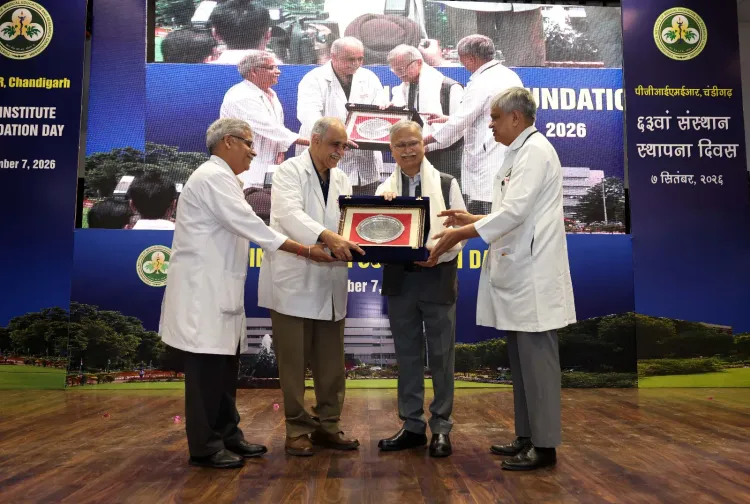
Banaras Hindu University (BHU) Vice-Chancellor Ajit Kumar Chaturvedi on 7 September declared that artificial intelligence will fundamentally reshape Indian healthcare — not by replacing doctors, but by dramatically expanding what they can know and do. Speaking as chief guest at the 63rd Foundation Day of the Postgraduate Institute of Medical Education and Research (PGIMER) in Chandigarh, Chaturvedi delivered the keynote address on the theme 'AI in Healthcare'.
AI as Enabler, Not Replacement
Chaturvedi was unequivocal that the most effective applications of AI in medicine are those that amplify physician capability rather than supplant it. 'The most successful healthcare deployments today are not examples of AI replacing doctors. They are examples of AI helping doctors perform at their best,' he said.
He underlined that AI has moved well past the stage of being a novelty or status symbol. 'AI is no more something like a fashionable toy or something that is a status symbol. It has made very deep inroads in the market, and naturally, we cannot be just watching it from a distance,' he told the gathering.
Expanding Knowledge and Research Frontiers
The BHU Vice-Chancellor highlighted AI's capacity to process vast volumes of clinical records, pathology reports, and scientific literature, enabling physicians to draw on a far wider knowledge base than was previously possible. 'The assistant does not replace expertise, but it dramatically expands the amount of knowledge a physician can effectively utilise,' he noted.
On the research front, Chaturvedi observed that AI is unlocking investigations that were once prohibitively expensive or time-consuming. 'The real transformation is that researchers can now ask questions that were previously too expensive or time-consuming to investigate,' he said. He also pointed to AI's growing role in radiology, hospital management, remote healthcare delivery, and evidence-based clinical decision-making, while acknowledging that complex physical tasks such as surgery remain an area requiring further development.
A Warning on Western Datasets
Chaturvedi struck a cautionary note on the uncritical adoption of AI tools built primarily on Western medical data. 'AI systems trained predominantly on Western datasets may not adequately reflect Indian disease patterns, patient populations and clinical practices,' he said. He stressed that India must transition from being a consumer of healthcare AI to becoming a creator of solutions grounded in Indian realities — a call that carries particular weight given the country's distinct epidemiological profile and resource constraints.
He also outlined how medical education itself will need to evolve, with greater emphasis on clinical judgement, critical thinking, evidence evaluation, and patient communication, rather than rote memorisation. Looking ahead, he described a generational arc for AI: 'The first generation of AI helped humans find information. The next generation is helping humans make decisions. The generation after that will help humans take action.'
PGIMER's Growth and PM Modi's Boost
Earlier at the event, PGIMER Director Vivek Lal highlighted the institute's significant expansion in recent months. He noted that Prime Minister Narendra Modi inaugurated two major facilities on 17 July — the Advanced Mother and Child Centre and the Advanced Neuroscience Centre — adding 800 beds to the institute's capacity. 'From 2,200 beds, we have 3,000 beds now for taking care of our patients,' Lal said.
Lal also spoke of PGIMER's commitment to affordable healthcare, citing the reach of Ayushman Bharat and the availability of low-cost generic medicines through Amrit Pharmacy outlets. He noted that patient savings through these initiatives run into crores, particularly for those undergoing treatment for serious or prolonged illnesses. Chaturvedi, for his part, described PGIMER as 'a true national asset — not limited to one region, but making a significant contribution to healthcare, education, research and innovation across the country.'
Point of View
Genetic diversity, and clinical infrastructure differ sharply from the populations on which most commercial medical AI has been trained, raising real questions about diagnostic accuracy and algorithmic bias. The call for India to become a creator rather than a consumer of healthcare AI is not new, but it gains urgency as hospitals adopt tools with minimal scrutiny of their training data. PGIMER's own expansion to 3,000 beds is a welcome development, but bed count alone does not resolve the deeper challenge of equipping a stretched healthcare workforce with tools that actually reflect the patients they serve.
NationPress
24 Oct 2026
Frequently Asked Questions
What did BHU Vice-Chancellor Ajit Kumar Chaturvedi say about AI in healthcare?
Chaturvedi said AI will fundamentally transform healthcare by expanding what doctors can know and do, rather than replacing them. Speaking at PGIMER Chandigarh's 63rd Foundation Day on 7 September, he described the most successful AI deployments as those that help doctors perform at their best, not those that substitute clinical judgement.
Why did Chaturvedi warn against using Western AI tools in Indian healthcare?
He cautioned that AI systems trained predominantly on Western datasets may not adequately reflect Indian disease patterns, patient populations, or clinical practices. He urged India to move from being a consumer of healthcare AI to a creator of solutions rooted in Indian realities.
What is PGIMER's current bed capacity after the recent expansion?
PGIMER Chandigarh now has 3,000 beds, up from 2,200, following the inauguration of the Advanced Mother and Child Centre and the Advanced Neuroscience Centre by Prime Minister Narendra Modi on 17 July. The two new centres together added 800 beds.
How is PGIMER making healthcare affordable for patients?
PGIMER Director Vivek Lal highlighted the role of Ayushman Bharat coverage and Amrit Pharmacy outlets offering generic medicines at low cost. He noted that patient savings through these schemes run into crores, particularly for those undergoing treatment for serious or prolonged illnesses.
How will AI change medical education, according to Chaturvedi?
Chaturvedi said medical education will increasingly prioritise clinical judgement, evidence evaluation, critical thinking, and patient communication over rote memorisation. He also outlined a three-generation arc for AI: from finding information, to aiding decisions, to eventually enabling action.