White House: 198 Democrats Vote Against Stock Trading Ban for Congress
Synopsis
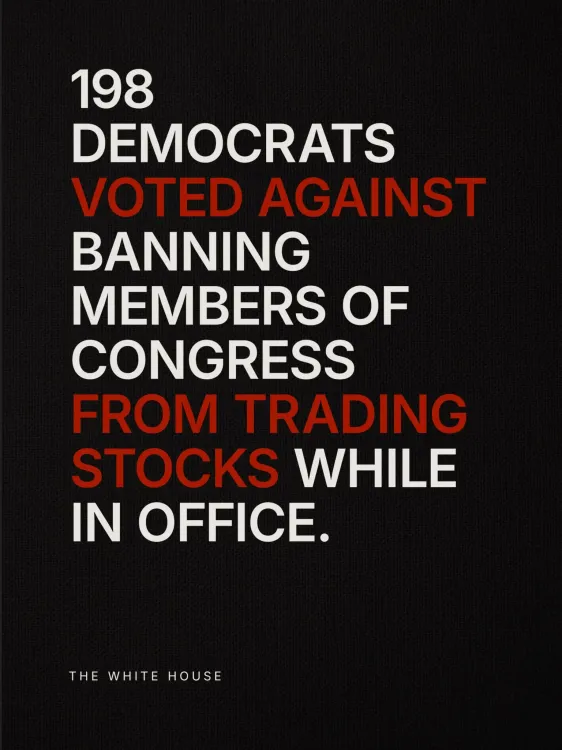
The White House has declared that 198 Democrats voted against the Stop Insider Trading Act, a bill banning Congress members from personally trading stocks while in office. The executive branch called the vote 'shameful,' reigniting a long-running debate over conflicts of interest in the US legislature.
Key Takeaways
198 Democrats voted against the Stop Insider Trading Act , according to a post by the official White House account on 23 July 2026 .
The bill would have banned sitting members of Congress from trading individual stocks while holding office.
The White House publicly labelled the vote 'shameful,' signalling executive-branch intent to sustain pressure on the legislature.
The existing STOCK Act of 2012 requires congressional stock-trade disclosures within 45 days but does not prohibit trading.
Legislative efforts to ban congressional stock trading have repeatedly stalled, typically advancing only as disclosure mandates rather than outright bans.
A companion bill in the Senate or an amended House vote remains the next procedural step to watch.
The White House declared on Wednesday, 23 July 2026 that 198 Democrats voted against the Stop Insider Trading Act, a bill that would prohibit sitting members of Congress from trading individual stocks while in office, calling the outcome 'shameful.'
Context
The official White House account posted on X that the vote represented a significant defeat for the proposed legislation. The post stated: 'BREAKING: 198 Democrats just voted against the Stop Insider Trading Act, which bans members of Congress from trading stocks while in office. Shameful.' The bill, if enacted, would have imposed one of the strictest curbs on congressional financial activity in recent American legislative history.
The Stop Insider Trading Act targets a long-standing concern in Washington DC: that elected legislators can exploit non-public policy information to profit on financial markets while simultaneously shaping the laws that affect those same markets.
Policy Backdrop
Congressional stock trading has been a recurring flash point in United States governance debates. The landmark STOCK Act of 2012 required members of Congress to disclose personal stock trades within 45 days, a transparency measure designed to deter abuse of insider knowledge — but it stopped short of an outright ban.
Since then, reform advocates have repeatedly pushed for stronger restrictions, arguing that disclosure alone is insufficient when members continue to trade freely. Legislative efforts have typically advanced through disclosure mandates rather than prohibitions, and votes on such measures have frequently split along partisan lines, even when bills carried bipartisan sponsorship at the drafting stage.
Stakeholders and Impact
The primary stakeholders in this debate are sitting members of Congress, whose personal investment portfolios would be directly constrained by the proposed ban, and the broader American public, which polls have consistently shown supports restrictions on congressional trading. Critics of the current system argue that legislators face an inherent conflict of interest when they can personally benefit from policy decisions they vote on.
The Democratic Party, whose members accounted for the reported votes against the measure, has faced internal divisions on the issue. Supporters of the bill argue that an outright ban is the only credible path to restoring public trust, while opponents have raised concerns about constitutional rights and practical implementation, including how to handle assets held in family members' names.
What's Next
Attention now turns to whether a companion bill will advance in the Senate or whether the House will revisit the legislation after potential amendments. Past reform cycles have shown that high-profile votes against anti-trading measures often generate renewed public pressure, sometimes prompting revised versions of the same legislation to re-enter the chamber within the same congressional session.
The White House's decision to publicly label the vote 'shameful' signals that the executive branch intends to keep pressure on Congress on this issue, potentially making it a defining political contrast heading into the next electoral cycle.
Point of View
Transforming a legislative procedural outcome into a public accountability narrative. By spotlighting Democratic opposition to an anti-corruption measure, the executive branch attempts to occupy the moral high ground on a reform issue that enjoys broad public support across party lines. This fits a broader pattern in which stock-trading restrictions have become a potent political weapon — the side opposing the ban absorbs reputational damage regardless of the legal or constitutional merits of their position. Whether the bill advances or stalls, the vote itself has already been converted into campaign-ready messaging.
NationPress
21 Oct 2026
Frequently Asked Questions
What is the Stop Insider Trading Act?
The Stop Insider Trading Act is proposed US legislation that would prohibit sitting members of Congress from buying or selling individual stocks during their term in office, going further than the existing STOCK Act of 2012, which only required disclosure of trades.
Why did 198 Democrats vote against the stock trading ban?
The White House post does not detail the reasons given by those who voted against the bill. Historically, opponents of such measures have cited concerns about constitutional rights, implementation challenges, and the adequacy of existing disclosure requirements.
Is it currently illegal for US Congress members to trade stocks?
No, it is not illegal for members of Congress to trade individual stocks. The STOCK Act of 2012 requires them to disclose trades within 45 days and prohibits trading on material non-public information, but does not impose an outright ban.
What was the STOCK Act of 2012?
The STOCK Act of 2012 was a US law that mandated members of Congress disclose personal stock trades within 45 days, aiming to curb the use of insider policy knowledge for personal financial gain. It did not ban trading outright.
What happens next after the Stop Insider Trading Act vote?
Observers are watching for a possible companion bill in the Senate or a revised version of the House legislation. The White House's public criticism of the vote is expected to sustain political pressure on Congress to revisit the measure.