31 rights groups demand Pakistan free Pashtun defender Idris Khattak after 7 years

Synopsis
Seven years after Pashtun rights defender Idris Khattak vanished in Pakistan, 31 international organisations — armed with a November 2025 UN ruling confirming arbitrary detention — are now demanding democratic governments weaponise trade access, specifically the EU's GSP+ programme, to force his release. The case epitomises a broader crisis of military-court impunity in Pakistan's former tribal belt.
Key Takeaways
31 organisations , including Freedom House and FIDH , jointly demanded the release of Idris Khattak on the seventh anniversary of his detention, 13 November 2026 .
Khattak was abducted on 13 November 2019 ; Pakistani authorities did not acknowledge his custody for seven months .
A Pakistani military court convicted him in late 2021 under the Official Secrets Act , sentencing him to 14 years after a secret trial with alleged due process violations.
The UN Working Group on Arbitrary Detention confirmed in November 2025 that his detention is arbitrary and violates his freedom of expression.
Rights groups are urging the EU to condition GSP+ trade benefits on Pakistan releasing detained human rights defenders.
Khattak's health has 'deteriorated significantly' due to untreated diabetes ; Pakistani authorities have denied him an independent medical examination.
Thirty-one international human rights organisations — including Freedom House, the Human Rights Commission of Pakistan, Front Line Defenders, Physicians for Human Rights, and the International Federation for Human Rights (FIDH) — have issued a joint statement calling for the immediate and unconditional release of Pashtun human rights defender Idris Khattak, who has been held in Pakistan since 13 November 2019. The statement was timed to mark the seventh anniversary of his detention.
Who Is Idris Khattak
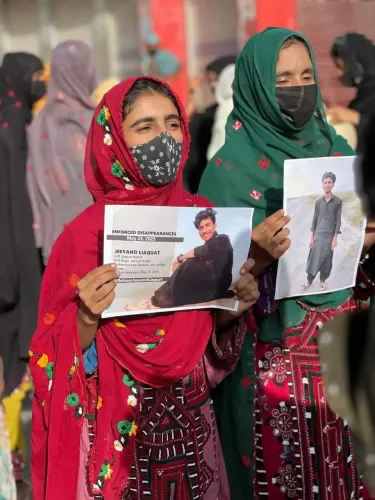
Idris Khattak is described in the joint statement as 'a well-known Pashtun human rights defender who spent decades documenting human rights abuses, including enforced disappearances, in Pakistan's Khyber Pakhtunkhwa Province and the former Federally Administered Tribal Areas.' On 13 November 2019, he was abducted and forcibly disappeared. For the following seven months, his family had no knowledge of whether he was alive.
Secret Trial and 14-Year Sentence
In June 2020, Pakistani authorities acknowledged for the first time that Khattak was in the custody of the country's military intelligence service. In late 2021, a military court convicted him of violating the Official Secrets Act and sentenced him to 14 years in prison. The joint statement alleged 'egregious due process violations': the trial was conducted in secret, Khattak was denied access to legal counsel, a forced confession was introduced as evidence, the prosecution relied on secret evidence never disclosed to the defence, and key defence witnesses were barred from testifying.
Deteriorating Health and Denied Medical Care
The signatory organisations expressed particular alarm over Khattak's health. He reportedly suffers from diabetes, and the groups say Pakistani authorities have denied him an independent medical examination as well as adequate medication and treatment. 'His health has deteriorated further,' the statement noted, referencing concerns previously raised by UN experts in April. The organisations urged that Pakistan's denial of appropriate medical care be treated as an additional human rights violation.
UN Finding and Trade Programme Pressure
In November 2025, the UN Working Group on Arbitrary Detention formally confirmed that Khattak's detention is arbitrary and in violation of his right to freedom of expression — lending multilateral legal weight to the campaign for his release. The coalition is now pressing democratic governments to 'forcefully demand' his freedom and is calling on the European Union to condition Islamabad's access to the GSP+ trade programme on the release of detained human rights defenders, including Khattak. The EU's GSP+ status grants preferential tariff access to developing countries that commit to upholding core human rights conventions.
Broader Context
Khattak's case sits within a wider pattern of enforced disappearances and military-court proceedings targeting activists and journalists in Pakistan, particularly those documenting abuses in the former tribal belt. Rights groups have repeatedly raised concerns that military courts lack the independence and transparency required under international fair-trial standards. This comes amid sustained international scrutiny of Pakistan's human rights record ahead of periodic reviews at multilateral bodies.
Point of View
The coalition's statement, however large, risks becoming another anniversary document that Islamabad can absorb without cost.
NationPress
14 Nov 2026
Frequently Asked Questions
Who is Idris Khattak and why is he in prison in Pakistan?
Idris Khattak is a Pashtun human rights defender who documented enforced disappearances and abuses in Khyber Pakhtunkhwa and Pakistan's former tribal areas. He was abducted on 13 November 2019, held secretly for seven months, and later convicted in a military court under the Official Secrets Act and sentenced to 14 years in prison following a trial that rights groups say was marred by serious due process violations.
What did the UN say about Idris Khattak's detention?
In November 2025, the UN Working Group on Arbitrary Detention formally determined that Khattak's detention is arbitrary and violates his right to freedom of expression. This ruling adds multilateral legal authority to the international campaign demanding his release.
Why are rights groups calling for EU GSP+ conditionality on Pakistan?
The EU's GSP+ programme grants Pakistan preferential trade access in exchange for commitments to uphold core human rights conventions. Rights organisations argue that Pakistan's continued detention of activists like Khattak breaches those commitments, and are urging the EU to suspend or threaten that access until detained human rights defenders are freed.
What due process violations occurred during Khattak's military trial?
According to the joint statement by 31 organisations, Khattak's trial was held in secret, he was denied access to legal counsel, a forced confession was introduced as evidence, the prosecution relied on undisclosed secret evidence, and he was not permitted to call key defence witnesses. Rights groups say these violations render the conviction illegitimate under international fair-trial standards.
What is the current state of Idris Khattak's health?
Khattak suffers from diabetes, and his health has reportedly deteriorated significantly because Pakistani authorities have denied him an independent medical examination and appropriate medication. UN experts raised this concern in April, and the 31 signatory organisations flagged it again on the seventh anniversary of his detention in November 2026.