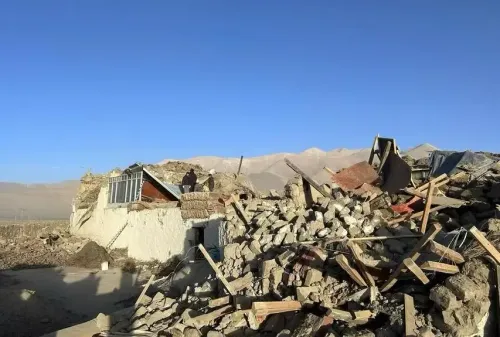
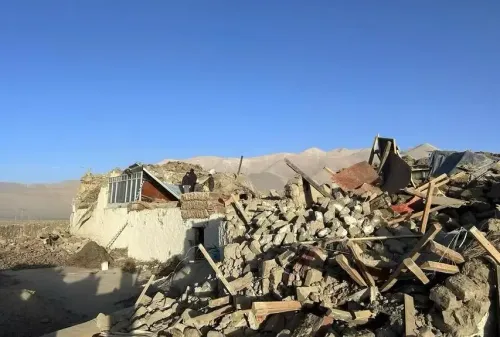
Four earthquakes hit China, Tibet, Nepal within hours on 31 July

Synopsis
Four earthquakes rattled the Himalayan belt — spanning China, Tibet, and Nepal — within a two-hour window in the early hours of 31 July 2026. The strongest, a magnitude 4.5 in China at just 10 km depth, raised the most concern, though no casualties or damage were reported. The cluster underscores the relentless seismic pressure building along the Indian-Eurasian plate boundary.
Key Takeaways
The National Center for Seismology (NCS) recorded four earthquakes across China , Tibet , and Nepal between 11:25 pm IST on 30 July and 1:44 am IST on 31 July 2026 .
The strongest tremor was a magnitude 4.5 quake in China at a depth of 10 kilometres .
Two Tibet earthquakes measured magnitude 4.3 (depth 130 km ) and magnitude 4.2 (depth 90 km ); a Nepal tremor registered magnitude 3.4 at 15 km depth.
No casualties, structural damage, tsunami warnings, or emergency advisories were reported as of Friday morning.
The Himalayan belt is one of the world's most seismically active zones due to the collision of the Indian and Eurasian tectonic plates .
Four earthquakes struck across China, Tibet, and Nepal within roughly two hours in the early hours of 31 July 2026, according to the National Center for Seismology (NCS). The strongest tremor, measuring magnitude 4.5, was recorded in China at 1:44 am IST. No casualties or significant damage were reported from any of the four events.
The Four Earthquakes at a Glance
The seismic sequence began late on Thursday, 30 July, when the NCS detected a magnitude 4.3 earthquake in Tibet at 11:25 pm IST, at a depth of 130 kilometres and coordinates 30.379°N, 85.789°E. Less than 90 minutes later, at 12:50 am IST on Friday, a magnitude 4.2 quake struck Tibet again at a shallower depth of 90 kilometres, centred near 29.068°N, 86.402°E.
At 1:18 am IST, a magnitude 3.4 tremor was recorded in Nepal at a depth of 15 kilometres, near 27.102°N, 87.514°E. The sequence concluded at 1:44 am IST with the strongest event — a magnitude 4.5 quake in China at a depth of just 10 kilometres, located near 35.259°N, 99.716°E.
No Damage or Casualties Reported
Authorities in China, Tibet, and Nepal had not issued any emergency updates as of Friday morning. There were no tsunami warnings or emergency advisories linked to any of the four tremors. The NCS, which posted real-time alerts on X (formerly Twitter), also directed users to download the BhooKamp App for further seismic updates.
Why the Himalayan Belt Is Prone to Frequent Tremors
The cluster of earthquakes is consistent with the geological character of the region. The Himalayan belt — encompassing Nepal, Tibet, and adjoining parts of China — ranks among the world's most seismically active zones, driven by the ongoing collision between the Indian and Eurasian tectonic plates. This convergence generates persistent stress along fault lines, producing earthquakes of varying depth and intensity on a near-daily basis.
Notably, the depth variation across Friday's four events — ranging from 10 km to 130 km — reflects the complex, layered fault architecture of the region. Shallower quakes, such as the magnitude 4.5 event in China at 10 km depth, typically carry a higher potential for surface impact even at lower magnitudes, while deeper events tend to dissipate energy before reaching populated areas.
What Comes Next
Seismologists routinely monitor such clusters for aftershock sequences, particularly when multiple events occur within a short window. Given the absence of damage reports and the sub-5.0 magnitudes involved, no elevated alert status has been declared. Residents in high-risk zones across the Himalayan region are advised to follow updates from national disaster management authorities.
Point of View
Yet both tend to get filed under 'no damage reported' and forgotten. The real story is systemic: India, Nepal, and China's early-warning infrastructure is uneven across this belt, and the next major rupture — geologists broadly agree one is overdue in the central Himalayas — will test those gaps severely.
NationPress
15 Sept 2026
Frequently Asked Questions
How many earthquakes struck the Himalayan region on 31 July 2026?
Four earthquakes were recorded across China, Tibet, and Nepal between 11:25 pm IST on 30 July and 1:44 am IST on 31 July 2026, according to the National Center for Seismology. The magnitudes ranged from 3.4 to 4.5.
Which was the strongest earthquake in the 31 July 2026 cluster?
The strongest tremor was a magnitude 4.5 earthquake in China, recorded at 1:44 am IST on 31 July 2026, at a depth of 10 kilometres near coordinates 35.259°N, 99.716°E. No damage was reported from the event.
Were there any casualties or damage from these earthquakes?
No casualties or significant structural damage were reported following any of the four earthquakes. Authorities in China, Tibet, and Nepal had not issued emergency advisories or tsunami warnings as of Friday morning.
Why does the Himalayan region experience so many earthquakes?
The Himalayan belt is among the world's most seismically active zones because of the ongoing collision between the Indian and Eurasian tectonic plates. This tectonic convergence generates persistent stress along fault lines, resulting in frequent earthquakes of varying depth and intensity.
What does the depth variation in these earthquakes indicate?
The four quakes ranged in depth from 10 km to 130 km, reflecting the complex fault architecture of the region. Shallower earthquakes, like the magnitude 4.5 event at 10 km depth, generally carry a higher potential for surface impact, while deeper events tend to dissipate energy before reaching populated areas.