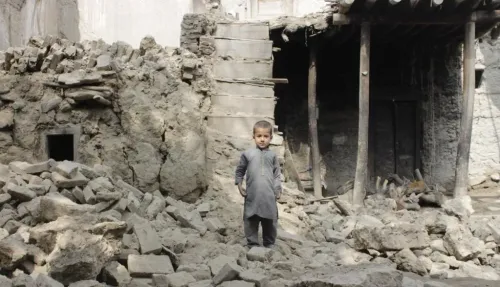
Tragic Earthquake Claims Eight Lives in Northern Afghanistan
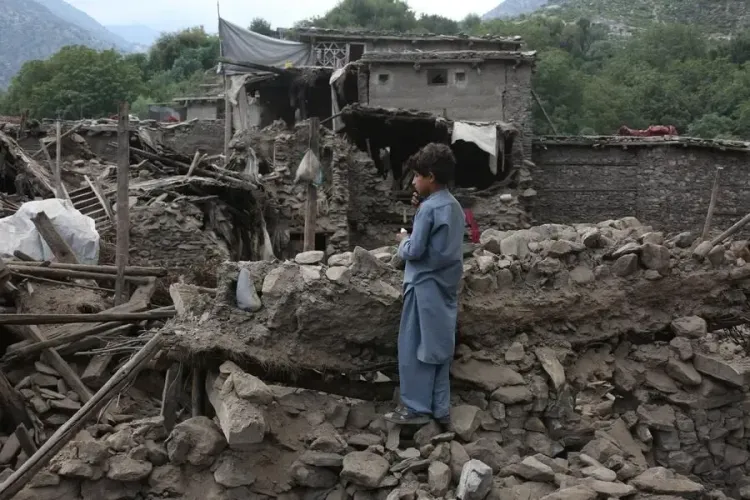
Synopsis
A powerful earthquake in northern Afghanistan has tragically resulted in the deaths of eight individuals. The quake, registering a magnitude of 5.9, caused significant destruction, particularly in Kabul province. Residents across several regions felt the tremors, leading to widespread panic. This incident underscores Afghanistan's vulnerability to natural disasters.
Key Takeaways
Eight lives lost in a 5.9-magnitude earthquake.
Epicenter located at 36.55° N latitude and 70.85° E longitude.
Tremors felt as far as North India, causing panic.
Afghanistan prone to frequent and deadly earthquakes.
Average earthquake damages in Afghanistan reach $80 million yearly.
Kabul, April 4 (NationPress) - A devastating 5.9-magnitude earthquake has resulted in the deaths of at least eight individuals in northern Afghanistan, as reported by Mohammad Yousuf Hammad, spokesperson for the Afghanistan National Disaster Management Authority.
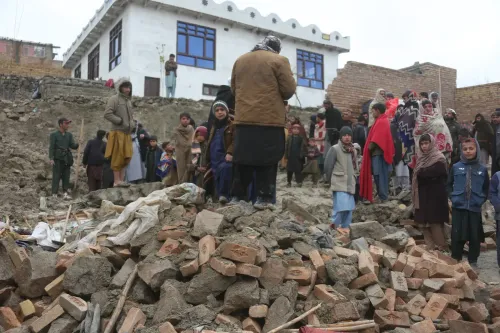
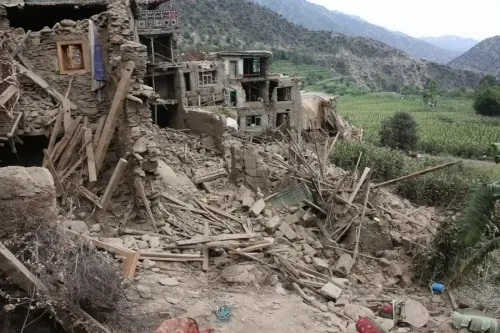
Following the earthquake, a house in Kabul province collapsed, causing fatalities among eight residents and injuring a child, Hammad disclosed late Friday evening.
The tremors were also felt strongly in the capital city, Kabul. The epicenter of the quake, located at a depth of 186.4 km, was initially identified at coordinates 36.55° N latitude and 70.85° E longitude, according to Xinhua news agency.
Residents in regions such as Delhi-NCR and various parts of North India experienced the tremors on Friday night, leading to widespread panic as people rushed out of buildings and homes.
Reports of the tremors came from numerous locations, including Delhi, Noida, Gurugram, Ghaziabad, Faridabad, and parts of Uttar Pradesh and Haryana, among others.
Many residents described sudden jolts while seated, with furniture and hanging items swaying. The shaking lasted for several seconds but was strong enough to be distinctly felt indoors.
As a safety measure, individuals in multiple residential areas exited their homes, while office workers temporarily evacuated their buildings. Many gathered in open spaces, awaiting further information.
Afghanistan is highly susceptible to various natural disasters, with earthquakes being particularly deadly, claiming an average of 560 lives annually and causing yearly damages estimated at $80 million. Studies reveal that over 355 earthquakes with a magnitude above 5.0 have occurred in Afghanistan since 1990.
Geographically, Afghanistan is situated on the edge of the Eurasian tectonic plate, sharing a transgression zone with the Indian plate, thus contributing to its seismic activity. The region is also influenced by the Arabian plate to the south, making it one of the most tectonically active areas globally.
The northward movement of the Indian plate and its interaction with the Eurasian plate is primarily responsible for the frequent earthquakes experienced in Afghanistan.
Regions in eastern and northeastern Afghanistan, particularly along the borders with Uzbekistan, Tajikistan, and Pakistan, are especially vulnerable to quakes.
This includes the densely populated Kabul, which suffers the highest estimated damages from earthquakes, averaging $17 million each year, as per studies.
Earthquakes in Afghanistan's mountainous regions can also trigger landslides, intensifying the loss of life and property.
Point of View
It's crucial to acknowledge the severe impact of the recent earthquake in northern Afghanistan. The loss of life and destruction of property highlight the country's ongoing vulnerability to natural disasters. Our thoughts are with the affected families and communities during this challenging time.
NationPress
20 Sept 2026
Frequently Asked Questions
What was the magnitude of the earthquake in Afghanistan?
The earthquake that struck northern Afghanistan registered a magnitude of 5.9.
How many people were killed in the earthquake?
At least eight individuals lost their lives due to the earthquake.
Where was the epicenter of the earthquake located?
The epicenter was determined to be at 36.55° N latitude and 70.85° E longitude, with a depth of 186.4 km.
Which regions felt the tremors from the earthquake?
Tremors were felt in various parts of North India, including Delhi, Noida, Gurugram, and Ghaziabad.
What are the historical impacts of earthquakes in Afghanistan?
Afghanistan experiences an average of 560 earthquake-related deaths annually, with significant damages estimated at $80 million each year.