Amish Shah vs Jay Feely: Arizona's CD-1 swing seat draws Trump's full weight
Synopsis
Trump is personally backing his longtime friend and golf partner Jay Feely in Arizona's CD-1, with over $22 million in Republican outside money flooding the race. Yet both Cook Political Report and Inside Elections rate the seat 'lean Democratic' — meaning Indian-American physician Amish Shah may be on the cusp of flipping a district he lost by 3.8 points just two years ago.
Key Takeaways
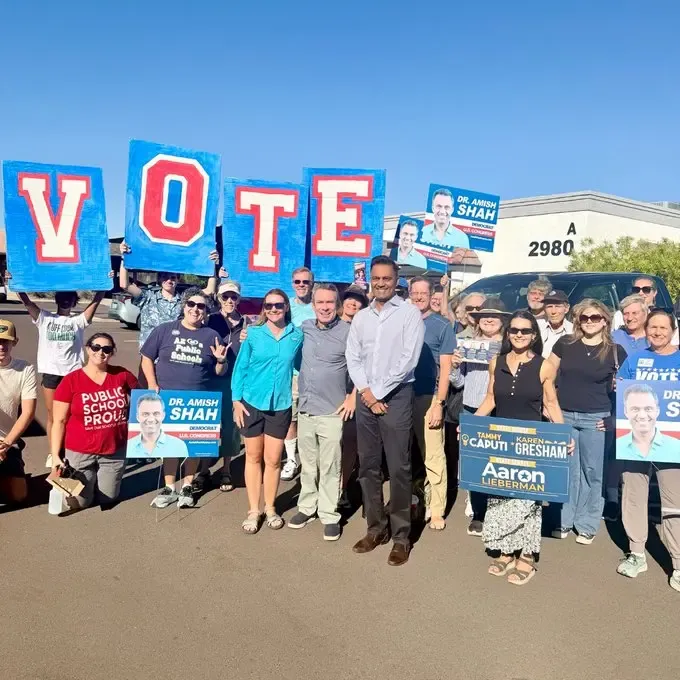
Amish Shah , an Indian-American emergency room physician and former Arizona legislator, faces Republican Jay Feely in Arizona's 1st Congressional District on 3 November .
President Donald Trump has known Feely 'for decades as a friend and golf partner' and is backing him with a last-minute campaign push.
Republican groups have spent more than $22 million to boost Feely, including $5.72 million from the MAGA Inc.-funded Safety & Affordability PAC against Shah.
The Cook Political Report rates the race 'lean Democratic'; Inside Elections calls it 'tilt Democratic', despite a Republican registration advantage of 38% to 26% -plus.
Shah lost the same district to Republican David Schweikert by 3.8 points in 2024 ; independent voter turnout is seen as the decisive factor.
The last day for Arizona voters to request an early ballot was 23 October .
Indian-American Democrat Amish Shah is locked in one of the most closely watched congressional contests of the 2026 cycle, facing Republican Jay Feely — a former NFL kicker and longtime friend and golf partner of President Donald Trump — in Arizona's 1st Congressional District. With the general election set for 3 November, Trump and his allies are making a last-minute push to deliver the seat for Feely.
Trump's Personal Stake in the Race
According to Politico, Trump has known Feely 'for decades as a friend and golf partner' and views the former Arizona Cardinals kicker as a formidable candidate. Two Trump officials familiar with their relationship confirmed the president's personal investment in the outcome. Republican groups have poured more than $22 million into boosting Feely's campaign, with much of that spending concentrated in the final weeks of the race.
Notably, Feely — a longtime Gilbert resident — originally entered the 5th district race before switching to the 1st district at Trump's urging, according to reports.
Who Is Amish Shah
Amish Shah is an emergency room physician and former Arizona state legislator. He previously contested the same district in 2024, losing to Republican David Schweikert by 3.8 percentage points. The district covers Scottsdale, parts of northeast Phoenix, Fountain Hills, and Cave Creek — a suburban belt with a Republican registration edge but a significant independent voter bloc.
The Data Centre Clash at the Debate
The two candidates clashed sharply over data centres at a recent Clean Elections debate. Shah argued that his constituents have made their opposition clear. 'When I'm talking to the voters, what they have said to me clearly is they don't want them in CD-1,' he said.
Feely pushed back on the economic case. 'They add about a billion dollars in revenue to the state of Arizona. That's giving you the opportunity to increase teacher's pay,' he said. He also accused Shah of inconsistency, noting that Shah had previously voted for the tax credits that brought data centres to the state. 'I think it's really hypocritical for you to stand up here and say to the voters that you're now against data centers,' Feely said.
Shah attributed his position shift to the rise of artificial intelligence and its energy demands. 'However, when the situation changes and suddenly you've got massive amounts of people applying as we have seen, and you see that you're going to double the amount of wattage that these things are going to take. You're going to have to think about the ratepayers,' he said.
How Outside Money Is Shaping the Race
Federal filings reveal heavy outside spending on both sides. The MAGA Inc.-funded Safety & Affordability PAC has spent $5.72 million against Shah, while the House Majority PAC has deployed $4.41 million against Feely. Total Republican-aligned spending exceeds $22 million, reflecting the national stakes attached to this seat.
Ratings and Voter Math
Despite Republicans holding a registration advantage — making up 38% of voters against 26%-plus Democrats and 35% independents or third-party registrants — both the Cook Political Report and Inside Elections currently favour Shah, rating the race 'lean Democratic' and 'tilt Democratic' respectively.
Pollster Marcus Dell'Artino told the Arizona Capitol Times: 'If independents show up in big numbers, it favors Shah. If they don't, it favors Feely.' The last day for Arizona voters to request an early ballot was 23 October, tightening the window for both campaigns. All eyes now turn to 3 November.
Point of View
By registration, should be a safe hold. That is an admission of structural vulnerability, not a show of strength. Shah's near-miss in 2024 against an incumbent has made him a credible threat, and Feely's last-minute district-switch at Trump's urging signals the GOP knows it cannot win on autopilot. The data-centre clash also surfaces something broader: suburban Arizona voters are increasingly asking energy-cost questions that neither party has clean answers to. Whoever wins, this race will be read as a referendum on how much Trump's personal brand can move a suburban district that has already begun drifting away from the party.
NationPress
24 Oct 2026
Frequently Asked Questions
Who is Amish Shah and why is he significant in the Arizona race?
Amish Shah is an Indian-American emergency room physician and former Arizona state legislator running as the Democratic candidate in Arizona's 1st Congressional District. He narrowly lost the same seat to Republican David Schweikert by 3.8 points in 2024, making him a credible challenger in a district that election analysts now rate as leaning Democratic.
Who is Jay Feely and what is his connection to Donald Trump?
Jay Feely is a former NFL kicker who played for the Arizona Cardinals and is the Republican candidate in Arizona's CD-1. President Donald Trump has known him for decades as a personal friend and golf partner, and Trump is actively backing his campaign in the final stretch of the race.
How much money has been spent on the Arizona CD-1 race?
Republican-aligned groups have spent more than $22 million to boost Feely, including $5.72 million from the MAGA Inc.-funded Safety & Affordability PAC targeting Shah. On the other side, the House Majority PAC has spent $4.41 million against Feely.
What do election forecasters say about the Arizona CD-1 race?
Despite Republicans holding a 38% voter registration advantage against just over 26% for Democrats, the Cook Political Report rates the race 'lean Democratic' and Inside Elections calls it 'tilt Democratic'. Independent voter turnout is widely seen as the deciding factor.
When is the Arizona general election and how can voters participate?
The general election in Arizona is on 3 November 2026. The deadline for voters to request an early ballot was 23 October 2026.