Is Indian American Doctor Tina Shah the Future of New Jersey Politics?
Synopsis
As Dr. Tina Shah steps into the political arena, her extensive medical background sheds light on critical healthcare issues. With her focus on systemic reform and patient advocacy, can she reshape New Jersey politics and bring forth much-needed change?
Key Takeaways
Tina Shah is running for Congress in New Jersey’s 7th District.
Her candidacy is fueled by her experiences in the healthcare system.
Shah aims to address systemic healthcare failures.
She advocates for greater representation for the Indian American community.
Her campaign has already surpassed $1 million in fundraising.
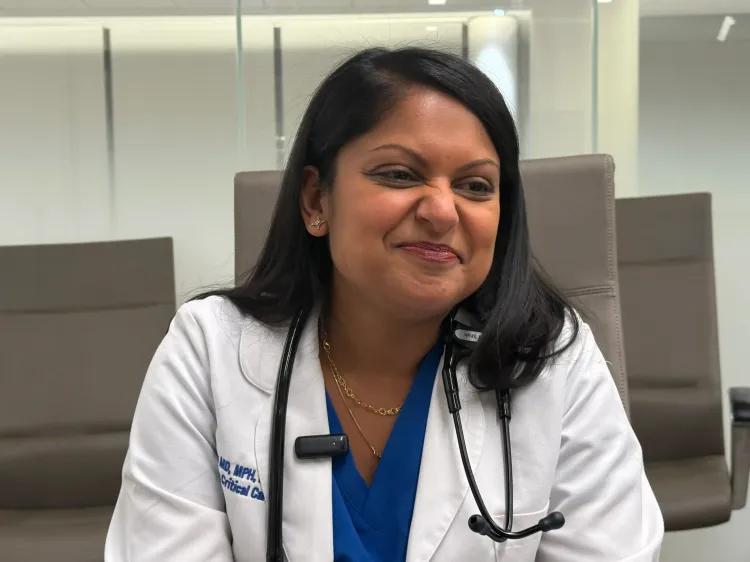
Washington, Jan 7 (NationPress) The journey of Indian American Dr. Tina Shah into the political arena is rooted in her extensive experience in intensive care units, where she provided care to patients whose health declined due to denied medications or delayed treatments.
Dr. Shah is now one of several Democrats vying for the party's nomination in New Jersey's 7th Congressional District, uniquely positioned as the only Indian American candidate. She contends that the systemic issues she witnessed in hospitals stem from decisions made by policymakers in Washington.
“I never envisioned myself running for office,” Dr. Shah remarked. “However, each day in practice reveals patients who suffer due to unaffordable medications or insurance denials for essential procedures,” she shared during an exclusive interview with IANS.
As a triple board-certified physician in internal medicine, pulmonary medicine, and critical care, Dr. Shah's choice to enter the political fray was influenced by her firsthand experiences with healthcare system failures. “Despite being in the US, our healthcare system is not adequate, and it requires reform,” she stated.
She believes that recent legislative decisions have exacerbated challenges for patients, particularly those with limited financial resources. Dr. Shah highlighted the adverse effects of Medicaid cuts and the removal of insurance subsidies for those obtaining plans through the Affordable Care Act exchanges.
“This year, many vulnerable individuals find themselves without health insurance,” she noted, indicating that Congress has not acted to reduce exorbitant drug prices or prevent insurance denials.
One particular case still resonates with her: a stable asthma patient required prior authorization for inhalers due to an insurance change. The denial led to the patient running out of medication and ultimately requiring ICU care on a ventilator. “This is unacceptable,” Dr. Shah emphasized.
This experience motivated her to engage in advocacy in New Jersey, where she collaborated with healthcare professionals and patients to mount a grassroots campaign against state-regulated insurance companies denying vital care.
Working alongside legislators, Dr. Shah reported that public pressure resulted in progress. “Now, if you have state-regulated insurance in New Jersey, you won't face denials for essential care,” she asserted, while advocating for similar protections at the national level.
Beyond her clinical practice, Dr. Shah has held significant policy positions in three White House administrations. As a senior advisor to the US Surgeon General, she contributed to the federal government’s inaugural strategy addressing clinician burnout. At the Department of Veterans Affairs, she served as the first National Director of Clinician Wellbeing, focusing on enhancing electronic medical records and expanding primary care access for veterans.
Transitioning to the private sector, she became the first chief clinical officer for a healthcare-focused artificial intelligence firm, where she aimed to alleviate administrative burdens on clinicians, allowing them more time with patients.
Dr. Shah has been vocal in her criticism of President Donald Trump’s healthcare policies. “His approach lacks concrete strategies and primarily aims to dismantle effective systems,” she stated, pointing to the removal of scientific experts from federal agencies and budget cuts to medical research. “How can we maintain our status as a superpower without investing in groundbreaking science and research?” she asked.
While recognizing Trump's attempts to negotiate lower drug prices, Dr. Shah noted that the results have been minimal. “A medication costing over $1,000 a month is still unaffordable,” she remarked, adding that tariff uncertainties have confused patients regarding their medication purchases.
Her candidacy is also influenced by her identity as a second-generation Indian American. She reflects on her family’s journey, with her parents migrating to North America in search of opportunities and prioritizing education for their children. “A defining characteristic of being Indian is our strong community, which supports one another,” she stated.
Despite the significant size and economic clout of the Indian American community in New Jersey, Dr. Shah expressed concern over the lack of political representation. She cited issues like the H-1B visa discourse and the uptick in hate crimes as reasons why Congress needs more diverse voices. “We need strong representatives in Congress to address our challenges,” she asserted.
Regarding hate crimes and immigration enforcement, Dr. Shah stated, “Such hate has no place in our society,” emphasizing the necessity for due process and equitable treatment under the law for all individuals.
She characterized New Jersey’s 7th District as pivotal for Democratic efforts to reclaim control of the House, noting that it is among a select few districts crucial for flipping the chamber. Dr. Shah has been critical of the incumbent Republican, Tom Kean Jr., whom she described as a career politician out of touch with constituents. “I’m calling him out, and I’m determined to defeat him,” she declared.
Her campaign has demonstrated strong early fundraising efforts, with her team reporting over $1 million raised—$1,017,000, to be precise. The campaign is framed around lowering family expenses, safeguarding reproductive rights, and enhancing healthcare access.
Juggling her medical practice and campaign efforts has been challenging, but Dr. Shah believes that maintaining her clinical work keeps her grounded. “Every day in practice allows me to engage with constituents and understand their struggles,” she noted. “As a physician, I am prepared to assist them.”
If elected, Dr. Shah would make history as the first Indian American to represent New Jersey in Congress. Currently, Indian Americans hold a limited number of seats in the House, which does not reflect the community's population or influence, she argues.
New Jersey’s 7th Congressional District, which encompasses several suburban areas with a notable Indian American demographic, is anticipated to be among the most scrutinized House races nationally, with significant implications for Congressional control.
Point of View
An experienced healthcare professional, seeks to translate her medical expertise into political action. Her candidacy emphasizes the importance of healthcare reform and representation for marginalized communities. As the political landscape evolves, the involvement of diverse candidates like Dr. Shah is crucial for addressing pressing national issues.
NationPress
26 Sept 2026
Frequently Asked Questions
Who is Dr. Tina Shah?
Dr. Tina Shah is an Indian American physician who is running for Congress in New Jersey's 7th District, advocating for healthcare reform and representation for marginalized communities.
What are Dr. Shah's main campaign issues?
Her campaign focuses on lowering healthcare costs, protecting reproductive rights, and expanding access to essential medical services.
Why is Dr. Shah's candidacy significant?
If elected, she would be the first Indian American to represent New Jersey in Congress, addressing the need for more diverse voices in politics.
What experiences influenced Dr. Shah's decision to run for office?
Years of witnessing systemic failures in healthcare, including patients suffering due to insurance denials, motivated her to seek political office.
How has Dr. Shah engaged in advocacy before her candidacy?
She has worked with healthcare professionals and legislators in New Jersey to combat insurance company practices that deny essential care.