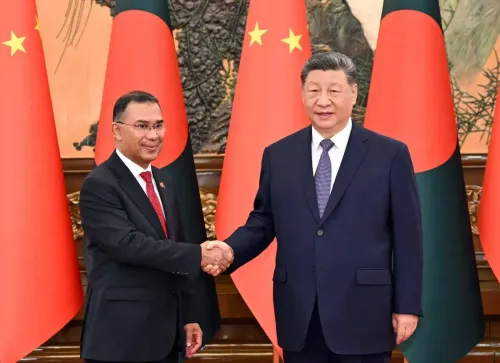
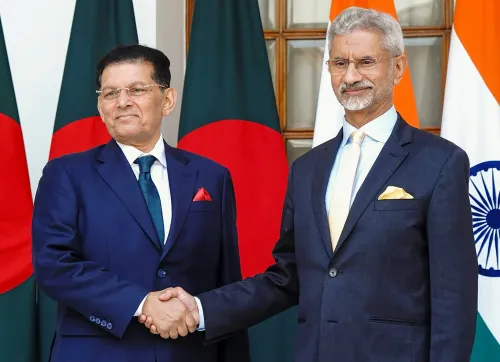
Bangladesh's New PM Maneuvers Trade Relations with US and China
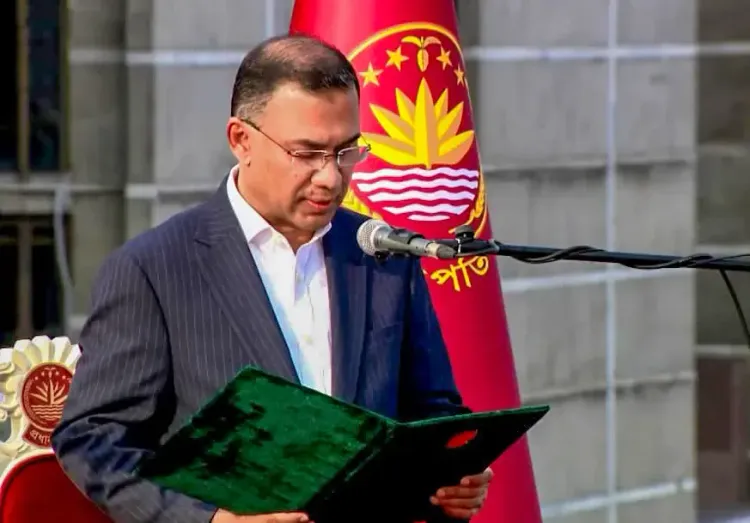
Synopsis
Bangladesh's new Prime Minister Tarique Rahman is navigating complex trade relations with the US and China, vital partners that offer contrasting benefits. This delicate balancing act poses significant challenges for the nation in the current geopolitical climate.
Key Takeaways
Bangladesh's new PM, Tarique Rahman, faces trade challenges.
US and China are both critical economic partners.
US offers market access and security; China provides infrastructure.
Compliance with US trade agreements is crucial for Bangladesh.
China's influence is deeply embedded in Bangladesh's manufacturing sector.
New Delhi, Feb 24 (NationPress) Bangladesh, now led by Prime Minister Tarique Rahman, is grappling with significant structural challenges in maintaining a balanced approach to its trade relationships with both the United States and China, both of which are essential economic allies, according to a recent report.
The Nikkei Asia report indicated that the difficult terms of a trade agreement with the US underscore how Rahman is managing a sensitive balancing act in diplomatic relations with Washington and Beijing, as these two powers compete for influence in Bangladesh.
While the US emphasizes market access, security collaboration, and regulatory influence, China counters with offers of infrastructure development, industrial integration, and defense supplies.
In light of the US Supreme Court's decision to nullify President Donald Trump's reciprocal tariffs, the terms of the agreement signify Washington's intent to deter Dhaka from aligning more closely with its competitors.
Non-compliance with the agreed terms could result in tariffs increasing from the current 19% back to 37%. Additionally, Bangladesh is expected to align with US export controls and sanctions.
As noted in the report, “If the US imposes new trade or border regulations based on economic or national security concerns, Dhaka must consult and may need to implement corresponding actions.”
China's foreign direct investment in Bangladesh has reached approximately $3 billion, and Beijing has also granted zero-tariff access to Bangladeshi exports, alongside other least developed nations.
According to Faiz Sobhan, Senior Research Director at the Bangladesh Enterprise Institute in Dhaka, navigating the current polarized landscape of global great-power rivalry presents more structural challenges for Bangladesh.
Moreover, the country's heavy reliance on exports to the US market increases the stakes of any potential trade agreement fallout.
“While US leverage is predominantly focused on trade and security, China’s presence is more deeply rooted in Bangladesh's industrial framework. China provides many essential goods that support Bangladesh’s manufacturing sector, particularly in garments,” the report concludes.
Point of View
It is imperative to understand the complexities of Bangladesh's trade dynamics under Prime Minister Tarique Rahman's leadership. The need for a balanced approach is crucial as the country finds itself at a crossroads between two powerful nations, each offering distinct advantages and potential pitfalls.
NationPress
30 Sept 2026
Frequently Asked Questions
What challenges does Bangladesh face under the new PM?
Bangladesh is navigating complex trade relationships with the US and China, each presenting unique economic opportunities and risks.
How significant is US trade for Bangladesh?
The US market is a major export destination for Bangladesh, making it crucial for the country's economic health.
What are the implications of US trade agreements?
Failure to comply with US trade agreements could lead to increased tariffs, impacting Bangladesh's economy.
What role does China play in Bangladesh's economy?
China is a significant investor in Bangladesh, contributing approximately $3 billion in foreign direct investment and supplying essential goods.
What strategies might Bangladesh adopt?
Bangladesh may need to carefully balance its relations with both the US and China to optimize benefits from both sides.