Can Bangladesh Achieve Its Trillion-Dollar Economy Dream by 2034?

Synopsis
Bangladesh's ambition for a trillion-dollar economy by 2034 has sparked national discussions and online debates. With the right policies and reforms, economists believe this target may be achievable, but significant challenges remain. Explore the factors influencing this economic vision and the necessary steps for success.
Key Takeaways
Bangladesh aims for a trillion-dollar economy by 2034.
Sustained high growth of 8% annually is critical.
Investment bottlenecks include high interest rates and policy uncertainty.
Diversification into various sectors is essential for resilience.
Youth employment and skill development are vital for economic growth.
New Delhi, Jan 21 (NationPress) The discussion surrounding Bangladesh's ambition to establish a trillion-dollar economy by 2034 has transitioned from political manifestos to a national dialogue and online banter. Some economists have suggested that this goal might actually be within reach, according to a media report published on Wednesday.
With the appropriate blend of policies, investments, and institutional reforms, it is argued that Bangladesh could achieve a significantly larger economy within the next decade. However, this is contingent on a rapid acceleration in growth, revenue mobilization, and structural transformation, as highlighted in an article from Bangladesh’s Prothom Alo.
The conversation has intensified recently, particularly after the Bangladesh Nationalist Party (BNP) declared its objective of a trillion-dollar economy by 2034, should they win the upcoming elections on February 12.
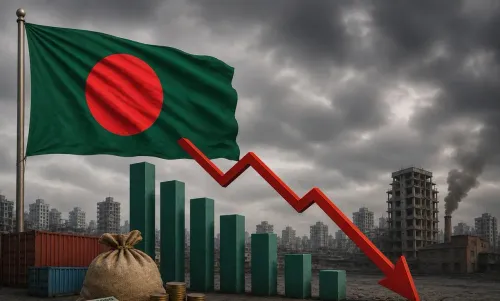
This assertion sparked social media trolling, with many dismissing the figure as mere campaign rhetoric rather than a viable economic strategy. The International Monetary Fund estimates that Bangladesh's GDP will be approximately 519 billion dollars by 2025.
According to the article, real growth has decelerated to about 3.7–3.9 percent in 2025, a decline from previous years, with only a modest rebound expected in the fiscal year 2026 at around 4.8–5 percent.
If the current pace continues, Bangladesh could exceed USD 700 billion by 2030. However, transitioning from this level to a trillion in real terms demands a radically different growth trajectory, the column emphasized.
It further clarified that while nominal GDP goals can be achieved through exchange-rate shifts or inflation, a true trillion-dollar economy at present values necessitates sustained, high real growth.
To achieve this scale in real terms, Bangladesh must maintain around 8 percent annual real GDP growth for a decade, a rare accomplishment that few nations have achieved without major structural transformations.
The article cautioned that relying on temporary accounting gains or currency fluctuations would yield superficial numbers without delivering the social and developmental advantages that a genuinely larger economy would provide.
Investment has been identified as the primary bottleneck. Factors such as high interest rates, policy unpredictability, a fragile banking sector, and political risks have suppressed quality private investment, according to the newspaper.
Bangladesh’s revenue-to-GDP ratio stands at roughly 7 percent, one of the lowest in South Asia. The column posits that unless this ratio increases to 14–15 percent, the government will struggle to finance the substantial public investments needed in infrastructure, education, and health to support high-growth trajectories.
Moreover, with around 20 lakh young individuals entering the labor market each year and approximately 68 percent of the population of working age, Bangladesh enjoys a demographic dividend until approximately 2030.
To effectively leverage this opportunity, the economy needs to generate productive jobs, especially as youth unemployment currently stands at 11-12 percent, with minimal investment in vocational training and skills development.
The column pointed out that spending on vocational training is under 0.1 percent of GDP, while allocations for education and health are also insufficient.
Additionally, Bangladesh’s economy heavily relies on ready-made garments, which represent over 80 percent of exports. This reliance limits value-added growth and makes the country vulnerable to global demand fluctuations.
The article advocates for diversification into sectors like electronics, light engineering, pharmaceuticals, and agro-processing, as well as upgrading services such as IT, logistics, and healthcare to enhance productivity.
Furthermore, chronic issues such as corruption, bureaucratic inertia, and a rising volume of nonperforming bank loans have been identified as significant impediments. These factors escalate the cost of doing business, deter long-term financing, and undermine investor confidence.
Unless there are substantial improvements in governance and a functioning corporate bond market for long-term financing, private investment will continue to face constraints, the Prothom Alo article concluded.
Point of View
I believe that while Bangladesh's aspirations for a trillion-dollar economy are commendable, they must be grounded in achievable strategies. The focus must be on sustainable growth, structural reforms, and diversified investments to truly realize this vision.
NationPress
10 Oct 2026
Frequently Asked Questions
What is the current GDP of Bangladesh?
According to estimates, Bangladesh's GDP is expected to reach approximately 519 billion dollars by 2025.
What growth rate is needed to achieve a trillion-dollar economy?
To reach a trillion-dollar economy in real terms, Bangladesh needs to sustain around 8 percent annual real GDP growth for a decade.
What are the major challenges facing Bangladesh's economic growth?
Key challenges include low revenue-to-GDP ratios, a reliance on garment exports, high-interest rates, and political risks that hinder private investment.
How can Bangladesh diversify its economy?
Bangladesh can diversify by investing in sectors like electronics, pharmaceuticals, agro-processing, and enhancing services in IT and logistics.
What role does youth employment play in the economy?
With around 20 lakh young people entering the labor market annually, creating productive jobs is crucial to leverage the demographic advantage until 2030.