Brexit cost UK 4% of GDP, 'not good enough': PM Andy Burnham
Synopsis
Ten years on from the Brexit vote, a sitting British prime minister has gone further than any predecessor in publicly declaring the experiment a net loss — citing a 4% GDP hit and invoking Churchill to argue for a European reset. It is a remarkable pivot, and the implications for UK-EU relations are only beginning to unfold.
Key Takeaways
PM Andy Burnham said the UK has 'lost more than it has gained' in the decade since the Brexit referendum of June 2016 .
He cited the Office for Budget Responsibility in putting Brexit's economic drag at 4 per cent of GDP , with some estimates as high as 8 per cent .
Burnham called Brexit 'the first domino to fall in a global move towards more isolationism and protectionism.' He invoked Winston Churchill's 'three majestic circles' framework to argue for a foreign policy reset with Europe .
Britain formally left the EU in 2020 ; 52 per cent of voters backed leaving in the June 2016 referendum.
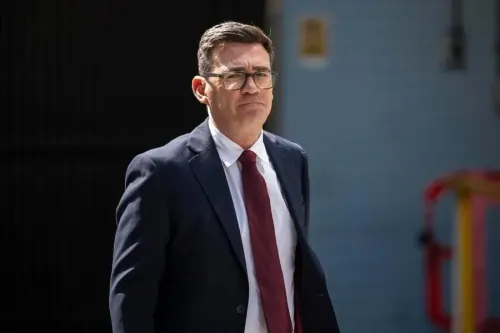
British Prime Minister Andy Burnham declared on Monday that the United Kingdom has lost more than it has gained in the decade since the Brexit referendum of June 2016, calling the divorce from the European Union 'not good enough' for Britain. The remarks, delivered at the Lord Mayor's Banquet in London, signal the sharpest official reassessment of Brexit by a sitting British prime minister.
The Economic Reckoning
'To be frank, we have lost more than we have gained in the last 10 years,' Burnham said in a foreign policy address. He cited Britain's Office for Budget Responsibility, which puts the economic drag from Brexit at 4 per cent of GDP. 'Others put it higher, at up to 8 per cent of GDP,' he added, acknowledging that some independent estimates are even more damaging. 'At a more fundamental level, what was broken a decade ago is still broken today,' he said.
Brexit as a 'First Domino'
Burnham framed Brexit not merely as a British policy misstep but as a harbinger of a wider global shift. He described it as 'the first domino to fall in a global move towards more isolationism and protectionism' — a characterisation that places the UK's 2016 vote in the same current as rising economic nationalism seen across the United States, Europe, and parts of Asia in subsequent years.
The Churchill Framework
In a pointed historical reference, Burnham invoked former British Prime Minister Winston Churchill, who had described Britain's strength as drawing from its position at the heart of three 'majestic circles' — one of which was 'the united Europe.' Burnham outlined three foreign policy resets, the third of which was explicitly 'with Europe, the last of Churchill's majestic circles.' The rhetorical device underscored his argument that re-engagement with Europe is not a betrayal of British tradition but a return to it.
A Relationship Under Review
'We have to consider whether the relationship we have now is right for this moment, for our economy, and for our security,' Burnham said, stopping short of calling for rejoining the EU but framing the current arrangement as inadequate. Britain formally left the EU in 2020, four years after 52 per cent of voters backed leaving in the June 2016 referendum. This year marks a full decade since that vote, lending Burnham's remarks both political weight and symbolic timing. How far any reset with Europe will go — and whether it carries domestic political support — remains to be seen.
Point of View
But Brexit's domestic political coalition did not dissolve when it lost the economic argument — and any meaningful re-engagement will have to reckon with that reality, not just quote from history.
NationPress
17 Nov 2026
Frequently Asked Questions
What did UK PM Andy Burnham say about Brexit at the Lord Mayor's Banquet?
Burnham said the UK has 'lost more than it has gained' in the ten years since the Brexit referendum, calling the arrangement 'not good enough' for Britain. He cited the Office for Budget Responsibility's estimate of a 4% GDP hit from Brexit, with some independent estimates as high as 8%.
How much has Brexit cost the UK economy according to official estimates?
Britain's Office for Budget Responsibility estimates Brexit has caused a 4 per cent drag on UK GDP. Some other analysts and economists put the figure higher, at up to 8 per cent of GDP, according to Burnham's remarks.
What foreign policy reset did PM Burnham propose?
Burnham outlined three foreign policy resets, the third of which involved rebuilding the UK's relationship with Europe. He stopped short of calling for EU membership but said the current post-Brexit arrangement needs to be reconsidered in light of economic and security realities.
What was Burnham's reference to Churchill about?
Burnham cited former PM Winston Churchill's concept of Britain drawing strength from three 'majestic circles,' one of which was 'the united Europe.' He used the reference to argue that re-engaging with Europe aligns with a longstanding British strategic tradition rather than contradicting it.
When did the UK formally leave the European Union?
The UK formally left the European Union in 2020, four years after 52 per cent of voters backed leaving in the June 2016 referendum. This year marks a full decade since that vote.