Chhath 2026: Indian diaspora brings sun prayers to US and Canada shores
Synopsis
Chhath Puja has quietly become a cross-continental institution. From a Rosenberg temple pond in Texas to a scout camp lake in Southern California and a three-day free-meal programme in Oakville, Ontario, the Indian diaspora is not just celebrating — it is building the organisational infrastructure to keep a Bihar-born sun festival alive for generations born far from the Ganga.
Key Takeaways
Chhath Puja 2026 is being observed by Indian diaspora communities across multiple US states and Canada , from Houston to Seattle and Oakville, Ontario .
The Potomac River celebration in Virginia has run for nearly two decades , dating to 2006 when Kripa Shankar Singh and Anita Singh first organised it as a family affair.
The Bihar-Jharkhand Association of North America in New Jersey and the Bihar and Jharkhand Association of Canada in Oakville are among the formal organisations anchoring celebrations.
In Canada , a three-day programme at the Vaishno Devi Temple will offer free meals, puja and prasad through community donations.
Organisers across locations emphasise passing traditions to younger generations, with children and volunteers central to every event.
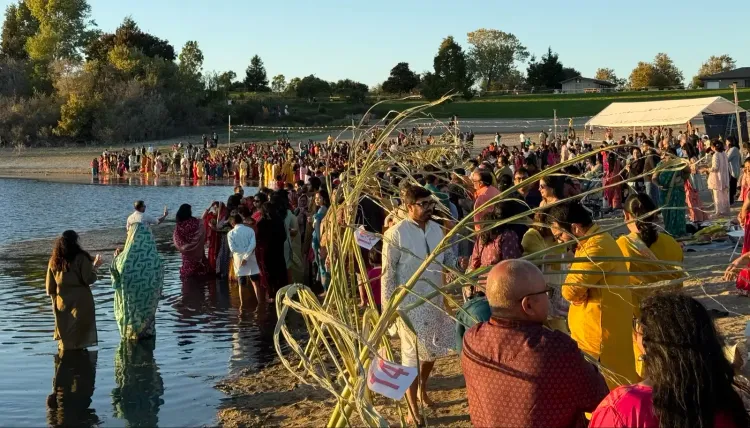
From a temple pond near Houston to the banks of the Potomac River in Virginia and a lake in Fremont, California, the Indian diaspora across North America is observing Chhath Puja this year with the same devotion that marks the festival back home — gathering at water's edge to offer prayers to the sun. The celebrations, spanning communities across the United States and Canada, reflect a growing effort to preserve a tradition rooted in the heartland of Bihar and Jharkhand, thousands of kilometres from where it was born.
Houston to the Potomac: Where the Prayers Are Held
Near Houston, the pond at the Jagannath Hindu Temple of Rosenberg has become the focal point for a tightly organised community effort. Organisers note that six scientists are sponsoring, cooking and serving food for attending families, while other volunteers handle setup, parking, cleanup and community welcome duties. The event's invitation is explicitly inclusive: 'Open to every family that celebrates.'
In the Washington DC national capital region, Chhath has been celebrated on the banks of the Potomac River in Virginia for nearly two decades. The tradition dates to 2006, when Kripa Shankar Singh and his wife, Anita Singh, sought a place to observe the festival away from home. 'This is our attempt to keep our culture alive in a foreign land,' Anita Singh said in an interview, adding that what began as a family affair now draws hundreds of community members from across the region every year.
New Jersey, Silicon Valley and Southern California
In New Jersey, the Bihar-Jharkhand Association of North America has framed its community invitation around cultural continuity, asking participants to 'help us keep our traditions alive, far from home but never apart.' The gathering welcomes both fasting devotees and those coming simply to offer support, making it a shared occasion for families and friends alike.
On the West Coast, the Bay Area celebration includes a gathering organised by Quarry Lakes Chhath in Fremont, near Silicon Valley. Its registration covers both the ritual evening offering and the practical requirements of using a public recreation space, including advance parking arrangements. Farther south, the Bihar Jharkhand Bandhu Association is hosting families at Oso Lake Scout Camp in Rancho Santa Margarita, where the natural lakeside setting is central to the group's vision of passing the tradition to younger generations.
Celebrations Spread Across the Eastern Seaboard and the Pacific Northwest
The festival's reach extends to Hindu Buddha Mandir in Maryland and the Shiv Mandir of Atlanta in Sugar Hill, Georgia. Near Seattle, the Hindu Temple and Cultural Center in Bothell is accepting registrations for collective Chhath worship, extending the festival's geographic footprint to the Pacific Northwest.
Canada: Three-Day Programme with Free Meals and Prasad
Across the border in Canada, the Vaishno Devi Temple in Oakville, Ontario is a central gathering point. The Bihar and Jharkhand Association of Canada has organised a three-day programme in which donations and sponsorships will make meals, puja and prasad available free of charge to all attendees. The initiative is described as a community effort to maintain the traditions of Bihar and Jharkhand for the diaspora settled in Canada.
A Tradition Finding New Roots
What connects these geographically scattered celebrations is a common impulse: ensuring that the rituals do not fade in the spaces between generations and continents. Organisers across cities have emphasised the involvement of children, the inclusion of extended family and the shared labour of community volunteers as essential to the festival's survival abroad. Notably, the festival has grown from a handful of household observations two decades ago to multi-venue, multi-city events requiring formal registration, logistics and cross-community sponsorship. As the diaspora from Bihar and Jharkhand grows in North America, so does the institutional scaffolding that keeps these traditions alive — suggesting Chhath abroad is no longer simply a nostalgic ritual, but an evolving community institution.
Point of View
Over twenty years, become a network of associations, temples, donor drives and logistics systems — the quiet bureaucracy of cultural survival. The more interesting question is not whether the diaspora is celebrating, but whether the rituals retain their meaning when transplanted into public recreation parks with parking-pass requirements. The children who grow up at Quarry Lakes in Fremont or Oso Lake Scout Camp may carry the form of Chhath into the next generation; whether they carry its spiritual and linguistic depth is a harder question that no registration form can answer.
NationPress
15 Nov 2026
Frequently Asked Questions
Where is Chhath Puja being celebrated in the United States in 2026?
Chhath Puja 2026 is being observed across multiple US locations, including a temple pond near Houston in Texas, the banks of the Potomac River in Virginia, Quarry Lakes in Fremont near Silicon Valley, Oso Lake Scout Camp in Rancho Santa Margarita in California, Hindu Buddha Mandir in Maryland, the Shiv Mandir of Atlanta in Georgia, and the Hindu Temple and Cultural Center near Seattle in Washington state.
How long has Chhath been celebrated on the Potomac River in Virginia?
The Potomac River Chhath celebration in Virginia has been running for nearly two decades, having started in 2006 when Kripa Shankar Singh and his wife Anita Singh sought a local place to observe the festival. What began as a private family gathering now draws hundreds of community members each year.
Which organisations are coordinating Chhath celebrations in North America?
Several diaspora bodies are coordinating celebrations, including the Bihar-Jharkhand Association of North America in New Jersey, the Bihar Jharkhand Bandhu Association in Southern California, and the Bihar and Jharkhand Association of Canada in Oakville, Ontario. Individual temples — including the Jagannath Hindu Temple of Rosenberg in Texas and the Vaishno Devi Temple in Oakville — are also hosting events.
What is the significance of Chhath Puja for the Indian diaspora?
Chhath Puja holds deep cultural and religious significance for communities originating from Bihar and Jharkhand, involving fasting, ritual offerings to the sun at water bodies, and communal prayer. For the diaspora, it serves an additional purpose: maintaining cultural identity and passing traditions to children born outside India, far from the festival's geographic roots on the Ganga plain.
How is Chhath being organised in Canada in 2026?
In Canada, the Bihar and Jharkhand Association of Canada is hosting a three-day programme centred at the Vaishno Devi Temple in Oakville, Ontario. Through community donations and sponsorships, meals, puja and prasad will be provided free of charge to all attendees throughout the programme.