Heightened Instability Threatens China's Belt and Road Projects Linked to Iranian Infrastructure: New Report
Synopsis
As tensions escalate with the US and Israel's actions against Iran, China's ambitious Belt and Road Initiative is in jeopardy. Discover how the ongoing conflict is jeopardizing vital infrastructure projects in Iran and impacting China's investment strategy in the region.
Key Takeaways
China's BRI projects in Iran are facing increased instability.
Ongoing US and Israeli actions threaten China's investments and strategic interests.
China has committed significant resources to infrastructure in Iran.
Iran's geopolitical situation impacts broader regional stability and trade routes.
The future of China-Iran relations remains uncertain amidst escalating tensions.
Colombo, March 29 (NationPress) China is poised to suffer significant geopolitical and material losses due to the recent strikes by the US and Israel on Iran. The ongoing conflict has rendered its Belt and Road Initiative (BRI) ventures linked to Iranian ports, railway routes, and energy infrastructure increasingly unstable and fraught with security threats, according to a report.
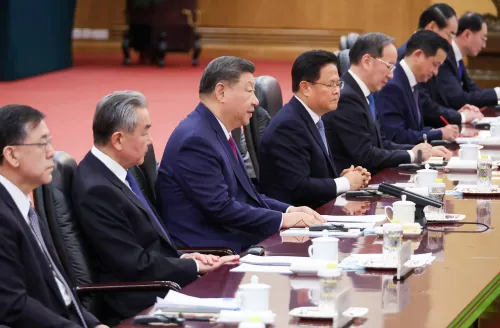
"Positioned at the intersection of global trade, Middle Eastern nations serve as a logistical hub and a burgeoning area for strategic investments. China's investments in Iran date back to 2005. Following Chinese President Xi Jinping's 2016 visit to Tehran to endorse the Belt and Road Initiative, Beijing has endeavored to position Iran as a foundational element of its Middle Eastern strategy; establishing a foothold in the region to counter US influence while facilitating trade routes to Africa and Europe," stated a report from Sri Lanka's Daily Mirror.
"In 2021, a comprehensive strategic partnership agreement was signed between Beijing and Tehran, committing $400 billion for long-term infrastructure in Iran and the purchase of Iranian oil. With the onset of war, China's grand strategy is in disarray. Investments in fixed assets are under severe threat; the oil supply from Iran, previously available to China at favorable terms, is now uncertain. With a potential regime change in Iran instigated by Washington, China could also lose the planned trade corridors through Iran," the report added.
Through its association with Iran, China has extended its influence into other West Asian nations that are rivals of Iran. With Iran engaging in hostilities against other Gulf states amidst the ongoing conflict, Chinese investments in those nations are now also at risk. In order to safeguard its investments in Iran and maintain the supply of Iranian oil, China finds itself unable to press Iran to cease its attacks on other West Asian countries, some of which host American military installations.
China has made substantial investments in Iranian railways. Additionally, both state-owned and private Chinese companies are pouring resources into essential infrastructure projects, which include high-capacity hospitals with nearly 4,000 beds, metro services, automobile manufacturing facilities, mining operations, and highways. China has also engaged with Iran on various nuclear-related projects, including contracts for constructing two 2,000 MW nuclear power plants, several 1,000 MW plants, and a heavy water reactor in Arak. However, following US sanctions on Iran, China has had to slow the pace on some of these nuclear initiatives, according to the report.
Moreover, China is advancing its Digital Silk Road and Green Silk Road initiatives in Iran. The country is also assisting Iran in developing smart cities featuring public Wi-Fi, smart buildings, mobile payment systems, e-commerce, and e-governance. Under the Green Silk Road initiative, Chinese firms are involved in renewable energy projects in Iran, including solar, hydroelectric, and biofuel energy. Of all the nations participating in BRI agreements with China, the projects in Iran hold the highest potential for overall investment returns for Beijing.
"Beijing had envisioned an Iran with nuclear capabilities, which could serve as a counterbalance to US power. However, the Midnight Hammer operation last June and the ongoing Epic Fury have severely degraded Iran's nuclear infrastructure and its long-range missile and drone capabilities. Iran's uranium enrichment facilities have been compromised, its military strength undermined, and its arsenal of weapons diminished," the report concluded.
"Iran can no longer destabilize the Middle East at China's request or keep Washington preoccupied in the region. The Belt and Road projects associated with Iranian ports, railway corridors, and energy infrastructure now face heightened instability and security risks. What was once a secure overland energy route from Iran to China, insulated from US naval dominance, has devolved into uncertainty. The strategic landscape has shifted dramatically, to China's detriment," it added.
Point of View
It highlights the vulnerabilities of foreign investments in regions beset by conflict. A careful analysis reveals the shifting dynamics that could have far-reaching consequences for global trade.
NationPress
7 Oct 2026
Frequently Asked Questions
What is the Belt and Road Initiative?
The Belt and Road Initiative (BRI) is a global development strategy adopted by China in 2013, aiming to enhance regional connectivity and embrace a brighter economic future through building infrastructure and broadening trade links.
How has the conflict affected China's investments in Iran?
The ongoing conflict has heightened instability and security risks for China's investments in Iran, particularly those linked to ports, rail corridors, and energy infrastructure.
What is the significance of Iran for China’s strategic goals?
Iran serves as a crucial nexus for China's Belt and Road Initiative, facilitating trade routes to Europe and Africa while countering US influence in the region.
What are the potential risks for China’s investments?
Risks include uncertainty surrounding oil supply from Iran, potential regime change, and threats to infrastructure investments due to regional conflicts.
How do sanctions impact China's nuclear projects in Iran?
US sanctions have forced China to slow down its involvement in nuclear projects in Iran, creating additional complications for its strategic initiatives.