China's Fifth Plenum: 33 officials purged, record-low attendance before 2027 transition
Synopsis
China's Fifth Plenum ended with a striking anomaly: a record-low share of Central Committee members in attendance and 33 officials reportedly expelled — just a year before the 2027 Party Congress. The episode lays bare the tension at the heart of Xi Jinping's China: a relentless loyalty-enforcement drive that is reshaping who will lead the world's second-largest economy next.
Key Takeaways
The Fifth Plenary Session of the CPC's 20th Central Committee concluded in Beijing on 29 October 2026 .
Only 279 of 376 Central Committee members reportedly attended — described as a record low .
33 officials were allegedly expelled from the Central Committee during or around the session.
The developments have raised global concerns about accountability and the concentration of power under President Xi Jinping .
Disciplinary outcomes are expected to shape the composition of China's next generation of leaders ahead of the 2027 Party Congress .
Analysts warn of a risk that tightening party discipline could erode the institutional capacity needed to govern China's complex economy.
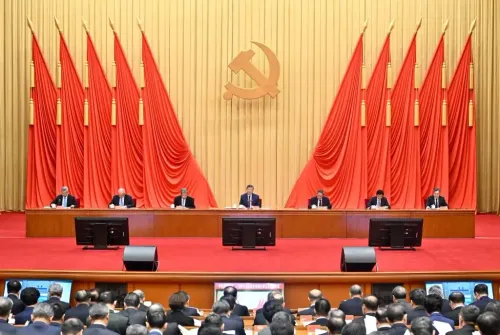
The Fifth Plenary Session of the 20th Central Committee of the Communist Party of China (CPC), which concluded in Beijing on 29 October 2026, has drawn intense global scrutiny — both for an unprecedented dip in Central Committee attendance and for the reported expulsion of 33 senior officials. The session arrived at a pivotal moment, with China's next leadership transition scheduled for 2027.
Record-Low Attendance and Reported Expulsions
According to multiple reports, only 279 out of 376 Central Committee members were present at the plenary — a figure described as a record low. Separately, 33 officials were reportedly expelled from the committee. The scale of these disciplinary actions has intensified scrutiny of China's senior leadership and prompted questions about the internal dynamics of the party ahead of a critical succession cycle.
Xi Jinping's Consolidation of Power
Analysts note that the disciplinary campaign reflects President and General Secretary Xi Jinping's broader approach to party-building, which places heavy emphasis on ideological conformity, organisational discipline, and the elevation of officials who faithfully implement central directives. Critics argue that the campaign has accelerated the concentration of authority at the top, raising concerns about accountability, political loyalty, and institutional resilience within the party. This comes amid a pattern of high-profile anti-corruption and loyalty-enforcement drives that have defined Xi's tenure since 2012.
Implications for the 2027 Leadership Transition
As the CPC prepares for its 2027 Party Congress, the ongoing investigations and disciplinary decisions are expected to directly influence the composition of the next generation of Chinese leaders. Analysts warn that the process could reshape the relationship between party discipline, political authority, and administrative effectiveness — well beyond the careers of the individual officials involved. Notably, the outcome of the Fifth Plenum is seen less as an endpoint and more as a signal of the rules governing power within the CPC ahead of the transition.
The Broader Governance Challenge
Observers point to a fundamental tension facing Beijing: maintaining a tightly disciplined party apparatus without eroding the institutional capacity needed to manage a large and complex economy and society. The longer-term question, according to analysts, concerns accountability mechanisms within China's political system — specifically, whether the party possesses credible tools to hold its own leadership answerable beyond top-down enforcement. The Fifth Plenum's significance, as one report put it, lies not in the number of officials facing disciplinary action, but in what the process reveals about how power is exercised and constrained within the CPC.
Global Reaction and What to Watch
The session has drawn commentary from governments and think-tanks tracking Chinese political risk, particularly those monitoring the lead-up to the 2027 congress. Foreign policy analysts are closely watching whether the purge signals a further centralisation of decision-making or a calibrated housecleaning ahead of a generational handover. The next major indicators will be the official communiqué from the plenum and any subsequent personnel announcements from Beijing.
Point of View
A record-low quorum — tell only part of the story. What they reveal is a party leadership actively pruning its own ranks on the eve of a generational handover, a dynamic with no clean precedent in post-Mao CPC history. The deeper risk mainstream coverage underweights is institutional: repeated loyalty-driven purges thin out the pool of experienced technocrats, and China's economic challenges in 2026 demand administrative competence, not just ideological compliance. Whether Xi's consolidation model can simultaneously enforce discipline and sustain policy execution capacity is the defining governance question heading into 2027 — and the Fifth Plenum has done little to answer it.
NationPress
1 Nov 2026
Frequently Asked Questions
What is China's Fifth Plenum and why is it significant in 2026?
The Fifth Plenary Session of the 20th Central Committee of the Communist Party of China (CPC) is a formal leadership meeting that sets political and policy direction. It is particularly significant this year because it concluded just ahead of the 2027 Party Congress, which will determine China's next generation of top leaders.
How many officials were expelled at the Fifth Plenum?
According to multiple reports, 33 officials were reportedly expelled from the CPC Central Committee around the time of the Fifth Plenum. The reports also noted that only 279 of 376 committee members attended — described as a record-low turnout.
What do the purges reveal about Xi Jinping's hold on power?
Analysts say the disciplinary campaign reflects President Xi Jinping's emphasis on ideological conformity and loyalty to central directives. Critics argue it signals a further concentration of authority at the top, raising questions about accountability and the independence of party institutions.
How will the Fifth Plenum affect China's 2027 leadership transition?
The investigations and expulsions are expected to directly influence which officials are elevated at the 2027 Party Congress. Those who survive the disciplinary process and demonstrate loyalty to Xi are more likely to fill key positions, potentially reshaping the CPC's top leadership for the next decade.
What is the risk of ongoing purges for China's governance?
Observers warn that sustained loyalty-driven purges risk hollowing out institutional expertise within the party, making it harder to govern a complex economy. The challenge for Beijing is to enforce discipline without undermining the administrative capacity needed to manage China's domestic and global challenges.