China political succession risks and economic slowdown: new report
Synopsis
A London-based research publication has delivered one of the starkest assessments yet of China's structural vulnerabilities: a fiscal revenue collapse of nearly six percentage points of GDP since 2012, a succession vacuum created by Xi Jinping's purges, and a social contract — prosperity for political silence — that may no longer be deliverable. The report draws direct parallels with the Ming and Qing dynasties before their falls.
Key Takeaways
A report by Tomorrow's Affairs warns that China faces compounding risks from political succession uncertainty, economic slowdown, and weakening fiscal capacity.
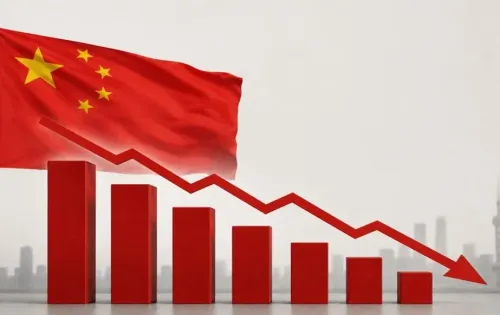
Tax revenues (excluding social insurance) fell from 18.4% of GDP in 2012 to 12.6% in 2025 — a collapse of nearly six percentage points .
Xi Jinping's elimination of rivals is described as creating future succession risks, with humiliated former officials potentially destabilising any transition.
China faces simultaneous headwinds from population ageing , a property market downturn , and trade barriers imposed by the US and Europe .
The report draws historical parallels with the fiscal deterioration seen in the Ming and Qing dynasties before their downfall.
The publication argues China's core social contract — prosperity in exchange for restricted freedoms — 'may be in trouble.'
China faces compounding risks from political succession uncertainty, a structural economic slowdown, and weakening fiscal capacity, according to a new report by Tomorrow's Affairs, a London-based publication. The analysis, released on 26 October 2026, argues that the country's growth model and social contract are under simultaneous pressure from multiple directions.
Succession Risk Under Xi Jinping
Xi Jinping's sweeping consolidation of control over state, party, provincial, and military leadership has eliminated potential rivals — but critics argue this has created dangerous fault lines for the future. The report contends that former officials who were humiliated during Xi's purges could 'create havoc when the time comes for Xi's succession.'
The publication draws on Chinese history to support this thesis, noting that 'periods of apparent stability followed by turmoil have recurred throughout Chinese history.' The absence of a credible successor or a transparent transition mechanism is, according to the report, a structural vulnerability rather than a sign of strength.
Economic Headwinds: Ageing, Property, and Trade
The economic picture painted by the report is equally sobering. China's growth model faces three simultaneous drags: a rapidly ageing population, a prolonged property market downturn, and rising external trade barriers. Both the United States and Europe have responded to Chinese export volumes with policy measures that are increasingly constraining market access.
Notably, this constellation of pressures arrives at a moment when Beijing's capacity to stimulate its way out of trouble appears structurally diminished.
Fiscal Collapse: A Historic Parallel
Perhaps the most striking finding in the report concerns China's fiscal trajectory. Taxes excluding social insurance contributions collapsed by nearly six percentage points between 2012 and 2025, falling from 18.4% of GDP to 12.6%, according to the publication.
The report draws a pointed historical comparison: 'China has never managed to raise sufficient sums of money via personal income taxation, even during a period of extraordinary economic vibrancy,' it stated. A similar fiscal deterioration, it argued, was observed in the Ming and Qing dynasties before their eventual collapse — a comparison the report uses deliberately to underscore long-run systemic risk.
The publication further warned of an 'unhealthy reliance on non-tax revenues,' which leaves the government with few options when those revenue streams dry up. This, it argues, could constrain Beijing's ability to exercise power domestically and project it abroad.
The Social Contract Under Pressure
'China's entire growth and fiscal model, along with the social contract between the state and its citizens — coveted stability and material prosperity for restricted freedom and muzzled voice — may be in trouble,' the report stated directly.
This framing is significant: the implicit bargain that has underwritten Communist Party legitimacy for four decades — rapid economic growth in exchange for political acquiescence — may no longer hold if material conditions deteriorate. Critics of the analysis, however, may argue that the Chinese state retains considerable coercive and administrative capacity to manage dissent even in a downturn.
What to Watch
The report's findings come as Beijing grapples with deflation pressures, a cautious consumer, and a real estate sector that has yet to find a stable floor. How China's leadership responds to the converging fiscal and demographic constraints — particularly ahead of any eventual political transition — will be a defining question for the global economy in the years ahead.
Point of View
Which tends to focus on near-term stimulus and trade policy. Beijing's reliance on non-tax revenues was always a structural fragility; the fact that it has widened sharply since 2012 — precisely the period of Xi's centralisation — invites the question of whether political concentration and fiscal deterioration are causally linked, not merely coincident. The Ming and Qing parallel will be dismissed as alarmist by many China watchers, but the underlying fiscal arithmetic is harder to wave away.
NationPress
26 Oct 2026
Frequently Asked Questions
What does the Tomorrow's Affairs report say about China's political future?
The report warns that Xi Jinping's consolidation of power and elimination of rivals has created a succession vacuum. It argues that humiliated former officials could destabilise any future political transition, and draws on Chinese history to note that periods of apparent stability have repeatedly preceded turmoil.
How much have China's tax revenues fallen since 2012?
According to the report, taxes excluding social insurance contributions fell from 18.4% of GDP in 2012 to 12.6% in 2025 — a decline of nearly six percentage points. The publication compares this fiscal deterioration to trends observed in the Ming and Qing dynasties before their collapse.
What economic pressures is China currently facing?
China faces a structural slowdown driven by population ageing, a prolonged property market downturn, and rising trade barriers from the United States and Europe. These pressures are compounded by a declining tax base and heavy reliance on non-tax revenues.
What is meant by China's 'social contract' being under threat?
The report refers to the implicit bargain between the Communist Party and Chinese citizens: political acquiescence in exchange for material prosperity and stability. With economic conditions deteriorating and fiscal capacity weakening, the report argues this bargain may no longer be sustainable.
Who published the report on China's risks?
The report was published by Tomorrow's Affairs, a London-based publication, and was released on 26 October 2026. It covers political succession risks, fiscal deterioration, and structural economic headwinds facing China.