Are Emerging Markets Resilient Despite Ongoing Risks?

Synopsis
The IMF has highlighted the remarkable resilience of emerging market economies amidst ongoing trade disruptions and geopolitical uncertainties, while cautioning about persistent risks. Discover how these economies are navigating the complexities of the global landscape and what this means for future growth.
Key Takeaways
Emerging markets are resilient amid global uncertainties.
IMF forecasts global growth at 3.3 percent for 2026.
Private sector agility plays a crucial role in maintaining supply chains.
Investment in technology and AI is driving positive outcomes.
Policymakers must remain vigilant to underlying risks.
Washington, Jan 29 (NationPress) Emerging market economies have demonstrated significant resilience in the face of trade disruptions, geopolitical instability, and evolving global financial conditions, according to high-ranking officials from the International Monetary Fund (IMF) during a briefing on Thursday. They cautioned, however, that downside risks remain prevalent.
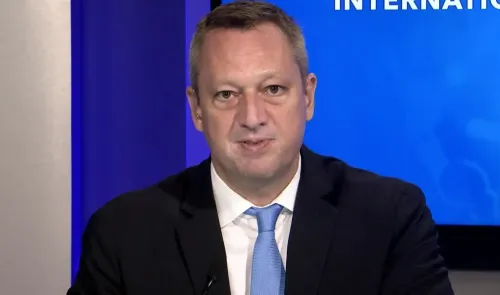
In a presentation detailing the IMF's most recent evaluation ahead of an upcoming conference focused on emerging economies, IMF Economic Counsellor and Director of Research, Pierre-Olivier Gourinchas, noted that global growth has exceeded expectations, despite recent tariff impacts and increased uncertainty.
"Global growth continues to exhibit resilience, despite trade disruptions and elevated uncertainty," Gourinchas remarked, referencing the IMF's January World Economic Outlook update, which has adjusted the global growth forecast for 2026 to 3.3 percent.
This adjustment marks the third upward revision since April of the previous year and surpasses projections made in October 2024.
"This strongly indicates that the global economy is recovering from the immediate effects of the tariff shock," he stated.
Gourinchas credited this resilience to various counterbalancing factors, highlighting first the remarkable adaptability of the private sector, which has maintained the smooth operation of supply chains by reorganizing trade routes in response to disruptions.
He also pointed to favorable financial conditions, robust investments in technology and artificial intelligence yielding positive outcomes, particularly for exports from Asia, along with increased fiscal stimulus in several countries, including China and Germany.
Despite the relatively optimistic outlook, Gourinchas warned that vulnerabilities are accumulating beneath the surface.
He noted that growth is increasingly concentrated in the areas of information technology and artificial intelligence.
"While the current investment boom in this sector holds the potential for a lasting productivity increase, the crucial question is whether the returns will align with or surpass expectations," he cautioned, adding that a reassessment of AI-related investments could incite a market correction with global implications.
Additionally, he observed signs of softening labor markets in various countries and expressed concerns that the broader deployment of artificial intelligence could result in significant worker displacement.
"Navigating this landscape demands vigilance from policymakers, preparation, and adaptability," Gourinchas emphasized, advocating for the monitoring of financial vulnerabilities, rebuilding fiscal reserves, and ensuring that central banks maintain their independence while focusing on price stability.
Shifting to the collective outlook for emerging market and developing economies, Gourinchas projected growth to be around four percent over the next two years, which he described as a strong performance by historical standards, with upward revisions observed across most regions compared to forecasts made in October.
Latin America, however, remains the primary exception.
He stated that emerging markets are still vulnerable to trade tensions, potential tightening of global financial conditions, and high public debt levels, but noted significant advancements in policy frameworks.
"Our in-depth analysis last October indicates that the implementation and credibility of monetary policy in emerging markets have improved," Gourinchas remarked, adding that central banks now depend less on foreign exchange interventions and permit exchange rates to function as greater shock absorbers.
Fiscal policies, he noted, have also become more counter-cyclical.
"The directive for policymakers in emerging market economies is unequivocal: continue your current strategies," he urged, encouraging governments to leverage this resilient period to fortify buffers, enhance debt management, maintain price stability, and accelerate structural reforms to boost productivity and broaden economic growth.
Jihad Azour, the Director of the IMF's Middle East and Central Asia Department, echoed the theme of resilience while highlighting region-specific risks.
"The narrative of 2026 is one of resilience, despite substantial uncertainty," Azour stated, pointing out that growth has been upgraded across both oil-exporting and oil-importing nations in the Middle East and North Africa, with regional growth anticipated to reach approximately 3.5 percent this year.
He identified four primary risks for the region in 2026, including geopolitical tensions, rising global uncertainty that could impact growth with a delay, concerns regarding debt sustainability if global financing conditions tighten, and fluctuations in oil prices.
"There are specific issues in certain countries that we are closely monitoring, particularly in post-conflict regions," Azour remarked, naming Lebanon, Syria, and Gaza, where he indicated that additional international support is essential.
These statements were made in advance of an IMF conference on emerging market economies organized in collaboration with Saudi Arabia's Ministry of Finance, scheduled to take place in AlUla in early February.
In recent years, emerging markets have reaped the benefits of enhanced macroeconomic frameworks, including greater monetary policy credibility, more flexible exchange rates, and disciplined fiscal management, enabling many nations to withstand shocks from the pandemic, surges in global inflation, and tighter monetary policies in advanced economies.
Point of View
It is crucial to recognize the resilience displayed by emerging markets as they adapt to complex global challenges. While the outlook remains cautiously optimistic, awareness of underlying risks is vital for informed policy decisions. Our commitment is to provide insights that align with national interests and support sustainable growth.
NationPress
23 Sept 2026
Frequently Asked Questions
What are the main risks facing emerging markets?
Emerging markets face several risks, including trade tensions, tightening global financial conditions, and high public debt levels. These factors may impact their growth trajectories.
How has the IMF adjusted its growth forecasts?
The IMF has revised its global growth forecast for 2026 to 3.3 percent, marking the third upward adjustment since April of the previous year.
What are the implications of AI for labor markets?
The rise of artificial intelligence poses potential risks to labor markets, as increased deployment could lead to job displacement in various sectors.
What strategies should policymakers in emerging markets adopt?
Policymakers should focus on strengthening fiscal buffers, enhancing debt management, ensuring price stability, and accelerating structural reforms to support sustainable growth.
What is the projected growth for emerging markets in the next two years?
Emerging markets are projected to grow at around four percent over the next two years, which is considered a solid performance by historical standards.