Why Are Flour Prices Skyrocketing in Khyber Pakhtunkhwa?
Synopsis
In Khyber Pakhtunkhwa, skyrocketing flour prices are causing serious distress among residents. With essential food supplies becoming unaffordable, locals are demanding government intervention. This situation not only exacerbates financial strain but also raises concerns about poverty and food insecurity. What measures can be taken to mitigate this crisis?
Key Takeaways
Flour prices in Khyber Pakhtunkhwa are skyrocketing.
Residents blame government negligence and hoarding.
Essential food items are becoming unaffordable for many.
Experts warn of increased poverty and food insecurity.
Immediate governmental action is necessary to stabilize prices.
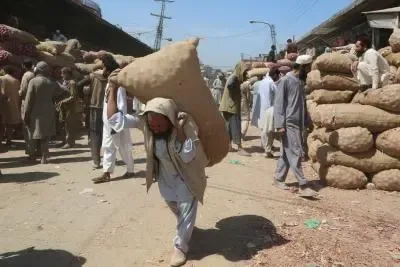
Islamabad, Jan 11 (NationPress) A notable rise in flour prices in Shangla and other regions of Khyber Pakhtunkhwa, Pakistan, has raised alarm bells among local residents. They attribute this increase to insufficient government regulation, hoarding practices, and profiteering, as reported by local media.
The cost of a 20-kilogram bag of flour has jumped to Rs 2,850 in Shangla and its surrounding areas, while a 40-kilogram bag is priced as high as Rs 5,700. Additionally, a 50-kilogram bag is available for approximately Rs 7,000, placing essential food items out of reach for many families in the low to middle-income bracket, according to The Nation.
Residents have expressed that the soaring flour prices have exacerbated the financial burden already caused by inflation and have called on the provincial government and district authorities to swiftly implement price controls on vital commodities.
Previously, the illegal smuggling of flour from Punjab and other provinces to Afghanistan was considered a reason for the price spike in Khyber Pakhtunkhwa. However, locals and traders have noted that the recent escalation in flour prices in upper districts, despite the closure of the Afghanistan-Pakistan border, indicates that smuggling is not the sole cause of the rising costs.
Economists and social analysts have cautioned that a persistent increase in prices may lead to heightened poverty and food insecurity. They are urging the authorities to activate the price control committee and take action against hoarding and profiteering networks.
Earlier this month, a report indicated that Pakistan's economy has shifted from growth to mere survival, with households compelled to allocate nearly two-thirds of their income on food and electricity. According to the latest Household Integrated Economic Survey from the Pakistan Bureau of Statistics, survival in Pakistan is increasingly becoming a challenge.
"Food alone now accounts for over a third of household expenditures. An additional quarter is spent on housing, electricity, and gas. Collectively, these necessities consume 63 percent of total spending. This situation results from prolonged inflation and policy choices that have consistently driven up the costs of essentials. Although average monthly incomes have nominally increased over the past six years, household expenses have surged at a faster rate. What families gain in nominal income is diminished by rising prices," reported The Express Tribune.
The report highlighted that the diminishing purchasing power of the Pakistani rupee is evident in what families can no longer afford.
"Expenditure on education has plummeted to only 2.5 percent, now less than half of what is spent on housing and utilities. Spending on health and recreation barely constitutes a few percentage points. A society that reduces investment in education and well-being is sacrificing its future stability for short-term gain," it cautioned.
According to the report, this is not resilience but rather a fragile situation disguised as coping. It emphasized the need for immediate actions: "First, stabilizing food and energy costs must become a primary economic goal. Secondly, inflation control must extend beyond changes in interest rates. There is a pressing need to address supply-side failures in food markets. Lastly, education and health expenditures need protection from economic shocks. Household budgets are under severe pressure."
"If policies continue to view survival as an acceptable norm, the long-term repercussions will far outweigh today's fiscal challenges," the report concluded.
Point of View
It is imperative to highlight the pressing concerns of Khyber Pakhtunkhwa residents regarding flour price hikes. The systemic issues of hoarding and inadequate government intervention must not be overlooked. The plight of the local populace calls for immediate action to implement price controls and ensure food security. We stand with the community in demanding accountability and swift governmental action.
NationPress
20 Sept 2026
Frequently Asked Questions
What has caused the recent surge in flour prices in Khyber Pakhtunkhwa?
Residents attribute the increase to weak government oversight, hoarding, and profiteering.
How much does a bag of flour cost now?
A 20-kilogram bag costs Rs 2,850, while a 50-kilogram bag is around Rs 7,000.
What are the economic implications of rising flour prices?
The rise in flour prices could exacerbate poverty and food insecurity in the region.
What actions are residents calling for?
Residents are urging the provincial government to implement price controls on essential commodities.
How is inflation affecting household budgets in Pakistan?
Households are now spending nearly two-thirds of their income on food and electricity due to rising costs.