G20 Foreign Ministers to meet in Atlanta on October 30-31, Rubio confirms

Synopsis
The US has confirmed Atlanta as the venue for the G20 Foreign Ministers' Meeting on October 30–31 — a key prelude to the G20 Leaders' Summit that President Trump will host at Trump National Doral in Miami on December 14–15, timed to coincide with America's 250th anniversary. For India, the meetings are a critical stage for pushing supply chain security, multilateral reform, and Global South priorities.
Key Takeaways
US Secretary of State Marco Rubio announced the G20 Foreign Ministers' Meeting will be held in Atlanta, Georgia on October 30–31 .
Discussions will focus on global stability, open markets, and resilient supply chains.
President Donald Trump will host the G20 Leaders' Summit on December 14–15 at Trump National Doral , Miami .
The Leaders' Summit coincides with the 250th anniversary of the United States.
India is expected to push for supply chain security, multilateral reform, and stronger Global South representation.
The G20 represents around 85% of global GDP and nearly two-thirds of the world's population.
US Secretary of State Marco Rubio on Monday, 19 May announced that the United States will host the G20 Foreign Ministers' Meeting in Atlanta, Georgia, on October 30–31, as Washington accelerates preparations for a series of high-profile multilateral gatherings later this year.
What the Meeting Will Cover
The State Department said the ministerial gathering will bring together foreign ministers from the world's leading economies to advance the G20's core mission of promoting global stability and prosperity. Discussions are expected to centre on strengthening international cooperation, addressing global economic challenges, and supporting open markets and resilient supply chains, according to the official statement.
Notably, the State Department did not immediately release details of the ministerial agenda, participating delegations, or potential bilateral meetings on the sidelines of the gathering.
Why Atlanta Was Chosen
The State Department said Atlanta was selected for its role as 'a center of diplomacy, business, and global connectivity,' describing it as 'an ideal setting for these critical discussions.' The city has grown into one of the United States' most internationally connected hubs, hosting major corporations and diplomatic missions.
G20 Leaders' Summit to Follow in December
The foreign ministers' meeting sets the stage for the broader G20 Leaders' Summit, which President Donald Trump will host on December 14–15 at Trump National Doral in Miami, Florida. The summit will coincide with celebrations marking the 250th anniversary of the United States — adding symbolic weight to what is already one of the most consequential diplomatic calendars Washington has hosted in years.
India's Stakes in the Discussions
India, a key G20 member and an increasingly influential strategic partner of the United States, is expected to closely track discussions on global trade, resilient supply chains, and economic coordination. New Delhi has consistently advocated for reforms in multilateral institutions, stronger Global South representation, and secure supply chains spanning semiconductors to critical minerals.
This comes amid a broader shift in G20 priorities: recent meetings have increasingly focused on economic resilience, energy security, supply chain diversification, climate finance, and emerging technologies. The grouping — which represents around 85% of global GDP and nearly two-thirds of the world's population — has also become a critical forum for managing geopolitical tensions and the evolving balance of global economic power.
The G20 Membership
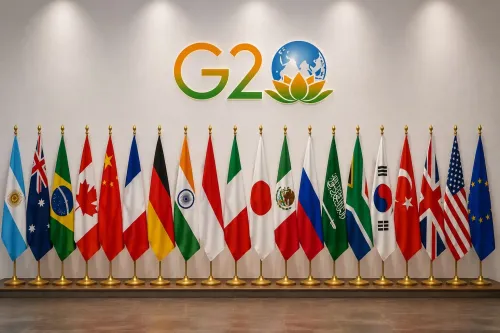
The G20 includes major economies such as the United States, India, China, Russia, Japan, Germany, France, Brazil, Saudi Arabia, South Korea, Australia, and the European Union. With the US holding the presidency this cycle, Washington's agenda-setting choices will shape the contours of global economic diplomacy through the end of 2025.
Point of View
A G20 ministerial that stops at platitudes about 'open markets' will satisfy no one. India's posture will be worth watching: New Delhi has leverage as a swing voice between the Global South and Western blocs, and how it uses the Atlanta platform — particularly on supply chain rules and multilateral reform — could shape the December Leaders' Summit's outcomes more than any bilateral Washington holds. The Miami venue choice, meanwhile, is hard to separate from its political optics.
NationPress
20 Sept 2026
Frequently Asked Questions
Where and when is the G20 Foreign Ministers' Meeting being held?
The G20 Foreign Ministers' Meeting will be held in Atlanta, Georgia, on October 30–31, 2025. US Secretary of State Marco Rubio confirmed the venue and dates on 19 May.
Why was Atlanta chosen to host the G20 Foreign Ministers' Meeting?
The State Department said Atlanta was selected because of its role as 'a center of diplomacy, business, and global connectivity.' The city's international connectivity and corporate presence made it the preferred choice for the ministerial gathering.
When is the G20 Leaders' Summit and where will it be held?
The G20 Leaders' Summit will be held on December 14–15 at Trump National Doral in Miami, Florida, hosted by President Donald Trump. It will coincide with celebrations marking the 250th anniversary of the United States.
What issues are expected to be discussed at the G20 Foreign Ministers' Meeting?
Discussions are expected to focus on strengthening international cooperation, addressing global economic challenges, and supporting open markets and resilient supply chains. Topics such as energy security, supply chain diversification, climate finance, and emerging technologies are also likely to feature.
What is India's stake in the G20 meetings?
India, as a key G20 member and a growing US strategic partner, is expected to closely follow discussions on global trade and supply chain resilience. New Delhi has consistently pushed for multilateral institutional reforms, stronger Global South representation, and secure supply chains in sectors including semiconductors and critical minerals.