Tulsi Gabbard Supports Trump's Iran Strikes Amid NCTC Chief's Controversial Resignation
Synopsis
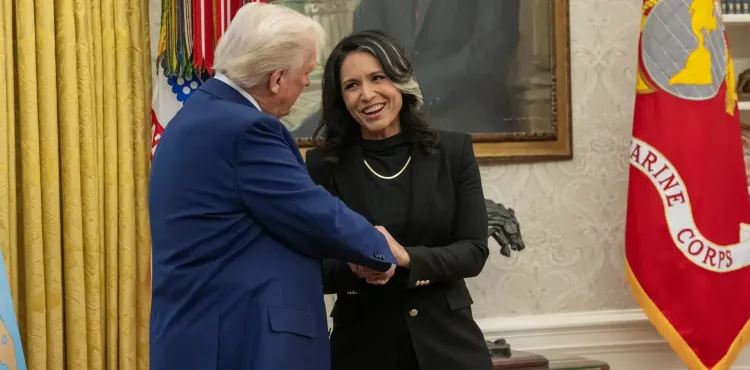
In a significant political clash, Tulsi Gabbard backs Trump's military decision against Iran following the resignation of NCTC Director Joe Kent, who protests the war’s justification. This moment underscores deep divisions within Washington regarding national security and foreign policy.
Key Takeaways
Tulsi Gabbard supports Trump's military action against Iran.
Joe Kent's resignation marks a significant protest against the war.
Debate over Iran's threat level continues within U.S. government.
White House defends military action with intelligence claims.
Kent's exit exposes political divisions regarding foreign policy.
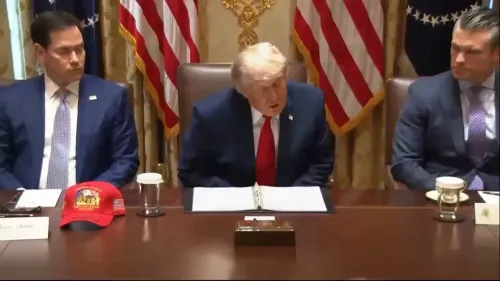
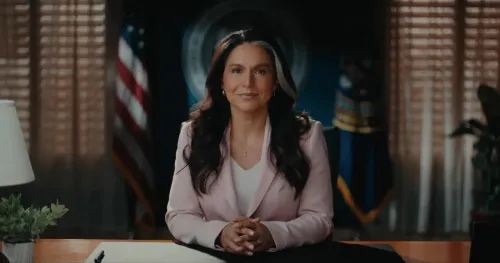
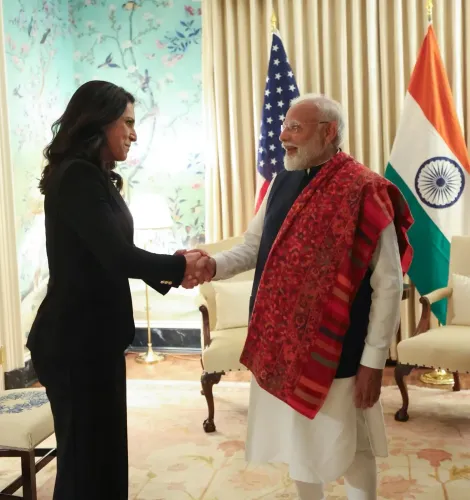
Washington, March 18 (NationPress) Tulsi Gabbard, the Director of National Intelligence, expressed her support for President Donald Trump’s decision to take military action against Iran. This statement followed the resignation of Joe Kent, the Director of the National Counterterrorism Center (NCTC), who stepped down in protest, marking a significant departure from the administration amid ongoing conflict.
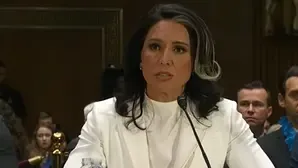
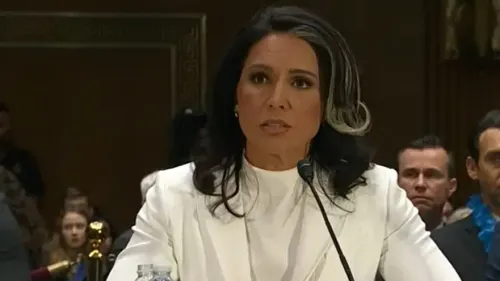
Gabbard asserted, “President Trump was decisively elected by the American populace to serve as our President and Commander in Chief.”
She emphasized, “As our Commander in Chief, he has the authority to assess what constitutes an imminent threat and to take necessary measures to ensure the safety and security of our armed forces, the American public, and our nation.”
As the highest-ranking Hindu American in any presidential administration, Gabbard highlighted that the decision was informed by intelligence evaluations. “The Office of the Director of National Intelligence plays a crucial role in coordinating and integrating intelligence to provide the President and Commander in Chief with the most reliable information available to guide his decisions.”
“After thoroughly analyzing all the information at his disposal, President Trump determined that the Islamist regime in Iran posed a significant imminent threat and acted accordingly,” she continued.
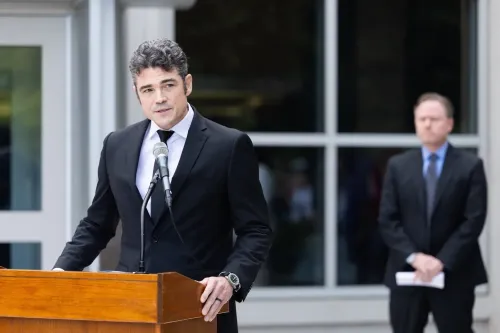
These comments came after Kent revealed his resignation, stating, “After considerable reflection, I have chosen to resign from my role as Director of the National Counterterrorism Center, effective immediately.”
Kent openly challenged the rationale behind the war, declaring, “I cannot in good conscience endorse the ongoing conflict in Iran. Iran did not present an imminent threat to our country, and it is evident that we initiated this war due to pressures from Israel and its influential American lobby.”
The White House countered Kent’s assertions, with Press Secretary Karoline Leavitt stating, “Numerous claims in this letter are inaccurate, specifically the assertion that ‘Iran posed no imminent threat to our nation.’”
She argued that President Trump possessed “substantial and compelling evidence that Iran was preparing to attack the United States first,” and that the decision was based on intelligence gathered from “various sources and factors.”
In response to Kent's resignation, Trump remarked, “It’s fortunate that he’s no longer in his position because he claimed Iran was not a threat. Every nation acknowledged Iran as a threat,” he told the press.
“I always regarded him as a decent individual, but I found him to be lacking in security matters, very lacking,” Trump added, remarking, “Upon reading his statement, I realized it was a good thing he’s out because he said that Iran was not a threat. Iran absolutely was a threat.”
The resignation elicited sharp responses from Capitol Hill.
Senate Republican leader Mitch McConnell accused Kent of anti-Semitism, stating, “Joe Kent testified before the Senate a year ago that Iran and its terror affiliates posed a threat to US servicemembers in the Middle East.”
“The overt anti-Semitism reflected in his resignation letter clearly indicates that Mr. Kent is unfit to uphold these responsibilities, and those who mistake his unfounded and incendiary conspiracy theories for courageous truth-telling are simply deceiving themselves.”
“Isolationists and anti-Semites are unwelcome in either party and certainly do not merit positions of trust in our government,” he further stressed.
Representative Jared Moskowitz also criticized Kent’s history, stating, “This is an individual who appeared on a podcast sympathetic to Nazis,” adding that Kent had “promoted pro-Kremlin narratives.”
“He even suggested that Anthony Fauci should be charged with murder. He’s not exactly the messenger we should be promoting, even if you align with some of his points in the letter,” Moskowitz remarked.
“So, I’m glad he’s gone. Frankly, he should never have held that position,” Moskowitz concluded.
Kent, however, defended his stance, cautioning against repeating previous errors. He stated he could not support sending “the next generation into a conflict that does not benefit the American people or justify the sacrifice of American lives.”
His resignation highlights the increasing divisions in Washington regarding the intelligence and rationale surrounding the conflict with Iran.
Point of View
This incident illustrates the ongoing tension within U.S. government regarding foreign policy and national security. The contrasting views between Gabbard and Kent signify a broader debate on military engagement and the implications for American lives and interests.
NationPress
8 Sept 2026
Frequently Asked Questions
Why did Tulsi Gabbard support Trump's decision to strike Iran?
Gabbard believes that as Commander in Chief, Trump is responsible for assessing threats and ensuring national security.
What prompted Joe Kent to resign from his position?
Kent resigned in protest over the war in Iran, arguing it lacks justification and that Iran posed no imminent threat.
What has been the response from the White House regarding Kent's claims?
The White House, through Press Secretary Karoline Leavitt, refuted Kent's claims, asserting that there was compelling evidence of an imminent threat from Iran.
How have other political figures reacted to Kent's resignation?
Reactions have been mixed, with some criticizing Kent for perceived anti-Semitism and others supporting his stance on the war.
What implications does this resignation have for U.S. foreign policy?
Kent's resignation highlights significant divisions in Washington over the justification for military actions and national security strategies.