Should the People of Gilgit-Baltistan Unite to Expel Occupying Pakistani Forces?
Synopsis
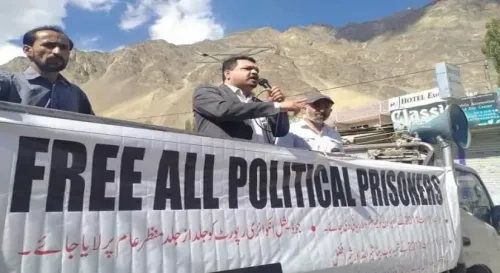
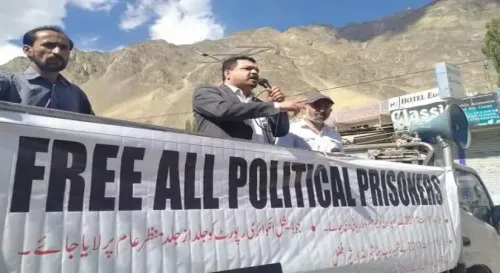
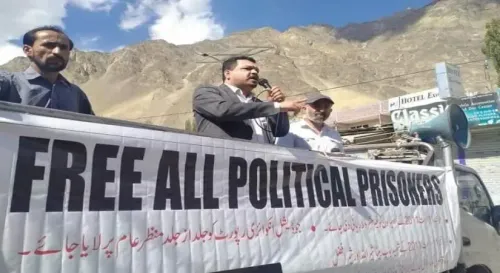
As tensions escalate in Pakistan-occupied Gilgit Baltistan, reports suggest that Pakistan is inviting foreign investment in resource exploitation. Local activists call for unity among residents to confront the occupying forces and protect their rights. This critical situation highlights the ongoing struggle for autonomy and the preservation of cultural identity.
Key Takeaways
Pakistan is seeking foreign investment for resource exploitation in Gilgit Baltistan.
Local activists believe that unity is crucial in confronting the occupying forces.
The region is rich in rare earth elements that are being exploited without local compensation.
Recent violence underscores the instability in the region.
Calls for autonomy and rights continue to grow among locals.
Washington, Feb 14 (NationPress) The political climate in Pakistan-occupied Gilgit Baltistan (PoGB) is worsening as Pakistan, alongside China, is actively seeking investment from American and Central Asian enterprises for the extraction of resources in the region it unlawfully controls, according to a recent report. It has been noted that Kazakhstan and Indonesia have shown interest in investing in gold and copper mining projects within Gilgit Baltistan.
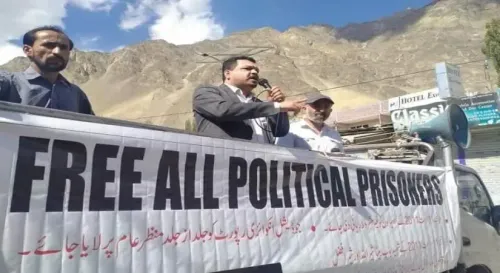
Local activists point out that, aside from terrorism, the strategic location and the presence of rare earth elements are significant contributors to the instability in Gilgit-Baltistan. The Pakistani military aims to exploit these resources without providing any revenue or compensation to the indigenous populace. An illegal and unconstitutional land reform act enforced by Pakistan allows for the continued abuse of natural resources in Gilgit Baltistan. When locals demand their rightful share, Pakistan denies any royalties due to the ongoing political dispute regarding Jammu-Kashmir, claiming it renders them ineligible for constitutional and economic rights,” stated Senge Sering, a local from Pakistan-occupied Gilgit-Baltistan, in an article for the Washington-based Global Strat View.
Sering, who directs the Institute for Gilgit Baltistan Studies (IGBS) based in Washington, elaborated further on the significance of Gilgit Baltistan’s geographical position, which complements the efforts of major global economies to diversify their rare earth supply chains, as the processing and supply of rare earth elements is concentrated in just a few nations.
He highlighted that Tangir and its neighboring valleys in Gilgit Baltistan are recognized globally as a mineralogical hotspot, rich in monazite, chevkinite, lanthanum, samarium, praseodymium, neodymium, cerium, titanium, thorium, and other rare earth elements. Furthermore, China’s infrastructure projects are aiding Pakistan in transforming the occupied region into a rare-earth hub strategically located at the intersection of Asia, the Middle East, and Europe.
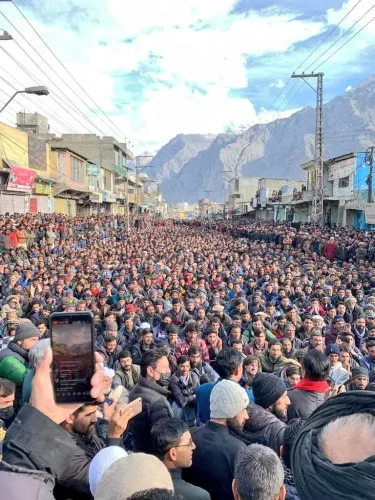
“In this context, the residents of Gilgit Baltistan must remain united and persist in their struggle to remove the occupying Pakistani colonial rulers, who are solely focused on exploiting and misusing natural resources and transit routes while denying local people their rightful political and constitutional entitlements. Their resilience will ultimately assist the people of Gilgit Baltistan in becoming constitutional citizens of India alongside Ladakh, safeguarding both their land and identity,” he asserted.
Recently, Pakistani media reported an incident in which one individual was killed and three others, including an Army Major, sustained injuries from an explosion caused by an Improvised Explosive Device (IED) near a vehicle in the Tangir valley of Diamer in PoGB.
Sering, a prominent scholar from the Pakistani-occupied region, also mentioned that a terrorist group associated with Commander Maulana Amir Hamza issued a statement prior to the attack, claiming responsibility for operations against Pakistani armed forces, including secret agencies like ISI and MI, as well as the police.
“The group asserted that the Pakistani military utilizes a divide-and-rule tactic to maintain control over Gilgit Baltistan. They indicated that previous sectarian attacks targeting leaders such as Aga Rahat or Qazi Nisar were orchestrated by Pakistan's military and their agents to create division among the locals. Moreover, they alleged that Pakistan’s government and military collaborate with global powers to destabilize peace in Pakistan. The spokesperson claimed that Pakistan’s armed forces have compromised their integrity by assisting Israel against Hamas,” Sering concluded in the Global Strat View.
Point of View
It's essential to acknowledge the complexities surrounding the situation in Gilgit Baltistan. The ongoing struggle for autonomy and rights amidst external pressures calls for a nuanced understanding of the local and geopolitical dynamics in play. We stand with the people of Gilgit Baltistan in their pursuit of justice and self-determination.
NationPress
17 Sept 2026
Frequently Asked Questions
What is the current political situation in Gilgit Baltistan?
The political situation in Gilgit Baltistan is deteriorating, with reports of Pakistan seeking foreign investment for resource exploitation while denying local residents their rights.
Who is Senge Sering?
Senge Sering is a prominent scholar and the head of the Institute for Gilgit Baltistan Studies, advocating for the rights and autonomy of the people in the region.
What are the local resources being exploited?
The region is rich in rare earth elements, including gold and copper, which are being targeted for exploitation without fair compensation to locals.
What recent incidents have occurred in Gilgit Baltistan?
A recent explosion caused by an IED in the Tangir valley resulted in one death and injuries to several others, highlighting the ongoing violence in the region.
What is the stance of local activists?
Local activists are calling for unity among the people of Gilgit Baltistan to resist the occupying forces and secure their political and constitutional rights.