Global trade defies tariff shocks, WTO chief cites AI surge
Synopsis
The WTO's own economists were caught off guard: global goods trade grew at 4.6% last year against a 2.4% forecast, with AI hardware and software driving nearly half the expansion. WTO chief Ngozi Okonjo-Iweala calls it resilience — but not robustness — and warns the AI gains are concentrated in East Asia and the US, the system's trust deficit is deep, and a bubble cannot be ruled out.
Key Takeaways
WTO Director-General Ngozi Okonjo-Iweala said global goods trade growth reached 4.6 per cent last year, against a forecast of 2.4–2.5 per cent .
AI-related products — semiconductors, processors, hardware and software — contributed 42 per cent of that growth.
72 per cent of world goods trade still takes place under WTO most-favoured-nation terms , providing businesses with stability.
First-quarter 2026 growth came in at 3.2 per cent , well above the WTO's 1.9 per cent projection for the year.
Okonjo-Iweala warned the AI trade boom may be a bubble and its benefits are concentrated in East Asia and North America .
Green trade has surpassed $2 trillion ; digitally delivered services are growing even faster than goods trade.
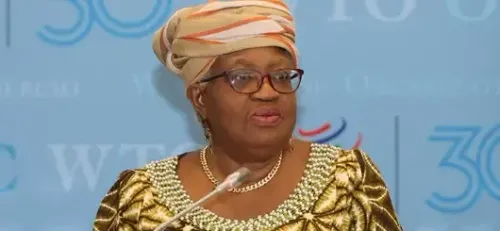
World Trade Organization Director-General Ngozi Okonjo-Iweala said on 5 October 2026 that global trade is proving unexpectedly resilient in the face of aggressive US tariffs, the Iran war, elevated energy prices, and mounting pressure on the rules-based trading system — with AI-related products accounting for 42 per cent of last year's goods trade growth. Speaking in an interview with CNN, Okonjo-Iweala described the performance as surprising even to WTO economists, while cautioning that the system's strength should not be mistaken for robustness.
Trade Growth Far Exceeds WTO Forecasts
The WTO had projected global goods trade growth of approximately 2.4 to 2.5 per cent for the previous year. The actual figure came in at 4.6 per cent — nearly double the forecast. When WTO economists investigated the drivers, they found that trade in AI-related hardware and software, including semiconductors and processors, contributed 42 per cent of that expansion.
The outperformance has carried into 2026. The WTO had projected goods trade growth of 1.9 per cent this year, accounting for headwinds from tariffs, high energy costs, and strategic choke points including the Strait of Hormuz. First-quarter data showed growth running at 3.2 per cent — again well ahead of expectations.
'So again, far more than what we had projected. That doesn't mean we should be complacent,' Okonjo-Iweala said.
72 Per Cent of World Goods Trade Still on WTO Terms
Despite the upheaval, Okonjo-Iweala noted that 72 per cent of world goods trade continues to take place under WTO most-favoured-nation (MFN) terms, providing businesses with a degree of stability and predictability. 'We find that 72 percent of world trade, world goods trade is still taking place on WTO terms on most favored nation terms. That's what we call a predictable stable,' she said.
She attributed businesses' continued reliance on the multilateral system to their fundamental need for certainty. 'We talk to businesses, and businesses need some stability and predictability in the way they trade,' she said. This is particularly notable given the backdrop: a fundamental shift in US trade policy under President Donald Trump, heightened Washington–Beijing tensions, and disruption to energy markets and global shipping routes.
AI Boom: Concentrated Gains and Bubble Risks
Okonjo-Iweala was candid about the uncertainties embedded in the AI-driven trade surge. 'We don't know whether this can be sustained or it's a bit of a bubble. So, we have to watch out for that,' she said. She also flagged that the benefits of AI-related trade growth are heavily concentrated geographically, flowing 'mainly to East Asia and North America, the United States mainly.' She warned that excluding the rest of the world from AI-driven commerce 'could be a bit problematic.'
Notably, this concentration echoes longstanding concerns about technology-driven globalisation benefiting advanced economies disproportionately — a pattern that has historically fuelled the very protectionist sentiment now threatening the WTO framework.
System Resilient but Not Robust, WTO Chief Warns
Okonjo-Iweala drew a sharp distinction between the trade system's current resilience and its long-term robustness. 'It doesn't mean that the system is resilient, but is it robust? And I don't think it is,' she said. She acknowledged a 'trust deficit' among WTO members that would make reforms difficult, even as she expressed optimism that members were increasingly accepting the need for modernisation.
'I used to think that with what is going on — the worst disruption for global trade in 80 years — that we wouldn't see these kinds of numbers,' she said, adding that the persistence of the data had led her to believe 'there's a core of the rules that really work.' The WTO-led system is credited, she noted, with lifting 1.5 billion people out of poverty.
Digital and Green Trade Add New Dimensions
Beyond goods, Okonjo-Iweala pointed to structural shifts reshaping international commerce. Digital trade is expanding, she said, with digitally delivered services growing even faster. She highlighted the importance of services trade for the United States, which holds a positive balance in that category — a nuance often lost in tariff-focused debates. Green trade, meanwhile, has surpassed $2 trillion, adding another layer to a global trading landscape increasingly defined by technology and energy transition rather than traditional manufacturing flows.
With first-quarter 2026 data already surprising to the upside, the WTO's next growth assessment will be closely watched by policymakers and markets navigating an unusually volatile trade environment.
Point of View
But the headline resilience masks a structural fragility the WTO chief herself acknowledges. A trading system where nearly half of recent growth is concentrated in one technology category — AI hardware — is not diversified; it is dependent. If that category cools, the underlying picture, already battered by US unilateralism and the Iran war's energy shock, looks considerably worse. The trust deficit she cites among WTO members is not a communications problem — it reflects a decade of the system failing to deliver equitable gains for the Global South, a pattern the AI concentration threatens to deepen. India, notably, sits outside the East Asia–North America axis that is capturing most of the AI trade dividend, which makes WTO reform not just a multilateral nicety but a direct economic interest for New Delhi.
NationPress
5 Oct 2026
Frequently Asked Questions
What did the WTO chief say about global trade resilience?
WTO Director-General Ngozi Okonjo-Iweala said global goods trade is proving unexpectedly resilient despite US tariffs, the Iran war, and high energy prices, growing at 4.6 per cent last year against a forecast of 2.4–2.5 per cent. She credited AI-related products — including semiconductors and processors — with driving 42 per cent of that growth, while cautioning that the system's resilience does not mean it is robust.
How much of world trade still follows WTO rules?
According to Okonjo-Iweala, 72 per cent of world goods trade continues to take place under WTO most-favoured-nation (MFN) terms, providing businesses with stability and predictability. She described this as a 'predictable stable' that companies rely on even as traditional trading rules come under severe pressure.
What role is AI playing in global trade growth?
AI-related hardware and software — including semiconductors and processors — contributed 42 per cent of global goods trade growth last year, according to WTO data. However, Okonjo-Iweala warned that these gains are concentrated in East Asia and North America and that it is unclear whether the surge is sustainable or represents a bubble.
What is the WTO's 2026 trade forecast versus actual performance?
The WTO had projected global goods trade growth of 1.9 per cent for 2026, accounting for tariff pressures, high energy costs, and disruption at strategic choke points like the Strait of Hormuz. First-quarter 2026 data showed growth running at 3.2 per cent — significantly above the forecast — though Okonjo-Iweala cautioned against complacency.
Is the WTO system under threat from US protectionism?
Okonjo-Iweala acknowledged the US shift toward protectionism under President Donald Trump represents the worst disruption to global trade in 80 years, and that there is a 'trust deficit' among WTO members. However, she expressed cautious optimism, saying members increasingly accept the need for reform and that the core of the rules-based system 'really works' — pointing to 1.5 billion people lifted out of poverty under the existing framework.