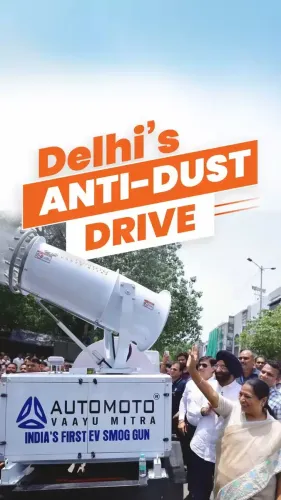
CM Rekha Gupta Launches ICCC to Fight Delhi Pollution

Synopsis
Delhi Chief Minister Rekha Gupta on October 5, 2026 announced the Integrated Command and Control Centre, unifying AI cameras, real-time pollution data and GPS sweeper tracking to shift the capital from monitoring air quality to enforcing action against it.
Key Takeaways
Delhi Chief Minister Rekha Gupta announced the activation of the Integrated Command and Control Centre (ICCC) on October 5, 2026 .
The platform consolidates 24×7 surveillance , AI-driven cameras , and real-time pollution data analysis onto a single dashboard.
GPS-based monitoring of mechanical sweepers is built in to ensure ground machinery is actually deployed, not just logged on paper.
The system is designed to shift Delhi's anti-pollution effort from passive data collection to timely enforcement action .
The launch comes at the start of Delhi's most severe pollution months — October through January — giving the ICCC an immediate stress test.
The announcement was branded under the BJP-led Delhi government's #ViksitDelhi development initiative.
Delhi's pollution crisis has long outlasted the promises made to fix it — but on Monday, October 5, 2026, Delhi Chief Minister Rekha Gupta announced the activation of the Integrated Command and Control Centre (ICCC), a platform she described as the city's first unified system capable of monitoring pollution in real time and triggering ground-level action simultaneously.
What the ICCC actually does — and why it took a decade
The Chief Minister's post was blunt about the wait: 'For over a decade, Delhi waited for a system that could monitor pollution in real time and drive action on the ground.' The ICCC is positioned as the answer — consolidating 24×7 surveillance, AI-driven cameras, real-time data analysis, and GPS-based tracking of mechanical sweepers onto a single operational dashboard. The ambition is not just to measure bad air, but to catch the sources of it as they happen and dispatch a response before the damage compounds.
Delhi's air-quality governance has historically been fragmented: pollution data sat with one agency, enforcement authority with another, and ground machinery with a third. A unified command layer — if it performs as described — would collapse that bureaucratic gap. The GPS monitoring of mechanical sweepers is a telling detail: it targets the perennial complaint that sweepers log shifts on paper but sit idle on the road.
AI cameras and the shift from data to enforcement
The deployment of AI-driven cameras across the system signals a move toward automated violation detection — the kind of infrastructure that can flag an uncovered construction site or an idling diesel truck without waiting for a field inspector to notice. This matters because Delhi's pollution load is not a single-source problem: it is construction dust, vehicle emissions, waste burning, and industrial discharge layered on top of each other, often in real time.
Gupta framed the ICCC's purpose precisely on this point: the city is 'moving from monitoring pollution to taking timely action against it.' That distinction — monitor versus act — is where most previous anti-pollution drives have stalled. Dashboards and sensors have existed in Delhi for years; the enforcement gap has been the chronic failure.
The #ViksitDelhi pitch and what comes next
The announcement was tagged #ViksitDelhi, the BJP-led Delhi government's development branding, positioning the ICCC as infrastructure investment rather than routine administration. With the capital's worst pollution months — October through January — beginning now, the timing of the launch is pointed. The system's credibility will be tested almost immediately against the season that reliably pushes Delhi's air quality into the 'severe' and 'hazardous' bands.
A cleaner Delhi has been promised before. This time, the infrastructure has a command centre, a camera grid, and a GPS trail — and the season to prove it starts today.
Point of View
Chief Minister Rekha Gupta implicitly indicts the previous AAP-led administration's pollution governance record. The GPS sweeper-tracking detail is shrewdly chosen — it targets a visible, street-level accountability gap that Delhi residents have complained about for years. The real test arrives within weeks: if AI-camera enforcement logs visible action during the October–January peak season, the ICCC becomes a governance win; if air-quality indices remain in the 'severe' band with little enforcement evidence, it risks becoming another data dashboard that impressed on launch day and was forgotten by February.
NationPress
5 Oct 2026
Frequently Asked Questions
What is the Integrated Command and Control Centre (ICCC) in Delhi?
The ICCC is a unified platform launched by Delhi Chief Minister Rekha Gupta that combines AI-driven cameras, real-time pollution data analysis, 24×7 surveillance, and GPS tracking of mechanical sweepers to monitor and act against pollution sources across the city.
How does the ICCC help reduce Delhi's air pollution?
Instead of just collecting pollution data, the ICCC is designed to trigger enforcement action in real time — for example, by using AI cameras to detect uncovered construction sites or idling diesel vehicles and dispatching a response immediately.
What is GPS monitoring of mechanical sweepers in Delhi?
The ICCC uses GPS to track whether mechanical road-sweeping vehicles are actively deployed at their assigned locations, addressing the long-standing complaint that sweepers were logged as operational but often idle.
When was the Delhi ICCC launched?
Delhi Chief Minister Rekha Gupta announced the activation of the ICCC on Monday, October 5, 2026, at the start of the capital's worst pollution season.
What is #ViksitDelhi?
#ViksitDelhi is the BJP-led Delhi government's development branding initiative, under which Chief Minister Rekha Gupta has been announcing infrastructure and governance projects including the ICCC pollution command centre.