CM Rekha Gupta Launches ICCC, 13 Air Monitors in Delhi

Synopsis
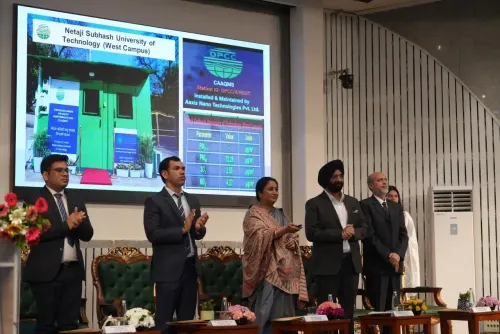
Delhi CM Rekha Gupta and Union Environment Minister Bhupender Yadav jointly reviewed a new AI-powered Integrated Command and Control Centre at Shastri Park on 13 October 2026, while inaugurating 13 new CAAQMS stations for real-time PM 2.5 and PM 10 monitoring ahead of the winter smog season.
Key Takeaways
Delhi's new ICCC at Shastri Park provides 24×7 AI camera, GPS, and real-time data-driven oversight of pollution-control operations across the capital.
13 new CAAQMS stations were inaugurated to sharpen measurement of PM 2.5 and PM 10 pollutants city-wide.
Union Environment Minister Bhupender Yadav visited the centre alongside CM Gupta, underlining centre-state coordination on Delhi's pollution response.
The launch is timed ahead of Delhi's annual winter smog season, when particulate levels routinely breach safe limits by several times.
The ICCC builds on existing frameworks including the CAQM (2021) , GRAP (2017) , and the National Clean Air Programme (2019) .
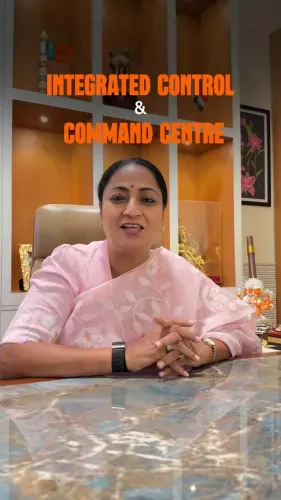
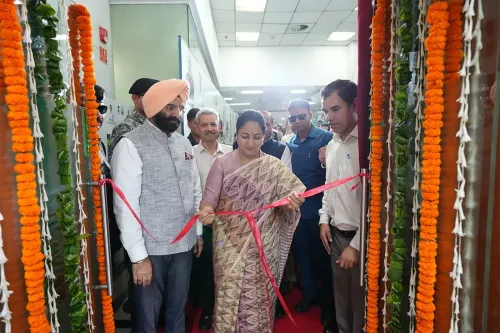
Winter is weeks away, and Delhi Chief Minister Rekha Gupta is not waiting for the smog to arrive. On Tuesday, 13 October 2026, the Delhi government inaugurated a new Integrated Command and Control Centre (ICCC) at Shastri Park — a 24×7 nerve centre built to track every pollution hotspot in the capital in real time, backed by AI cameras, GPS technology, and live data feeds.
Posting on X, CM Gupta described the centre as Delhi's sharpest tool yet against air pollution — 'प्रदूषण के हर हॉटस्पॉट पर पैनी नजर' ('a sharp watch on every pollution hotspot') — and announced that 13 new Continuous Ambient Air Quality Monitoring Stations (CAAQMS) were simultaneously inaugurated to deliver precise measurements of PM 2.5 and PM 10 particulate matter across the city.
Union Minister Bhupender Yadav Reviews the Centre
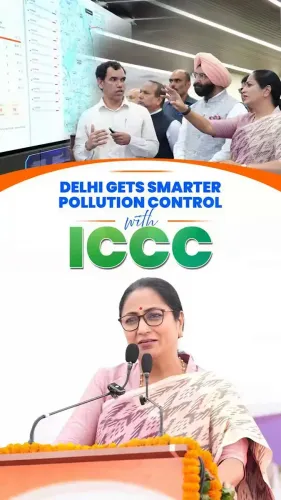
Union Environment Minister Bhupender Yadav joined CM Gupta at Shastri Park to tour the facility and review its operational setup — a visible signal of centre-state alignment on Delhi's pollution crisis ahead of the peak smog season. Also present were Delhi BJP president and Union Minister of State Harsh Malhotra, Cabinet colleague Manjinder Singh Sirsa, and MLA Arvinder Singh Lovely.
The joint visit carries political weight. Delhi's pollution battles have historically been mired in blame between the state and central governments. The shared platform projects a unified front — both levels of government visibly co-owning the response.
What the Shastri Park ICCC Actually Does
The centre integrates AI-enabled surveillance cameras, real-time environmental data, and GPS tracking to monitor pollution-control operations round the clock. The idea: when enforcement teams are deployed at construction sites, waste-burning spots, or high-traffic corridors, the ICCC can track their movement and action — not just detect pollution, but verify the response to it.
The addition of 13 new CAAQMS stations strengthens the data backbone. India's National Clean Air Programme (2019) had targeted a 20–30% reduction in particulate matter in 131 non-attainment cities, Delhi chief among them. Denser monitoring networks are a prerequisite — you cannot cut what you cannot measure accurately.
Delhi's Pollution Toolkit Entering a New Phase
The broader architecture behind today's launch includes the Commission for Air Quality Management (CAQM), established by Parliament in 2021, and the Graded Response Action Plan (GRAP), first notified in 2017 and revised repeatedly to trigger escalating emergency measures as air quality deteriorates each winter. The ICCC slots into this system as the operational eye — the layer that converts monitoring data into coordinated ground action.
CM Gupta framed the effort explicitly as mission-mode: 'केंद्र सरकार के सहयोग से हमारी सरकार प्रदूषण के हर प्रमुख स्रोत पर नियंत्रण के लिए मिशन मोड में काम कर रही है' — 'In cooperation with the central government, our government is working in mission mode to control every major source of pollution.'
The real test arrives in the next eight weeks, as Delhi slides into its annual pollution emergency. Whether the ICCC translates to measurably cleaner air — or becomes another well-equipped room that the smog ignores — is the only question that matters now.
Point of View
Arriving at a politically significant moment — the BJP government in Delhi seeking to draw a sharp contrast with past administrations on the city's most chronic governance failure. The visible presence of Union Minister Bhupender Yadav reframes the narrative from centre-state conflict to centre-state collaboration, a posture both sides now have electoral incentive to maintain. However, Delhi's pollution record shows that monitoring infrastructure, however sophisticated, has repeatedly outpaced enforcement capacity — the ICCC's value will ultimately be measured in action taken, not cameras installed. The 2026-27 winter will be the first real audit of whether this command layer changes outcomes on the ground.
NationPress
13 Oct 2026
Frequently Asked Questions
What is the new ICCC launched in Delhi at Shastri Park?
The Integrated Command and Control Centre (ICCC) at Shastri Park is a 24×7 facility using AI cameras, GPS technology, and real-time environmental data to monitor and coordinate pollution-control operations across Delhi.
What are CAAQMS stations and why were 13 new ones inaugurated in Delhi?
Continuous Ambient Air Quality Monitoring Stations (CAAQMS) measure pollutants like PM 2.5 and PM 10 in real time. Delhi inaugurated 13 new stations on 13 October 2026 to expand and sharpen its monitoring network ahead of the winter smog season.
Who inaugurated the ICCC and CAAQMS stations in Delhi?
Delhi Chief Minister Rekha Gupta inaugurated both the ICCC at Shastri Park and the 13 new CAAQMS stations on 13 October 2026, with Union Environment Minister Bhupender Yadav present for the review.
What is the Graded Response Action Plan (GRAP) and how does the ICCC relate to it?
GRAP is a staged emergency action framework for Delhi-NCR, first notified in 2017, that activates escalating restrictions as air quality worsens each winter. The ICCC serves as the operational layer to monitor and coordinate enforcement under such frameworks in real time.
What is India's National Clean Air Programme?
Launched in 2019, the National Clean Air Programme targets a 20-30% reduction in PM 2.5 and PM 10 concentrations across 131 highly polluted cities in India, including Delhi, through expanded monitoring, stricter enforcement, and source-specific controls.