Did 9/11 Momentarily Forge a Strong Alliance Between Putin and Bush?
Click to start listening

Synopsis
Discover how the events of September 11, 2001, briefly united two global leaders, **Vladimir Putin** and **George W. Bush**, in a shared fight against terrorism. This deep dive into their relationship reveals the complexities of international alliances formed and dissolved within a decade.
Key Takeaways
- Post-9/11 alliance between Putin and Bush was initially strong.
- Counterterrorism efforts fostered cooperation.
- Trust eroded due to shifting U.S. focus and NATO expansion.
- Transcripts reveal the complexities of their relationship.
- Ultimately, their partnership turned into rivalry.
Washington, Dec 25 (NationPress): Following the September 11, 2001, terrorist attacks, Russian President Vladimir Putin became one of U.S. President George W. Bush’s most significant allies, according to newly declassified transcripts.
The documents outline a relationship that began with robust counterterrorism cooperation but ultimately devolved into profound distrust. These transcripts, detailing conversations and meetings between the two leaders from 2001 to 2008, were made public by the National Security Archive after a Freedom of Information Act lawsuit.
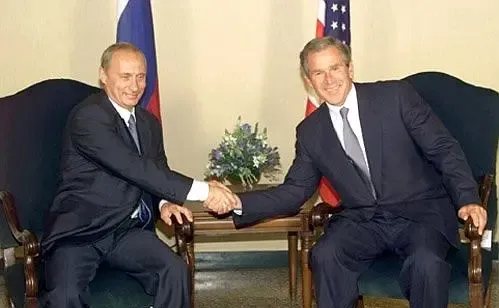
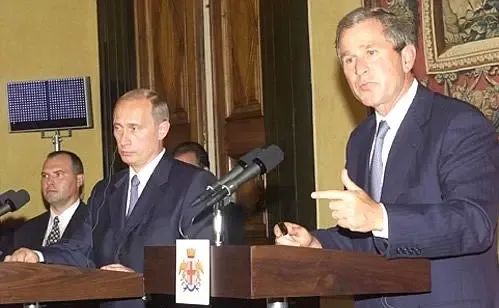
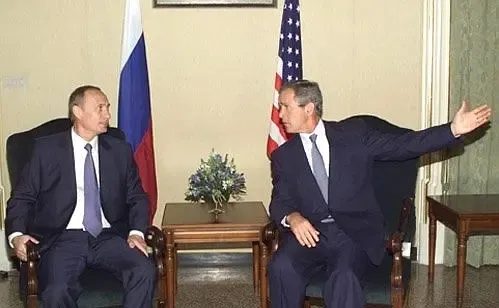
Bush and Putin's initial encounter occurred on June 16, 2001, at Brdo Castle in Slovenia, just months before the attacks. During this meeting, they deliberated on strategic stability, terrorism, NATO, and missile defense. Bush expressed his belief that Russia was “part of the West and not an adversary.”
However, the atmosphere shifted dramatically after 9/11. Putin expressed Russia’s alignment with the U.S. in the war on terror, likening Russia's struggle in Chechnya to America's battle against Al-Qaeda. He described Chechen militants as “Bin Laden’s students,” suggesting they received training from the terror mastermind.
Bush exhibited a rare level of personal trust, stating, “You’re the type of guy I like to have in the foxhole with me.”
The transcripts reveal extensive discussions regarding Afghanistan, including intelligence sharing and the pursuit of Osama bin Laden. Putin mentioned that there might be “no other opportunity” like the one at Tora Bora to capture bin Laden, to which Bush concurred that collaboration was vital.
For a period, the focus on counterterrorism defined their relationship, with Russia providing logistical and intelligence support. The two leaders maintained frequent and direct communication.
However, by September 16, 2005, when Putin visited Bush in the Oval Office, the agenda had expanded. While terrorism remained a topic, discussions also included Iran, North Korea, and nuclear proliferation. The dialogues were candid but noticeably less warm than before.
The transcripts from this meeting highlight moments of humor and honesty, with Putin reflecting on his past commitment to communism. Bush urged for unity against nuclear threats posed by extremist regimes. Unfortunately, the easy trust established in 2001 started to diminish.
The last in-person meeting occurred on April 6, 2008, at Bocharov Ruchei in Sochi, shortly after the NATO summit in Bucharest. By this time, the post-9/11 partnership was largely dissolved.
This meeting was marked by tension, as Putin vehemently opposed NATO expansion into Ukraine and Georgia, while Bush defended U.S. policies. Discussions centered on missile defense and strategic stability, with counterterrorism no longer taking precedence.
Despite the evolving dynamics, the transcripts indicate that both leaders remained vigilant regarding global security threats. Bush cautioned against nuclear miscalculations, while Putin voiced concerns about Western military systems encroaching near Russia's borders.
The documents chronicle how the shared trauma following 9/11 briefly united Washington and Moscow. While that alignment was genuine, it proved to be fleeting.
As U.S. focus shifted towards Iraq and NATO expansion persisted, trust dissipated, transforming the partnership into a rivalry.
The National Security Archive notes that these transcripts offer a rare chronological perspective on how the Bush-Putin relationship transitioned from post-9/11 solidarity to strategic estrangement within a mere decade.
Point of View
The relationship between **Bush and Putin** illustrates the transient nature of political alliances, especially in the face of global crises. While their initial solidarity was built on mutual interests in counterterrorism, the evolution of their partnership serves as a reminder of how quickly trust can erode in international relations.
NationPress
25/12/2025
Frequently Asked Questions
What was the nature of the relationship between Putin and Bush after 9/11?
Initially, the relationship was characterized by strong cooperation in counterterrorism efforts, but over time, it deteriorated into distrust and rivalry.
What key topics did Putin and Bush discuss in their meetings?
They discussed a range of topics, including strategic stability, NATO, missile defense, and later, issues related to Iran, North Korea, and nuclear proliferation.
How did the 9/11 attacks impact international relations?
The attacks briefly united Washington and Moscow against a common threat, demonstrating how shared crises can foster unexpected alliances.
What ultimately led to the breakdown of the Bush-Putin relationship?
As U.S. focus shifted towards Iraq and NATO expansion continued, trust eroded, resulting in a transformation from partnership to rivalry.
What insights do the released transcripts provide?
They offer a rare chronological account of the transition from post-9/11 solidarity to strategic estrangement between Bush and Putin.