Did Bush and Putin See China as a Long-Term Strategic Threat?
Synopsis
In private talks between Presidents Bush and Putin, China was identified as a significant long-term strategic threat. Newly released transcripts reveal their differing perspectives on Beijing's rising influence and its implications for global power dynamics. Discover how these dialogues reflect early 21st-century geopolitical thinking.
Key Takeaways
China viewed as a long-term strategic challenge.
Bush emphasized the need for vigilance regarding Beijing .
Putin prioritized immediate security concerns over China.
Differences in perception reflect broader geopolitical dynamics.
Transcripts provide insight into early 21st-century strategic dialogues.
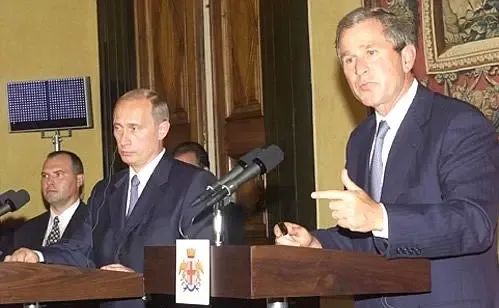
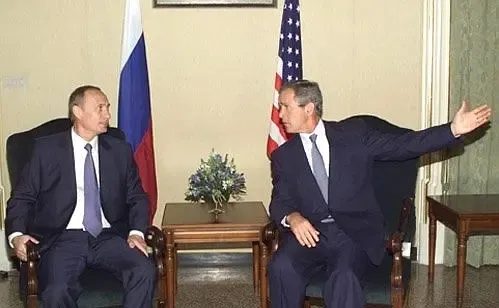
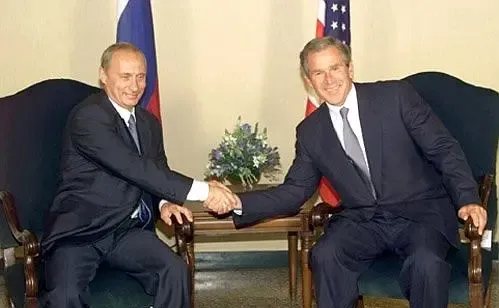
Washington, Dec 25 (NationPress) The emergence of China has become a significant concern in private discussions between U.S. President George W. Bush and Russian President Vladimir Putin. Bush cautioned that Beijing represented the “greatest long-term challenge”, according to recently disclosed transcripts of their meetings and dialogues.
The documents, made public by the National Security Archive after a Freedom of Information Act lawsuit, cover Bush and Putin’s exchanges from 2001 to 2008. They include detailed accounts of in-person meetings in Europe, Washington, and Russia, alongside telephone conversations between the two leaders.
The topic of China was raised as early as their initial face-to-face meeting on June 16, 2001, at Brdo Castle in Slovenia, where the two presidents examined the future of US-Russia relations, strategic stability, and emerging global threats.
During that encounter, Bush highlighted that Russia was “part of the West and not an enemy,” while also identifying China as a potential long-term challenge that would impact global politics for decades to come, as per the transcripts.
Bush revisited this theme in later discussions, including a meeting on September 16, 2005, at the Oval Office in the White House. In that dialogue, Bush directly told Putin that “China is the biggest long-term problem for both of us,” emphasizing Washington’s rising anxiety regarding Beijing’s expanding economic, military, and geopolitical influence, according to the records.
“More for you,” Putin replied, indicating Moscow’s perspective that China represented a more significant strategic issue for the United States than for Russia. Bush countered, noting that although China did not share Washington's geography, its long-term intentions would impact both nations.
The transcripts indicate that Putin consistently directed the conversation toward what he described as Russia’s more pressing security issues — particularly NATO expansion and U.S. missile defense systems in Europe — while viewing China as a factor to be observed rather than confronted.
At their last in-person meeting on April 6, 2008, at Bocharov Ruchei, the Russian presidential residence in Sochi, China re-emerged in broader discussions about future global power dynamics.
Bush warned Putin that China's trajectory necessitated long-term strategic planning and advised against underestimating Beijing’s ambitions, as per the transcripts. Putin acknowledged China's ascent but contended that the Western military presence near Russia's borders posed a more immediate and tangible threat to Russian security.
The exchanges illustrate that while both leaders acknowledged China’s increasing influence, they perceived it through distinctly different lenses. Bush positioned China as a systemic, long-term challenge to the international order, whereas Putin viewed Western pressure as the more urgent issue that influenced Moscow’s strategic priorities.
The transcripts also shed light on why Russia later aligned more closely with China despite underlying distrust. The documents suggest that Moscow assessed Western pressure to be the primary threat, making engagement with Beijing a strategic counterweight rather than a reflection of a common worldview.
The National Security Archive stated that the newly released records provide a transparent view of early 21st-century strategic thought, capturing how two global leaders evaluated China’s rise years before it became a dominant force in global geopolitics.
Point of View
It’s clear that the discussions between Bush and Putin reveal the complexities of international relations. The contrasting views on China illustrate how geopolitical concerns are multifaceted. Engaging with China remains a critical issue for both nations, influencing their strategic priorities. Our commitment to delivering balanced analysis remains unwavering.
NationPress
20 Sept 2026
Frequently Asked Questions
What did Bush warn Putin about regarding China?
Bush warned Putin that China posed the 'biggest long-term problem' for both the U.S. and Russia.
When did Bush and Putin first discuss China's rise?
They first discussed China's rise during their initial meeting on June 16, 2001, at Brdo Castle in Slovenia.
How did Putin view China's influence?
Putin viewed China's influence as less of a direct threat to Russia compared to Western pressure.
What did the transcripts reveal about U.S.-Russia relations?
The transcripts revealed that both leaders recognized China’s growing influence, but they perceived its implications differently.
How did the National Security Archive describe the released records?
The National Security Archive described the records as offering an unfiltered view of early 21st-century strategic thinking.