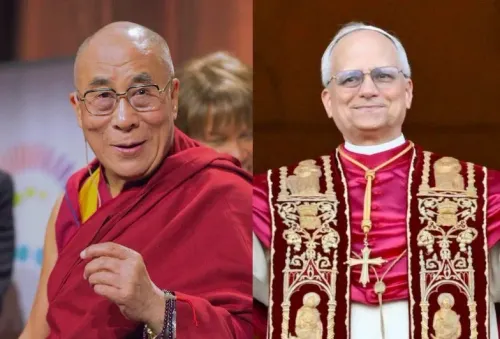
Pope John Paul II–Dalai Lama friendship: How faith bridges divides
Synopsis
A newly published report in the European Times, written by the Dalai Lama's own nephew, documents how Pope John Paul II and the 14th Dalai Lama met repeatedly from 1980 to 2003 — not as a photo-op exercise, but as a sustained dialogue that proved deep theological conviction and genuine friendship are not mutually exclusive.
Key Takeaways
Pope John Paul II and the 14th Dalai Lama met repeatedly over more than two decades , with documented meetings in 1980, 1986, 1988, 1999 and 2003 .
The relationship was grounded in mutual respect and personal warmth , not theological compromise, according to the European Times report.
Author Khedroob Thondup , nephew of the Dalai Lama, argues the bond directly challenges the assumption that strong religious identities lead to conflict.
Both leaders shared commitments to compassion, religious freedom and human dignity despite profound doctrinal differences.
The report concludes that lasting peace stems from mutual respect between people of conviction , not from uniformity of belief.
As societies grow more polarised along religious and cultural lines, the decades-long bond between Pope John Paul II and the 14th Dalai Lama stands as a compelling model of how mutual respect can transcend deep theological differences, according to a report published in the European Times. The two leaders — one heading over a billion Catholics, the other the global voice of Tibetan Buddhism and the Tibetan people in exile — built a relationship rooted not in doctrinal agreement, but in shared humanity.
A Bond Built Across Two Decades
Khedroob Thondup, nephew of the 14th Dalai Lama, authored the report, drawing on official records to document the breadth of the relationship. According to Thondup, the two leaders met repeatedly over more than two decades, with the Dalai Lama's official records listing meetings in 1980, 1986, 1988, gatherings in the 1990s including 1999, and again in 2003.
'Their encounters were not symbolic one-off photo opportunities. They reflected an ongoing relationship between two men who saw value in sustained conversation,' Thondup wrote.
Theological Differences, Shared Values
What made the relationship remarkable, the report argues, was precisely that neither leader compromised on his own tradition. 'John Paul II remained thoroughly Catholic; the Dalai Lama remained thoroughly Buddhist. Their relationship succeeded precisely because it was based not on theological compromise but on mutual esteem,' the report noted.
Despite profound doctrinal differences, both men shared a commitment to compassion, morality, religious freedom and human dignity. The report frames this as a direct challenge to the assumption that strong religious identities inevitably produce conflict.
A Challenge to the Religion-as-Barrier Narrative
'In an age when religious differences are often portrayed as barriers, the friendship between Pope John Paul II and His Holiness the 14th Dalai Lama offers a more compelling story: that deep conviction need not produce division. It can instead create a common purpose,' Thondup stated.
This comes amid a broader global conversation about the role of religion in public life, with critics on multiple sides arguing that faith-based identities fuel exclusion. The John Paul II–Dalai Lama dynamic, Thondup argues, offers a counter-narrative with historical weight behind it.
The Enduring Lesson
The report's conclusion carries a pointed message for contemporary interfaith relations. 'Peace is not achieved when everyone believes the same thing. It is achieved when people of conviction treat one another with respect, friendship, and a shared commitment to humanity,' the report stated.
Thondup's essay suggests that the legacy of this friendship is not merely historical — it is instructional, offering a template for interfaith engagement at a time when such models are in short supply. As religious polarisation deepens in multiple regions of the world, the documented record of these two leaders choosing dialogue over distance may carry renewed relevance.
Point of View
Lending its historical argument fresh urgency. What is striking, however, is the structural lesson it draws: the John Paul II–Dalai Lama relationship worked not because either man softened his convictions, but because both held them firmly enough to respect conviction in another. That is a harder model to replicate than it sounds — most contemporary interfaith gestures tend toward vagueness rather than honest engagement across difference. The report's real contribution is in insisting that depth of faith and openness to the other are not opposites.
NationPress
21 Nov 2026
Frequently Asked Questions
How many times did Pope John Paul II and the Dalai Lama meet?
According to the Dalai Lama's official records cited in the European Times report, the two leaders met multiple times over more than two decades, with documented meetings in 1980, 1986, 1988, gatherings in the 1990s including 1999, and again in 2003. The report emphasises these were sustained engagements, not ceremonial one-offs.
Who wrote the report about Pope John Paul II and the Dalai Lama?
The report was authored by Khedroob Thondup, the nephew of the 14th Dalai Lama, and published in the European Times. Thondup drew on the Dalai Lama's official records to document the history of the relationship.
Did the two leaders agree on theology?
No. The report explicitly notes that Pope John Paul II remained 'thoroughly Catholic' and the Dalai Lama remained 'thoroughly Buddhist.' Their friendship was built on mutual esteem and shared values — compassion, human dignity, and religious freedom — rather than any theological convergence.
Why does this relationship matter today?
The report argues that as societies become more polarised along religious lines, the John Paul II–Dalai Lama bond offers a documented model showing that deep religious conviction and genuine interfaith friendship are compatible. It challenges the widespread assumption that strong religious identities inevitably produce conflict.
What is the central lesson drawn from this interfaith friendship?
According to the report, the core lesson is that 'peace is not achieved when everyone believes the same thing — it is achieved when people of conviction treat one another with respect, friendship, and a shared commitment to humanity.' It presents the relationship as a template for meaningful interfaith cooperation.