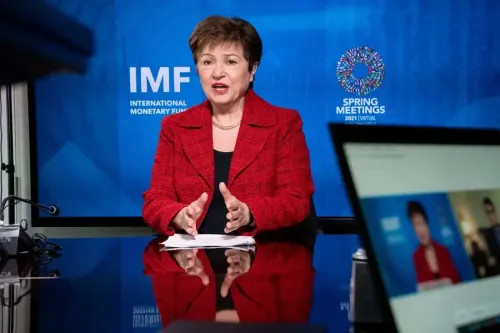
IMF projects oil at $95.74 in 2026, flags worst squeeze for energy importers
Synopsis
The IMF's October 2026 World Economic Outlook puts oil at $95.74 a barrel this year — a 41% jump from 2025 — and draws a stark dividing line: energy exporters gain, while importers with no tech-sector cushion face a triple squeeze of higher import costs, inflation, and exchange rate pressure. India is holding up, but its consumer inflation is set to more than double to 5% in 2026.
Key Takeaways
The IMF projects crude oil at an average of $95.74 a barrel in 2026 , up from $67.74 in 2025 — a 41% increase .
Natural gas prices are projected at $20 per million BTU , roughly 36% above the April reference price; fertiliser prices up 10% , food prices up 5% .
Global headline inflation is forecast to rise to 4.7% in 2026, easing to 4.1% in 2027.
Without supply adjustments, the Hormuz closure could have pushed oil to $110 a barrel and cut global growth by 0.9 percentage point ; the net toll is now estimated at 0.3 percentage point .
India's consumer inflation is projected to rise to 5.0% in 2026 from 2.0% in 2025, before easing to 4.4% in 2027.
IMF Chief Economist Silvana Tenreyro warned that dwindling energy inventories could amplify the impact of future geopolitical shocks on prices.
The International Monetary Fund (IMF) has projected crude oil prices will average $95.74 a barrel in 2026 — a sharp rise from $67.74 in 2025 — and warned that energy-importing nations with limited exposure to the technology value chain face 'the most difficult configuration' of any economy this cycle. The warning was contained in the Fund's October 2026 World Economic Outlook (WEO), released on Tuesday, 13 October 2026.
What the IMF's Oil Forecast Covers
The $95.74 figure is a simple average of Brent, Dubai Fateh, and West Texas Intermediate (WTI) crude, derived from futures markets. The Fund projects the benchmark will ease to $87.39 a barrel in 2027, suggesting markets expect the current disruption to be largely temporary.
The WEO noted that the assumed price 'corresponds to an increase of 41 per cent in crude oil prices and 48 per cent in natural gas prices in 2026 relative to those in 2025.' Natural gas is projected at $20 per million British thermal units (BTU), roughly 36 per cent above the April reference price.
Inflation and Food Prices: The Knock-On Effect
Higher energy costs are feeding through to the broader price basket. Fertiliser prices are projected to rise 10 per cent in 2026, while food prices are expected to climb 5 per cent, 'reflecting higher energy and fertiliser costs and more expensive transport and insurance,' the WEO said.
Global headline inflation is projected to rise to 4.7 per cent in 2026 before easing to 4.1 per cent in 2027 — a cumulative upward revision of 0.7 percentage point compared to earlier projections, driven mainly by energy and food.
The Hormuz Factor: How Bad It Could Have Been
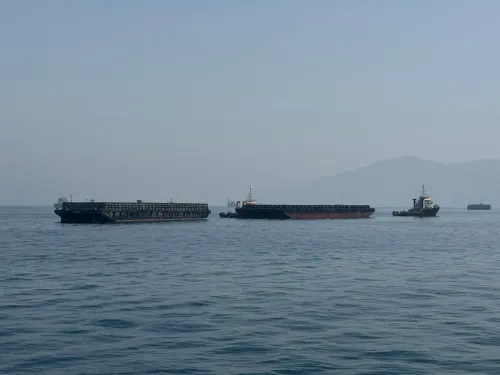
The IMF noted that disruptions linked to the Hormuz closure could have pushed oil prices to an average of around $110 a barrel for the year, shaving 0.9 percentage point off global growth in 2026, had supply not adjusted. Rerouted Gulf production, higher output elsewhere, and inventory drawdowns helped bring the implied price down to around $85 a barrel.
With the 20 per cent fall in oil intensity of world GDP since the mid-2010s factored in, the IMF estimates the net toll on global growth at 0.3 percentage point. The WEO also noted that 'over the past two decades, energy usage per dollar of global GDP has fallen by 32 per cent,' with renewables accounting for 60 per cent of the increase in electricity production since 2010.
India's Position: Resilient but Exposed
The WEO acknowledged that India, as a large energy importer, has so far weathered the pressure. 'India's growth remained robust, underpinned by domestic demand and services, despite higher oil prices,' the report said. However, the Fund projected Indian consumer prices to rise 5.0 per cent in 2026 — up sharply from 2.0 per cent in 2025 — before moderating to 4.4 per cent in 2027.
The broader warning is pointed: energy-importing economies with 'little connection to the technology value chain face the most difficult configuration — higher import costs and exchange rate pressures, weaker real incomes, more constrained fiscal space, and fewer offsetting demand impulses,' the WEO said. India's ability to sustain its services and domestic demand edge will be critical in buffering this squeeze.
Risks Skewed to the Downside
IMF Chief Economist Silvana Tenreyro, in a blog accompanying the report, warned that 'the oil disruption alone would have significantly reduced global growth in 2026' without flexible supply responses. She cautioned that 'dwindling energy inventories could allow geopolitical shocks to transmit even more forcefully to energy prices.'
The Fund described risks as 'skewed to the downside,' warning that 'a prolonged stalemate or further escalation in the Middle East could keep energy and food prices elevated and volatile, revive inflationary pressures, worsen fiscal and external balances, and weigh on growth.' Backwardation in oil futures markets, the IMF noted, still suggests traders treat the current disruptions as temporary — but that could change if tensions persist. Higher commodity prices, the WEO added, 'could widen current account deficits, increase external financing needs, and intensify exchange rate pressures' for emerging markets with limited fiscal buffers.
Point of View
But it does not insulate the bottom half of the income distribution from fuel and food price pass-through, and that is the pressure point policymakers cannot afford to underestimate.
NationPress
13 Oct 2026
Frequently Asked Questions
What oil price has the IMF forecast for 2026?
The IMF has projected crude oil will average $95.74 a barrel in 2026, up from $67.74 in 2025 — a rise of 41%. The figure is a simple average of Brent, Dubai Fateh, and West Texas Intermediate crude, based on futures market data, and is expected to ease to $87.39 a barrel in 2027.
Why does the IMF say energy-importing countries face the 'most difficult configuration'?
Energy importers with little exposure to the technology value chain face simultaneous pressure from higher import bills, currency depreciation, weaker real incomes, tighter fiscal space, and fewer demand offsets — a combination the IMF describes as the most challenging macro environment of this cycle. Countries with stronger tech-sector links can offset some of these costs through export revenues and investment inflows.
How does the Hormuz closure affect the IMF's oil price estimate?
The IMF said that without flexible supply responses, the Hormuz closure could have pushed oil to around $110 a barrel and cut global growth by 0.9 percentage point in 2026. Rerouted Gulf production, higher output elsewhere, and inventory drawdowns brought the implied price down to around $85 a barrel, limiting the net growth toll to an estimated 0.3 percentage point.
What is the IMF's inflation forecast for India in 2026?
The IMF projects Indian consumer price inflation will rise to 5.0% in 2026, more than doubling from 2.0% in 2025, before moderating to 4.4% in 2027. The WEO attributed India's resilience to robust domestic demand and services activity, even as higher oil prices add to cost pressures.
What are the downside risks the IMF has flagged?
The IMF has warned that a prolonged stalemate or further escalation in the Middle East could keep energy and food prices elevated, reignite inflation, and widen current account deficits for emerging market economies. IMF Chief Economist Silvana Tenreyro added that dwindling energy inventories could make future geopolitical shocks transmit even more forcefully into prices.