IMF warns of 'much worse outcome' if Iran war drags to 2027, oil at $125
Synopsis
The IMF's Managing Director has effectively declared the optimistic baseline for global growth obsolete — the adverse scenario is now live. With oil above $100 and the Iran conflict showing no sign of resolution, the world economy is one escalation away from a severe scenario that would push inflation to 5.8% and growth down to just 2%.
Key Takeaways
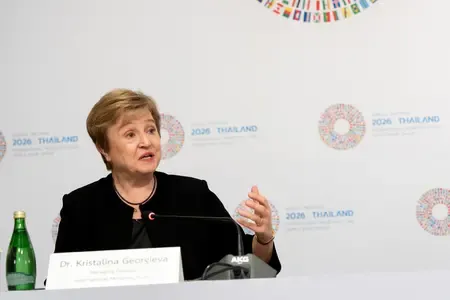
IMF Managing Director Kristalina Georgieva warned of a "much worse outcome" if the Middle East war extends into 2027 .
The IMF's adverse scenario — global growth of 2.5% and inflation of 5.4% in 2026 — has already been activated, Georgieva said.
The worst-case severe scenario projects global growth of just 2% and inflation of 5.8% .
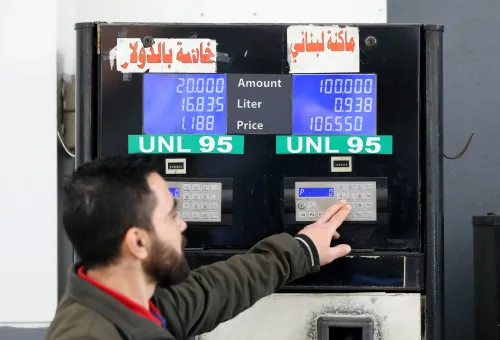
Oil prices remain above $100 per barrel despite a 3% dip on Monday after President Trump pledged steps to clear vessels in the Strait of Hormuz .
Brent crude stood at $107.51 and WTI at $99.11 per barrel as of Monday.
The IMF's optimistic baseline — growth of 3.1% , inflation of 4.4% — is increasingly distant, per Georgieva.
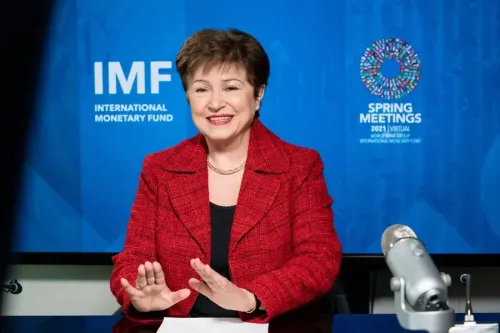
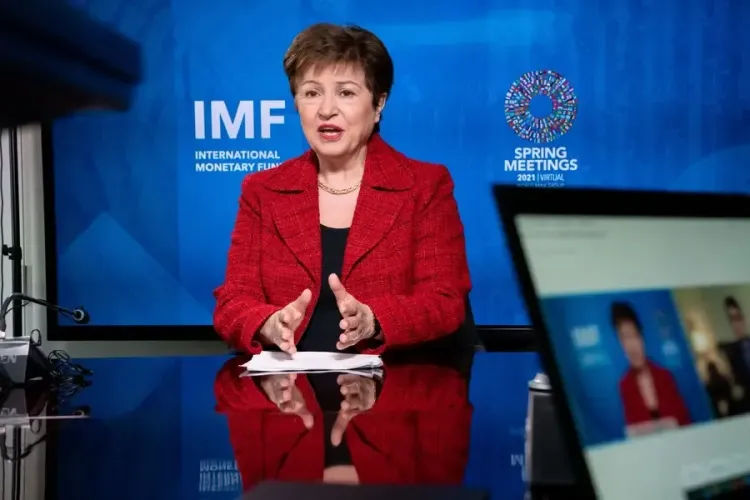
International Monetary Fund (IMF) Managing Director Kristalina Georgieva warned on Monday that the global economy faces a "much worse outcome" if the Middle East war extends into 2027, with oil prices potentially hitting $125 per barrel. Speaking at a conference hosted by the Milken Institute in Washington, D.C., Georgieva said the IMF's "adverse scenario" has already been activated by current conditions — a sobering signal for global policymakers.
Inflation and Growth Under Threat
Georgieva cautioned that a prolonged conflict would drive inflation sharply higher. "We are going to see inflation climbing up, and then inevitably, inflation expectations would start de-anchoring," she said. The IMF's adverse scenario — triggered by oil prices hovering at or above $100 per barrel and mounting inflationary pressures — projects global growth slowing to 2.5 per cent in 2026, with inflation rising to 5.4 per cent.
Three Scenarios: From Bad to Severe
In April, the IMF published three forecast tracks for global GDP growth in 2026 and 2027. The baseline "reference scenario," which assumes a short-lived conflict, projects growth of 3.1 per cent and inflation of 4.4 per cent. The middle "adverse scenario" trims growth to 2.5 per cent with inflation at 5.4 per cent. The most pessimistic "severe scenario" sees global growth collapsing to just 2 per cent and inflation surging to 5.8 per cent. Georgieva made clear that the optimistic baseline is rapidly losing relevance: "This scenario, with every day that passes, is further and further behind in the rear-view mirror," she said.
Oil Markets React to Hormuz Developments
Global crude oil prices declined nearly 3 per cent on Monday after US President Donald Trump said Washington would take steps to help clear vessels stranded in the Strait of Hormuz. However, the absence of a breakthrough in US-Iran talks kept prices above the critical $100-per-barrel mark. International benchmark Brent crude slipped 66 cents or 0.61 per cent to $107.51 per barrel, while US West Texas Intermediate (WTI) fell $2.83 or 2.77 per cent to $99.11 a barrel, according to market data.
What This Means for Emerging Economies
Prolonged elevated oil prices pose a compounded risk for oil-importing emerging economies, including India, which imports over 85 per cent of its crude requirements. Higher energy costs feed directly into domestic inflation, fiscal deficits, and current account pressures. This comes amid an already fragile global trade environment, with US tariff uncertainty adding a second front of risk. The IMF's warnings suggest that central banks, which had been cautiously pivoting toward rate cuts, may now face renewed pressure to hold or even tighten monetary policy.
What to Watch Next
All eyes remain on the trajectory of US-Iran diplomatic talks and developments in the Strait of Hormuz. Any escalation that disrupts oil shipping lanes could rapidly push prices toward Georgieva's $125-per-barrel threshold, tipping the global economy into the IMF's severe scenario. The next IMF growth update is expected to reflect evolving conflict conditions.
Point of View
Central banks lose the flexibility to cushion a slowdown with rate cuts, creating a stagflation trap. For India and other oil-importing emerging markets, the compounding of energy costs, a stronger dollar, and tightening global liquidity is a triple squeeze that domestic monetary policy alone cannot resolve. The Strait of Hormuz remains the world's most consequential chokepoint, and the IMF is essentially warning that the global economy is one naval incident away from the severe scenario.
NationPress
7 Oct 2026
Frequently Asked Questions
What did the IMF chief warn about the global economy?
IMF Managing Director Kristalina Georgieva warned that the global economy faces a 'much worse outcome' if the Middle East war drags on into 2027, with oil prices potentially reaching $125 per barrel, driving inflation higher and de-anchoring inflation expectations.
What are the IMF's three scenarios for global growth in 2026-2027?
The IMF outlined a baseline 'reference scenario' projecting 3.1% growth and 4.4% inflation, an 'adverse scenario' with 2.5% growth and 5.4% inflation, and a 'severe scenario' with just 2% growth and 5.8% inflation. Georgieva indicated current conditions have already activated the adverse scenario.
Why did oil prices fall on Monday despite the conflict?
Oil prices fell nearly 3% on Monday after US President Donald Trump said Washington would take steps to clear vessels stranded in the Strait of Hormuz. However, prices remained above $100 per barrel as no breakthrough in US-Iran talks was achieved.
What is the current level of Brent crude and WTI oil prices?
As of Monday, Brent crude stood at $107.51 per barrel, down 0.61%, while US West Texas Intermediate (WTI) fell 2.77% to $99.11 per barrel.
How does the Iran war affect countries like India?
India, which imports over 85% of its crude oil, is particularly vulnerable to sustained high oil prices. Elevated energy costs feed into domestic inflation, widen fiscal deficits, and pressure the current account — risks that are compounded by global trade uncertainty.